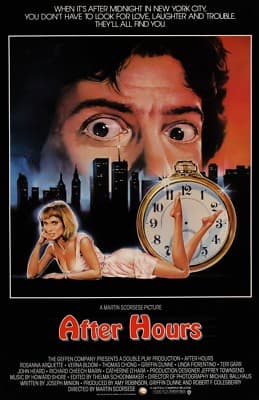
After Hours
After Hours: our relationship with technology, and why this 1985 movie still matters.
The setup
After Hours arrived in 1985, directed by Martin Scorsese. Late one evening, mild-mannered New York computer clerk Paul Hackett strikes up a conversation with Marcy Franklin at a café. Decades later, it is worth looking at why the film still connects with audiences.
THE MOVIE
Paul Hackett is still the reason this movie works
After Hours was released in 1985 and directed by Martin Scorsese. Rather than simply retelling the plot, the film is worth revisiting for the characters, conflicts and ideas that give its story its identity.
Technology emerge through what the characters face and the choices they make, giving the story more to explore beyond its immediate plot.
Paul Hackett, Marcy Franklin and June do not begin the film seeing one another clearly, and watching those first impressions break down is a big part of why After Hours still works.
THE SETUP
The idea that sets After Hours in motion
Elsewhere, late one evening, mild-mannered New York computer clerk Paul Hackett strikes up a conversation with Marcy Franklin at a café.
Paul is intrigued by the quirky stranger – whose roommate, sculptor Kiki Bridges, makes and sells plaster-of-Paris paperweights resembling bagels – and accepts her phone number. That detail matters because it shapes the way the characters initially see one another.
Later, Paul takes a taxi to her SoHo apartment, but his only $20 bill flies out the taxi window, leaving him virtually penniless and earning the driver's wrath. From there, the film can concentrate less on explaining the setup and more on what happens between the people inside it.
At the apartment, Kiki is working on a large papier-mâché sculpture of a screaming man while Marcy is out.
When Marcy returns, her erratic behavior and Paul's discovery of burn cream and ominous photos convince him that she is severely disfigured and unstable.
Unnerved, he abandons the date.
Attempting to take the subway home, he learns the fare has jumped at midnight, and he cannot afford to pay.
Paul goes to a bar tended by a man named Tom, who lends Paul his apartment key to retrieve the key for the bar's cash register, but Paul floods the bathroom and is confronted by suspicious residents.
THE CHARACTER
Why Paul Hackett matters
Griffin Dunne plays Paul Hackett. Late one evening, mild-mannered New York computer clerk Paul Hackett strikes up a conversation with Marcy Franklin at a café.
On the street, Paul confronts two thieves hauling away Kiki's sculpture and chases them off.
Her body shows no burns, disproving Paul's misconceptions about her.
UNDER THE SURFACE
After Hours has more on its mind than the plot suggests
After Hours has more on its mind than the basic setup suggests. our relationship with technology sits close to the centre of the film, but it is explored through the characters rather than treated like a lesson.
PURE 80S
After Hours could not belong to any other decade
After Hours could hardly be separated from the decade that produced it. Released in 1985, it carries the attitudes, style and filmmaking rhythms of the 1980s without needing to announce them.
It also sits comfortably within the era's comedy filmmaking, even if the movie itself is more interesting than any single genre label suggests.
That is part of why it still appears in conversations about 1980s movies and 1980s comedy movies. The film has become tied not only to its own story but to the wider memory of what 1980s movies felt like.
WATCHING IT NOW
What has aged — and what hasn't
Watching After Hours now means seeing both what has lasted and what unmistakably belongs to 1985.
What still works best is the human material. Ideas around our relationship with technology have not stopped being relevant simply because the clothes, language and cultural references belong to another era.
Some moments inevitably land differently for a modern audience. Revisiting an older film properly means enjoying what still works without pretending every choice has aged equally well.
THE LEGACY
Why After Hours still matters
A large part of that staying power comes from the characters. Paul Hackett, Marcy Franklin and June are still useful shorthand for the personalities and pressures the film explores.
After Hours has lasted because people continue to recognise something in it. Nostalgia helps, but nostalgia alone does not keep a movie in the conversation for decades.
THE VERDICT
Does After Hours still hold up?
So, does After Hours still hold up? Yes — although watching a film from 1985 honestly means accepting that not every moment will land exactly as it once did.
The film still has something recognisable to say about technology, and its characters stop those ideas from feeling abstract.
After Hours remains worth revisiting because characters such as Paul Hackett, Marcy Franklin, June, Pepe and Kiki Bridges still feel like people rather than labels once the film gets underneath the stereotypes.
Share this movie
Keep watching
More movies from the 80s
1985
A Chorus Line
A Chorus Line: love and memory, and why this 1985 movie still matters.
Read our take →
1985
Back to the Future
A time machine, a restless teenager and a very particular set of family problems.
Read our take →
1985
Better Off Dead
Better Off Dead: family, and why this 1985 movie still matters.
Read our take →