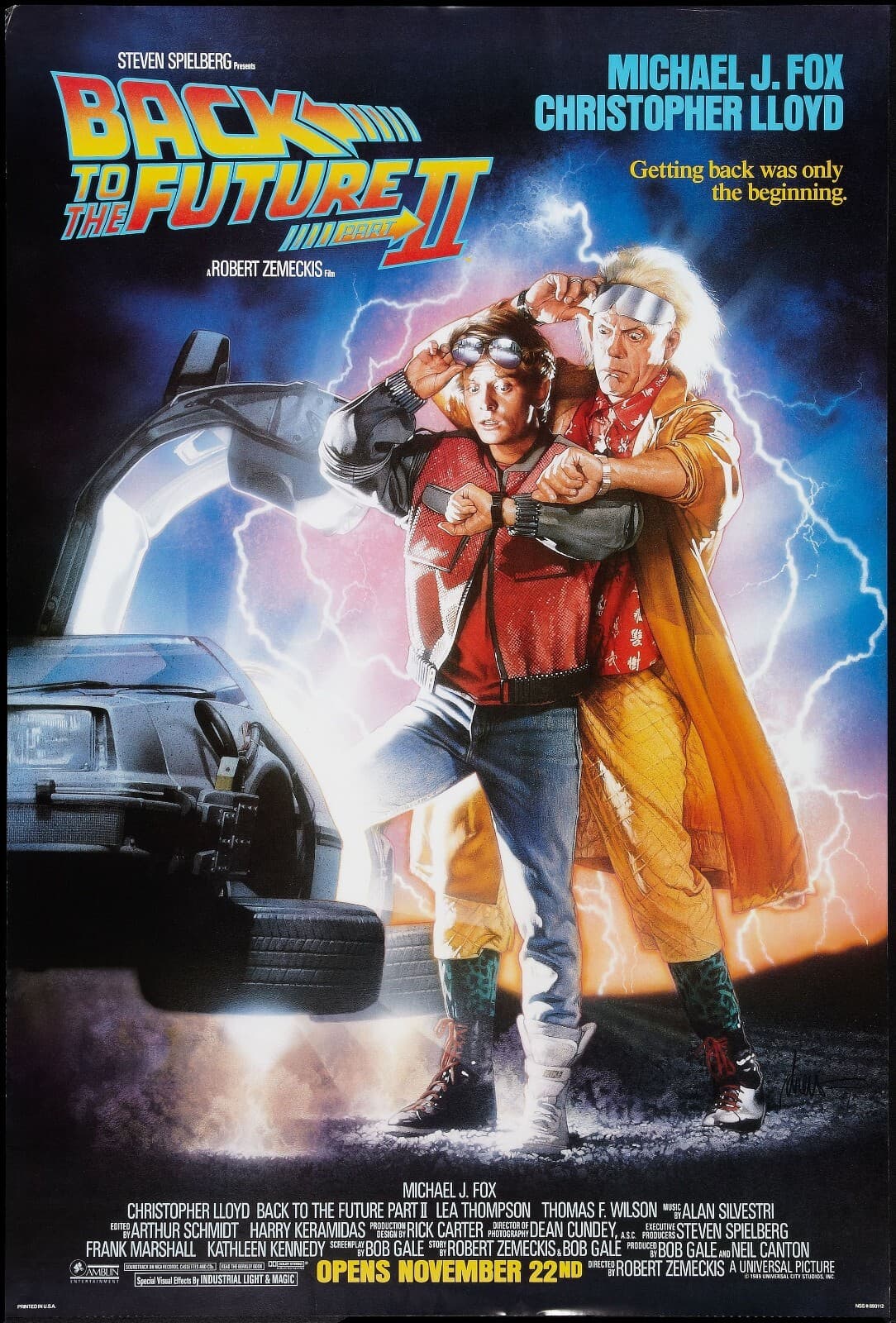
Back to the Future Part II
Hoverboards, alternate 1985s and one man trying to stop his whole family from unravelling—again.
The setup
Back to the Future Part II arrives like its DeLorean: fast, impatient and stubbornly unwilling to be tidy. Robert Zemeckis and Bob Gale pick up the story exactly where the first film left off and then spend much of the next 108 minutes proving how fragile a single timeline can be — especially when someone hands a cheat-sheet to the wrong Biff. It’s a sequel that doubles down on personality, consequence and the ridiculous logistics of undoing your own past.
THE MOVIE
Marty McFly / Marty McFly, Jr. / Marlene McFly is still the reason this movie works
The film throws us straight back into motion: Doc Brown turns up and hauls Marty and Jennifer into the future to deal with a problem in their family. There’s no easing-in — which is precisely the point; Part II treats the franchise as ongoing business, not a standalone spectacle.
That business quickly turns complicated. While in 2015, an older Biff gets hold of a sports-results almanac and folds himself back into 1955, creating an alternate 1985 where he’s rich and Hill Valley answers to him. Tiny changes ripple. Large consequences follow.
What keeps the movie threaded together — and what makes people still talk about it — is Marty’s blunt objective: keep his family intact, fix the timeline and avoid the paradoxes that come from visiting the same past more than once. It’s grimly sensible, and oddly moving, for a film that delights in gadgetry and improbable plots.
THE SETUP
The idea that sets Back to the Future Part II in motion
Part II essentially asks a clean question: what happens when time travel doesn’t just correct the past but multiplies it? Answer: you end up with different versions of the same people coexisting across decades, and the movie uses that as its central engine.
It starts immediately after the first film, zips to the future (2015) and then back to 1955 again so Marty and Doc can undo an altered timeline. The repetition is deliberate — the filmmakers mirror and replay scenes from the original to show how small edits in 1955 produce a very different 1985.
That mirroring gives the film its dramatic tension. Marty isn’t fighting abstract stakes; he’s fighting his own previous decisions, the ones he made in someone else’s timeline. The setup works because the emotional problem is concrete: family, reputation and a past you keep bumping into.
And because the movie is built as the next chapter — conceived as a continuation rather than a reboot — it can afford to be fussy about continuity, causality and the absurd logistics of swapping one 1955 for another.
THE CHARACTER
Why Marty McFly / Marty McFly, Jr. / Marlene McFly matters
Michael J. Fox appears in multiple guises here — the familiar Marty, versions of his offspring and a quick disguise as Marlene — and the movie depends on that elastic centre. Marty’s through-line is simple: protect his family and put the timeline back the way it should be.
That personal mission gives the film ballast. Time travel becomes less about dazzling tricks and more about the consequences of a single altered decision: when someone meddles with your family’s record, the fight gets intimate and urgent.
The setup also leans on technical sleights. Industrial Light & Magic’s work lets several versions of the same character share the frame, which is crucial to the film’s premise — Marty literally faces himself across years and choices.
Part II doesn’t treat those doubles as a gimmick alone. They are the puzzle pieces you move around to test what family, chance and history mean when they’re editable.
THE PERFORMANCE
Why Michael J. Fox's performance matters
Contemporary and later coverage has consistently pointed to the chemistry between Michael J. Fox and Christopher Lloyd as a key reason the trilogy holds together; Part II is no exception. The movie asks Fox to be several things at once — straight man, father-figure proxy and shape-shifting centre of the plot.
That interplay with Doc keeps the film grounded when the time mechanics get fiddly. When you’re watching multiple Martys share a frame, you still register the human relationship beneath the tumbling clocks.
There’s also a secondary note: other cast members are called upon to show variations on themselves, and those differences feed the film’s energy. Part II relies on performance as a way of sorting versions of people, not just as comic or dramatic ornament.
So even when the set-pieces are elaborate, the film depends on the way its leads connect — and coverage of the time has repeatedly marked that chemistry as essential to the trilogy’s success.
UNDER THE SURFACE
Back to the Future Part II has more on its mind than the plot suggests
On paper the movie is a sci-fi caper about a stolen almanac and a blinkered baddie. Underneath, it’s obsessed with unintended consequences: one small change in 1955 produces a new, darker 1985. The film keeps returning to the idea that time is brittle.
That brittleness makes the family drama feel sharper. When your grandfather’s name is changed on a page, your place in the world changes with it. Family and generational shifts are what give the spectacle emotional teeth.
There’s also a tug-of-war in the film between fate and free will. Characters keep bumping into the past they’ve already lived and must decide whether to accept outcomes or fight them — and that tension sustains the story’s stakes.
Finally, Part II is unusually interested in futures you can buy. The movie plays with consumerised visions of tomorrow — a future as a collection of gadgets and branded promises — and uses that to comment, quietly, on what kinds of futures we imagine and who gets to sell them.
THE FILMMAKING
How Back to the Future Part II was put together
Part II is a technical juggling act. Industrial Light & Magic supplied new camera and compositing techniques so the film could convincingly place multiple versions of the same character in a single shot. Those visual tricks are central to the story, not mere decoration.
On the practical side, Dean Cundey’s role as director of photography and the editing team give the sequence work its necessary clarity; the movie asks viewers to follow identical faces across timelines, which requires precision at every cut.
Production design also plays a hand: the crew recreated several Hill Valleys — 1955, 1985, an alternate 1985 and the imagined 2015 — and those staged town-square sets let the story move from one version of the town to another without losing orientation.
And beneath the spectacle, Alan Silvestri’s score keeps the film feeling like the same house as the first movie. All these choices add up to a picture that’s mechanically ambitious but narratively purposeful.
PRACTICAL EFFECTS
The effects work that gives Back to the Future Part II its physical personality
ILM executed ambitious multi-split-screen compositing so several versions of an actor could credibly share a frame; that work was vital to the movie and earned the film industry recognition.
Prosthetics and makeup were also in the toolbox: footage from the original film was reused in places, and the production used a replacement actor with prosthetic makeup to approximate a role previously played by another performer — a choice that later led to legal complications.
The film blends physical props and practical rigs with optical compositing for its future devices. The hoverboard stunts, for example, rely on real, wearable pieces combined with on-camera effects to register as flight.
Put together, these methods give the movie a tactile feel: it leans on both craft and emerging technology to sell the impossible.
PURE 80S
Back to the Future Part II could not belong to any other decade
This is very much a late-1980s product: conceived and shot as part of a tightly scheduled multi-film production, it reflects the period’s appetite for blockbuster planning and cost-conscious efficiency. Parts II and III were made in immediate sequence, which shaped the movie’s careful reliance on continuity.
There’s also the industry pressure angle. Michael J. Fox was juggling night shoots on this sequel while finishing a television season, an odd production detail that speaks to the era’s demands on actors and franchises.
The film’s imagined future is saturated with brand-name devices and consumer technology. That explicit branding is a late-80s trend — speculative futures sold as products — and the movie uses it to make tomorrow feel purchasable and slightly ridiculous.
Finally, the story elements that define the film — the DeLorean, the 2015 sequence, the stolen sports almanac and the hoverboard — are very much of their moment: ambitious set pieces born from a time when studios were happy to let a franchise play with gadgets on a grand scale.
WATCHING IT NOW
What has aged — and what hasn't
Some of the film’s bones are stubbornly resilient. The teen sensibility remains — the plot still reads as a young-person’s adventure about family and reputation — and the central family theme continues to register.
Technically, ILM’s multi-version work still plays an essential storytelling role; those compositing techniques let the movie do something narratively specific that simpler effects couldn’t have pulled off at the time.
Other production choices are more complicated in retrospect. The filmmakers reused footage from the original and used prosthetic makeup with a replacement actor to suggest a previously played character, a decision that eventually generated legal fallout and raises awkward questions about likeness and continuity.
All told, the film’s narrative ideas — the fragility of the timeline, the way small choices cascade into big changes — remain clear and effective, even when some technical or casting choices invite a second look.
THE LEGACY
Why Back to the Future Part II still matters
Formally, Part II occupies the middle slot in a tightly connected trilogy and was released immediately before Part III; its ending explicitly invites continuation and closure in the next film.
Its visual-effects work earned industry attention — nominations and awards — and the film’s technical ambitions are a big part of why it’s still discussed in retrospectives about late-80s blockbuster effects.
Pieces of the film have taken on lives of their own: props and designs, notably the footwear imagined for 2015, have been reproduced and sold in later commercial releases and charity auctions, which says something about how tangible elements of the film have endured.
The picture also remains a staple of anniversary re-releases and trilogy box sets, and it continues to be part of conversations about franchise filmmaking and the era’s appetite for spectacle.
THE VERDICT
Does Back to the Future Part II still hold up?
Yes — with the caveat that you’re watching a very specific kind of sequel. If you want tidy, single-film closure you’ll be frustrated; this is a middle chapter that delights in complication. It picks up the story immediately, sends Marty and Doc forward and back, and then asks them to undo an alternate 1985 created by a stolen sports almanac.
What still works is the film’s commitment to consequence. It uses multiple coexisting versions of the same characters not as a stunt but as a way to show how small changes in 1955 ripple into someone’s life. The mirrored scenes that replay the first film’s beats help underline that point.
The relationship between its leads keeps everything readable: Michael J. Fox’s multiple turns as Marty, supported by the chemistry noted between him and Christopher Lloyd, preserve the emotional clarity when the time-travel logistics get messy.
So should you watch it? Absolutely — if you enjoy sequels that complicate, not simply amplify. Part II is an ambitious, occasionally messy middle chapter that rewards anyone interested in consequences, family shifts and the weird arithmetic of fixing the past. It doesn’t tidy everything up — and that, rightly, is the point.
Share this movie
Keep watching
More movies from the 80s
1989
Bill & Ted's Excellent Adventure
A daft time‑travel comedy where being mates saves the world — and yes, Ted matters more than you remember.
Read our take →
1985
Back to the Future
A time machine, a restless teenager and a very particular set of family problems.
Read our take →
1985
Real Genius
Real Genius: the safety of home and family, and why this 1985 movie still matters.
Read our take →