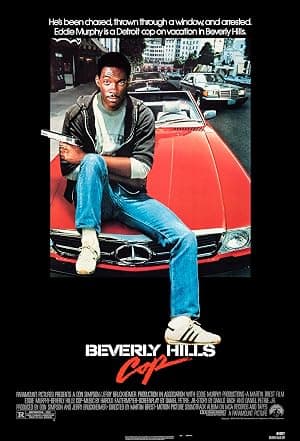
The setup
Beverly Hills Cop hangs on one very particular energy: a Detroit detective who treats protocol like an optional suggestion and keeps turning polite shock into comedy. Martin Brest gives Eddie Murphy room to roam, and the result is a fish‑out‑of‑water buddy‑cop movie where street smarts constantly outmanoeuvre buttoned‑up procedure. If you remember one thing, remember Axel Foley walking into a world that assumes rules matter more than answers.
THE MOVIE
Axel Foley is still the reason this movie works
Beverly Hills Cop is a very simple idea told with a lot of personality: after his friend is killed in Detroit, a gutsy local copper hops a plane to Beverly Hills to follow the case himself.
That setup — a streetwise detective dropped into an upscale, by‑the‑book police culture — gives the film its constant friction. The comedy and the forward momentum come from watching Axel Foley use improvisation and fast talk to short‑circuit expectations at every stop.
Martin Brest directs with a clear sense of where the movie’s life comes from: it isn’t the plot so much as the character who drives it. Eddie Murphy plays the lead role that keeps the story sprinting through its 105 minutes.
THE SETUP
The idea that sets Beverly Hills Cop in motion
The engine that starts the film is straightforward: Mikey Tandino’s murder in Detroit pushes Axel Foley out of his jurisdiction and into Beverly Hills, where the killing doesn’t quite fit the local assumptions about crime.
That friction — Axel’s rule‑bending methods against the guarded professionalism of the Beverly Hills force — sets the tone. There’s an actual criminal thread, connected to an art dealer, but the movie habitually lets the culture clash supply its surprises.
Rather than papering every scene with procedural detail, the screenplay keeps things elastic. Foley works around jurisdictional limits using undercover reconnaissance, impersonation and collaborative stakeouts; the mechanics exist to let the character improvise his way forward.
So the plot gives Axel something to solve, but the set pieces mostly exist to stage the contrast: blue‑collar methods versus polished institutions, quick thinking versus the official rulebook.
THE CHARACTER
Why Axel Foley matters
Axel Foley is the movie’s motor. He’s described plainly as a fast‑talking, rule‑bending Detroit detective whose curiosity and improvisation keep the plot moving and keep the laughs coming.
That description sounds small until you remember how much of the film is built around him making things happen: slipping into other people’s lives, turning modest reconnaissance into breakthroughs, and refusing to accept a polite shrug from local authorities.
Crucially, Axel doesn’t exist alone. Billy Rosewood and John Taggart arrive as the official, slightly condescending partners who gradually move toward cooperation — the buddy relationship that gives the film a warm centre despite the culture clash.
There’s also a pragmatic connective tissue in Jenny Summers, a Beverly Hills officer who becomes Axel’s ally and a useful narrative bridge between his methods and the local force. Behind the scenes, the script was a living thing: production reports note revisions during shooting and frequent improvisation on set, which helps explain the film’s loose, livewire feel.
UNDER THE SURFACE
Beverly Hills Cop has more on its mind than the plot suggests
On the surface it’s an action comedy: a cop chases leads, plants himself in strange rooms and drives suspicious cars. Below that surface are a few steady ideas the film keeps returning to.
First, it’s a fish‑out‑of‑water story — the delights and discomforts of someone who simply doesn’t belong in a place that runs on other rules. That clash fuels most of the comedy.
Second, it’s a buddy picture that trades on mismatch: two local detectives, initially bemused and superior, end up learning how to cooperate with a different kind of cop; their relationship supplies the film’s emotional payoffs.
Finally, the movie is quietly interested in the tension between street smarts and institutional policing, with class and materialism often serving as the comic backdrop against which those ideas play out.
THE FILMMAKING
How Beverly Hills Cop was put together
Martin Brest steered the production while a small team handled the camera and cutting: principal cinematography credit goes to Bruce Surtees, with editing credited to Billy Weber and Arthur Coburn. Those names anchor the film’s craft choices without turning it into an exercise in showy technique.
Production design, credited to Angelo Graham, favours real locations over elaborate backlot sets. The movie leans on actual warehouses, city streets and mansions to stage its contrasts rather than inventing a facsimile of Beverly Hills.
That practical approach keeps the film honest. You feel Axel in ordinary spaces — a bonded warehouse, a hotel lobby — which matches the script’s preference for improvisation over theatrical artifice.
Taken together, the direction and production choices make Beverly Hills Cop feel immediate and lived‑in, which helps the comedy land: it’s funny because the world feels real enough to be surprised by a character like Axel.
PRACTICAL EFFECTS
The effects work that gives Beverly Hills Cop its physical personality
Beverly Hills Cop relies on real stunts and collisions to sell its action. Multiple on‑location stunt and crash sequences were filmed in Detroit and handled by the production’s second unit.
Reporting from early production documents confirms staged vehicle chases and practical crash effects shot on city streets — including a cigarette truck incident and a heavier two‑ton truck collision — rather than depending on studio trickery.
Those tangible stunts give the movie a physical weight that suits its humour. When a chase ends with metal and dust, the laughs sit next to real consequences, which keeps the action grounded.
In short, the film’s action feels earned because those set pieces were built and executed on location, not conjured entirely in post.
PURE 80S
Beverly Hills Cop could not belong to any other decade
Released in December 1984, Beverly Hills Cop arrived at a moment when high‑concept, commercially driven pictures were the order of the day — and it helped cement Eddie Murphy’s status as a bankable movie star.
The film’s production team — the Simpson/Bruckheimer pairing — were emblematic of that 1980s approach, favouring punchy premises that mixed action with broad appeal.
Musically, Harold Faltermeyer’s synth‑driven score and the inclusion of pop songs plugged the movie into contemporary marketing: the soundtrack worked as a promotional tool as much as background music.
All of these elements — timing, producers, and the pop soundtrack — make Beverly Hills Cop feel of its era in a way that supports the story rather than merely dressing it in trendiness.
THE LEGACY
Why Beverly Hills Cop still matters
Part of the film’s afterlife is institutional: it earned an Academy Award nomination for its screenplay and, in 2024, was selected for preservation in the U.S. National Film Registry for its significance.
More narratively, the picture created a recognisable blueprint — a wisecracking outsider upsetting a pampered system — that left room for sequels and periodic returns to the character.
Musically, the instrumental theme 'Axel F' became a hit single worldwide and has been covered and remixed repeatedly, which helped the film’s presence spill out of cinemas into popular culture.
Taken together, those threads — awards recognition, franchise continuation and a ubiquitous musical hook — explain why the movie continues to be referenced and revisited.
THE VERDICT
Does Beverly Hills Cop still hold up?
Yes — but only if you’re watching it for what it set out to do. This is a culture‑clash buddy cop film where a murder plot provides momentum, and the pleasure comes from the collisions between Axel’s street methods and Beverly Hills’ institutional caution.
The movie’s structure — frequent fish‑out‑of‑water gags, mismatched‑cop dynamics and a willingness to use undercover stunts and impersonations to bypass jurisdictional hurdles — still delivers brisk entertainment across its 105 minutes.
If you enjoy a plot that exists largely to let a character keep surprising people and reshuffling expectations, Beverly Hills Cop still works: Axel Foley’s improvisation and the gradual friendship with Rosewood and Taggart carry the film even when individual subplots aren’t strictly procedural.
If you’re looking for a tightly plotted thriller, this isn’t it. But if you want a film where personality drives the engine and the pieces were assembled to showcase that energy, it remains worth watching.
Share this movie
Keep watching
More movies from the 80s
1984
The Pope of Greenwich Village
The Pope of Greenwich Village: greed and consumerism, and why this 1984 movie still matters.
Read our take →

1985
Police Story
Police Story: freedom and authority, and why this 1985 movie still matters.
Read our take →
1985
The Protector
The Protector: family and parents protecting their children, and why this 1985 movie still matters.
Read our take →