The setup
Breaker Morant is one of those films that feels less like a history lesson and more like a tightly wound theatrical argument: a courtroom at the centre, scenes of violence around it, and a junior officer who refuses to be a neat moral cipher. Directed by Bruce Beresford and released in 1980, it stages a 1901 court-martial to ask uncomfortable questions about obedience, responsibility and who pays when empires need a scapegoat.
THE MOVIE
Lieutenant Harry "Breaker" Morant is still the reason this movie works
Breaker Morant launches from a single insoluble question: what happens when soldiers claim they were only following orders and the people above them need someone to blame? The film stages that question by dramatizing the 1901 court-martial of three members of the Bushveldt Carbineers, the very affair that supplies the movie’s moral spark.
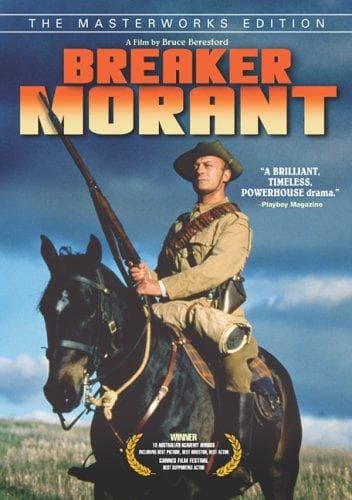
At the centre is Harry 'Breaker' Morant — presented here as cultured, quick to laugh and just as quick to snap — a junior officer who’s constantly at odds with authority. That tension between a defiant individual and a military system is what gives the film its personality; it’s not merely about facts, it’s about character pushing against consequence.
Bruce Beresford directs with a clarity that keeps the trial tightly focused while the field incidents that produced the charges keep cutting in, so the whole thing feels less like a courtroom drama with interruptions and more like two arguments played against each other. That structural choice — courtroom as organising device, violence as counterpoint — is the film’s cleverest move.
THE SETUP
The idea that sets Breaker Morant in motion
At its simplest, the story is a courtroom question: were these officers executing orders — official or whispered — or were they committing punishable atrocities? That ambiguity is the hinge the movie swings on.
The trial scenes do the heavy narrative lifting. They aren’t isolated; the film repeatedly cuts away to the field actions that produced the charges, so testimony and memory keep interpenetrating one another. You watch people say one thing and then watch what actually happened; the tension between the two frames the whole moral puzzle.
Those flashback intercuts don’t just show events. They force the audience to weigh command, context and culpability at the same time the court is trying to give a tidy answer. It’s a neat structural approach because it refuses the comfort of a single perspective.
So the set-up works because the trial isn’t an endpoint — it’s the device that lets the film argue about obedience, responsibility and the messy business of wartime decisions.
THE PERFORMANCE
Why Jack Thompson's performance matters
Jack Thompson’s part as Major J. F. Thomas was recognised at home and abroad — he won the 1980 Australian Film Institute Best Actor award and also received a Cannes festival acting prize for the role. Those honours signal the part’s centrality to the film: Thomas is the mouthpiece who tries to make sense of an impossible situation.
What the awards tell you — without getting into an actor-by-actor breakdown — is that the film depends on the defence counsel as much as it does on the accused. The trial needs someone who can hold attention and frame the legal and moral argument, and the recognition Thompson received confirms that the role succeeds in doing exactly that.
In short: the movie’s courtroom work runs through Thomas, and the fact that the role earned both national and festival prizes suggests it was a keystone of the film’s effect.
UNDER THE SURFACE
Breaker Morant has more on its mind than the plot suggests
If you strip the film down to its ideas, four things keep surfacing: obedience and responsibility; the moral ambiguity of wartime violence; imperial politics and scapegoating; and the failings of military justice when it’s pressured by higher command. Those are not incidental; they’re the reason the trial feels urgent rather than merely procedural.
The movie uses the courtroom to examine who carries the blame. Is the blame personal — the men who fired the shots — or is it political, passed down from command decisions and then thrown back onto a few convenient figures? That question is the film’s moral engine.
Because the film keeps cutting between testimony and the violent episodes that produced the charges, it never lets you accept a single simple answer. The contradictions are left visible, which is how the movie pushes you to feel the ambiguity rather than read it as a thesis statement.
And finally, there’s the imperial dimension: when an empire wants to protect its image, the legal system can be enlisted to tidy things up. The film points that out without turning it into a lecture — it simply shows how political pressure reshapes justice.
THE FILMMAKING
How Breaker Morant was put together
Donald McAlpine served as the film’s director of photography, a credited choice the film leans on to give its period courtroom and field sequences a consistent visual weight. The photography is one of the pieces that helps the movie sit confidently between theatre and cinema.
Bruce Beresford’s direction keeps the focus tight: the trial scenes are economical and the field episodes are used sparingly but to clear effect. That discipline stops the film from sprawling and keeps the ethical puzzle in high relief.
The film’s craftsmanship was recognised at home: it won several major Australian Film Institute awards, including Best Film and Best Direction. Those prizes underline how the movie’s choices were read at the time — as a carefully assembled statement, not just a good story told on screen.
In short, the filmmaking is purposeful rather than flashy, and that restraint is part of why the narrative side of the film holds together so effectively.
PURE 80S
Breaker Morant could not belong to any other decade
Released in 1980, Breaker Morant arrived when Australian cinema was finding a louder voice overseas. It was part of a small wave of films that turned national military experiences into subjects for wider debate and international attention.
The film sits naturally alongside other early-1980s Australian historical works that re-examined national service and its political fallout; the period asked similar questions about memory, myth and accountability.
Its screening in competition at the 1980 Cannes Film Festival and the haul of Australian Film Institute awards at home show how the film operated on both domestic and international stages — very much a film of its moment for the way it carried local material to global forums.
Seen this way, Breaker Morant helped mark the moment Australian stories were being packaged and presented with confidence to international audiences, and that positioning is part of its 1980s personality.
THE LEGACY
Why Breaker Morant still matters
There are concrete reasons the film has stayed in conversations about cinema: its screenplay received an Academy Award nomination for Best Adapted Screenplay, and it won multiple major Australian Film Institute awards including Best Film and Best Direction. Those honours mark it as a standout of its year.
The film’s festival run — it represented Australia in competition at Cannes — helped it find international ears, which matters when you think about how national cinema gets noticed beyond its borders.
Beyond prizes and festivals, Breaker Morant is regularly mentioned in surveys of the Australian New Wave and credited with helping raise attention for Bruce Beresford’s work; it’s one of those titles that gets cited when people trace the director’s early career.
Put together, the awards, the festivals and the film’s place in national cinema histories explain why it still turns up in discussions about both Australian film and screen treatments of military justice.
THE VERDICT
Does Breaker Morant still hold up?
Yes — and not because it’s a museum piece but because the drama still does the thing it set out to do: stage a courtroom argument that keeps clashing with the messy reality of violence in the field. The film’s structure, which intercuts testimony and the field incidents that produced the charges, still forces you to think rather than to feel you’ve been spoon-fed an answer.
Edward Woodward’s portrayal of Lieutenant Harry 'Breaker' Morant — a cultured yet volatile junior officer whose behaviour repeatedly collides with authority — gives the moral questions a character to live inside. The central dispute about whether the accused were following orders or being politically sacrificed remains the film’s beating heart.
The movie’s recognised craft — screenplay award recognition, AFI prizes and its Cannes slot — matters because it’s not merely a competent reconstruction of events; it’s a deliberately shaped argument about obedience, responsibility and imperial politics. That shaping is what keeps it watchable and thoughtful.
So if you’re deciding whether to watch it now: go for the moral sparring and the clean, purposeful filmmaking. Breaker Morant doesn’t sentimentalise its subject; it makes you sit with the awkward fact that, in wartime, the machinery of justice can be both necessary and easily bent. It’s a film that still asks an awkward question and refuses to hand you a comfortable answer.
Share this movie