The setup
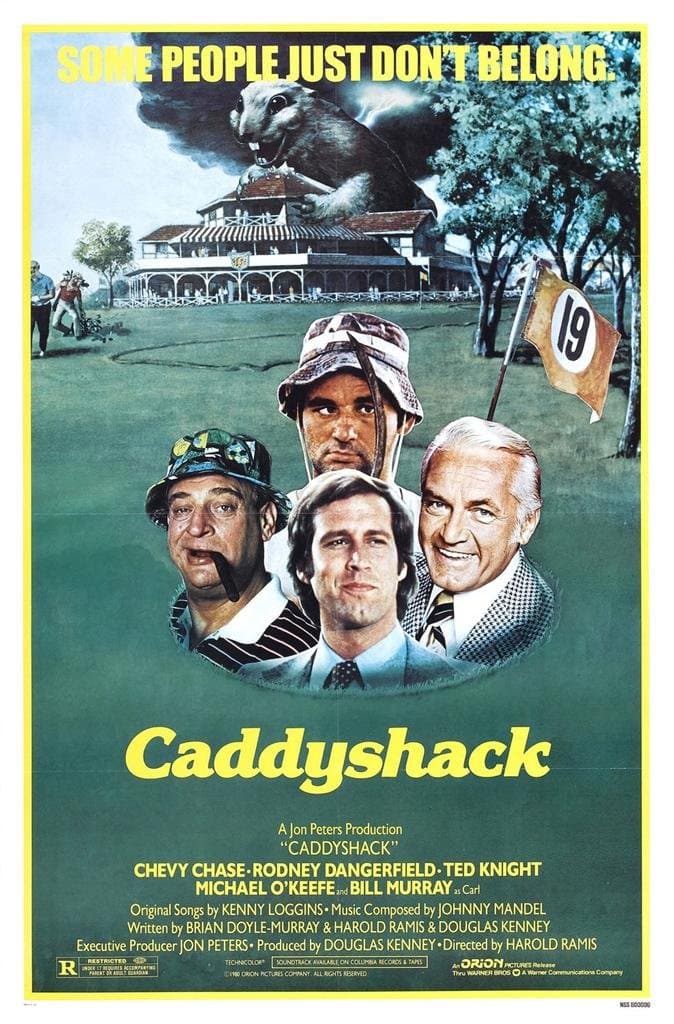
Caddyshack arrives like a golf ball you didn't expect to care about until it knocks over a lamp. At its heart there's a simple contest — a teenage caddie chasing a scholarship while two very different men brawl over who owns the clubhouse — but the film keeps detouring into anarchic sketches and impossible one-liners. It's Harold Ramis's first time directing, and the result is the sort of loose, funny mess that still gets talked about precisely because it refuses to be tidy.
THE MOVIE
Ty Webb is still the reason this movie works
If you remember one thing from Caddyshack it won't be the scorecard; it will be the mood. The movie sets up a fairly straightforward spine — Danny Noonan, a teenage caddie, is trying to win a caddie scholarship at the exclusive Bushwood Country Club — and then sprays colour and noise around that spine until the scene you didn’t expect becomes the scene you can’t forget.
Alongside Danny's story is a deliciously grubby cultural scrap: Judge Elihu Smails and the upstart Al Czervik trade social barbs and on-course escalations, which gives the whole thing a clear slob-versus-snob energy. That clash keeps the picture from collapsing into mere silliness; there’s an argument being made, even as the film enjoys letting jokes tumble out in every direction.
Harold Ramis made his feature directorial debut here in 1980, and he simply lets the players play — a 98-minute tumble of improvisation-driven sketches, a few anchored plot beats, and a cast who can turn an episode into an event. And yes: Chevy Chase is Ty Webb, the calm, worldly golfer whose cool presence helps hold the chaos together.
THE SETUP
The idea that sets Caddyshack in motion
Caddyshack gives you a tidy premise and then refuses to behave like a tidy film. The core plot follows Danny Noonan, a young caddie whose hopes rest on a scholarship that could change his future. That's the story's hinge: loyalty, ambition and the small moral decisions of a kid trying to find his way.
Around Danny, the movie stages a social war. Bushwood co-founder Judge Elihu Smails and the nouveau-riche Al Czervik keep escalating their personal beef, and those confrontations — on and off the course — provide the film’s most sustained comic engine.
Running beside that is a delightfully strange subplot: greenskeeper Carl Spackler's increasingly extreme campaign against an elusive gopher. It feels like a different film at times, but that split personality is exactly the point; Caddyshack is happiest when it hops from one set-piece sketch to the next.
All of this leads toward a climactic team golf match that functions as the competitive set piece and the emotional test for Danny. In other words: there's a goal, but getting there is mostly an excuse for mayhem.
THE CHARACTER
Why Ty Webb matters
Ty Webb arrives like someone who's read the room and decided to buy it a drink. Chevy Chase plays him, and the character is written as a relaxed, worldly playboy golfer — the sort of figure who offers Danny casual mentorship and philosophical quips rather than a lecture.
That matters because Ty is the movie's social lubricant. When the plot tightens around the scholarship and the club war, Ty's offhand comments and laissez-faire attitude remind us it's all meant to be funny, not dire. He steadies the film without stopping the jokes from running wild.
He's also the bit of glamour the caddie world needs: a friendly, unattached presence who shows Danny another possible adulthood, one less trapped by etiquette and more inclined to skewer it.
THE PERFORMANCE
Why Rodney Dangerfield's performance matters
Rodney Dangerfield as Al Czervik arrives like a fart in a cathedral — loud, unapologetic and impossible to ignore. Contemporary and later coverage note that his comic presence injected new energy into the film.
That injection matters on two levels: it gives the movie a combustible foil for the aristocratic Smails, and it changed how Dangerfield was seen on screen, helping to raise his profile as a movie comedian.
Put simply: Czervik keeps the chaos supersonic, and the film is that much livelier for it.
UNDER THE SURFACE
Caddyshack has more on its mind than the plot suggests
Beneath the pratfalls and punchlines there's a clear streak of anti-authoritarianism. The film delights in undermining uptight figures of authority and puncturing the dignity of social institutions — which is why the Smails/Czervik brawl feels like more than a gag.
That slob-vs-snob conflict is the movie’s moral weather: working-class employees and caddies bump up against wealthy club members, and the tension feeds both the jokes and the stakes. It's comedy with a small, persistent edge.
There's also a coming-of-age current. Danny's apprenticeship as a caddie is small-scale but meaningful: loyalty, compromise and ambition appear as real choices rather than abstract ideas.
Finally, improvisation-driven comedy is woven through everything. The film leans into sketch-like beats and spontaneous moments, letting performers wander and the script catch up. That looseness is part of the movie’s character — sometimes it pays off brilliantly, sometimes it feels scattershot, but it keeps the film alive.
THE FILMMAKING
How Caddyshack was put together
One of the film's most obvious signatures is the way it's pieced together: rather than a relentlessly tight plot, Caddyshack often feels like a series of set pieces stitched around the central scholarship story. The shooting and editing left it with a loose, sketch-driven structure.
That looseness is a directorial choice as much as a by-product of production; Harold Ramis — directing his first feature — lets scenes breathe and performers poke at their lines. It makes the movie unpredictable. Sometimes that unpredictability lands a brilliant joke; sometimes it leaves a gap where the narrative could have been stronger.
But that’s part of the charm. The film prefers the messy life of a gag to the sterile cleanliness of a perfectly plotted scene.
PRACTICAL EFFECTS
The effects work that gives Caddyshack its physical personality
Caddyshack's physical comedy gets a literal assist from its effects work. The onscreen gopher was realised with a practical puppet and mechanical/animatronic methods — a very physical creature in a largely human comedy.
The production also brought in visual-effects vendors for inserts like storm and lightning elements and animated gopher sequences to supplement what was done on set. Those techniques let the film sell moments that would have been harder to stage live.
In short: the movie blends hands-on puppetry with some optical inserts, and that blend helps the absurd gopher subplot feel present in a very tangible way.
PURE 80S
Caddyshack could not belong to any other decade
Caddyshack was released in the summer of 1980 and it sits neatly at the start of a period that favoured anarchic, anti-establishment humour. There’s an attitude to the film — cheeky, disruptive, impatient with decorum — that feels of its time.
It's often grouped with the slob-vs-snob subgenre that ran through late-1970s and early-1980s American comedy. That grouping is useful: it helps explain why the film's social jabbery and ensemble chaos landed so readily with audiences then.
The movie's timing also matters because it arrived while ensemble, anarchic comedies were still freshly fashionable; it wasn't trying to reinvent that wheel so much as tilt it and see what spilled out.
THE LEGACY
Why Caddyshack still matters
Caddyshack did well at the box office and, despite some mixed reviews when it first came out, it quietly built a substantial cult following. People kept talking about its jokes, its scenes and the sheer nerve of its comic choices.
Its sequel's failure didn't erase that; if anything, the uneven follow-up highlighted how particular the original's chemistry was. The fact that only one principal player returned for Caddyshack II underlines how singular the first film's ensemble felt.
You'll also find Caddyshack turning up on retrospective lists of notable comedies and sports films — not because it's immaculate, but because it became a touchstone for the anarchic, ensemble style the era favoured.
THE VERDICT
Does Caddyshack still hold up?
Yes — with reservations. If you want a neatly plotted comedy, this isn't it. The film's heart is a small, human story: Danny Noonan chasing a caddie scholarship while the Smails/Czervik feud bubbles over. That gives the movie something to land on when the sketches start to scatter.
What helps it survive is cast and character: Ty Webb's relaxed, worldly presence gives the film a kind of moral shrug that lets everything else get away with murder, and Rodney Dangerfield's injection of comic energy as Al Czervik brightens the whole film in a way that was noticed both then and later. Bill Murray's improvised Carl Spackler material — expanded during production — is another of those wildcards that keep you watching.
Technically and tonally it’s a product of its moment: a loose, improvisational ensemble piece from 1980 that likes to favour jokes over neat narrative closure. If that kind of anarchic comedy appeals, Caddyshack still rewards a watch; if you need tight structure and polish, it will feel scattershot.
So ought you to watch it? If you're curious about early Harold Ramis, the slob-vs-snob comedy of the era, or just want an uneven but frequently brilliant comic evening, yes. Bring a willingness to be pulled in different directions — that's the point.
Share this movie
Keep watching
More movies from the 80s

1980
Airplane!
A pilot who can’t fly, a plane full of nonsense — and the odd inflatable hero called Otto.
Read our take →
1980
Any Which Way You Can
Any Which Way You Can: courage and heroism, and why this 1980 movie still matters.
Read our take →
1980
Can't Stop the Music
Can't Stop the Music: love and friendship, and why this 1980 movie still matters.
Read our take →