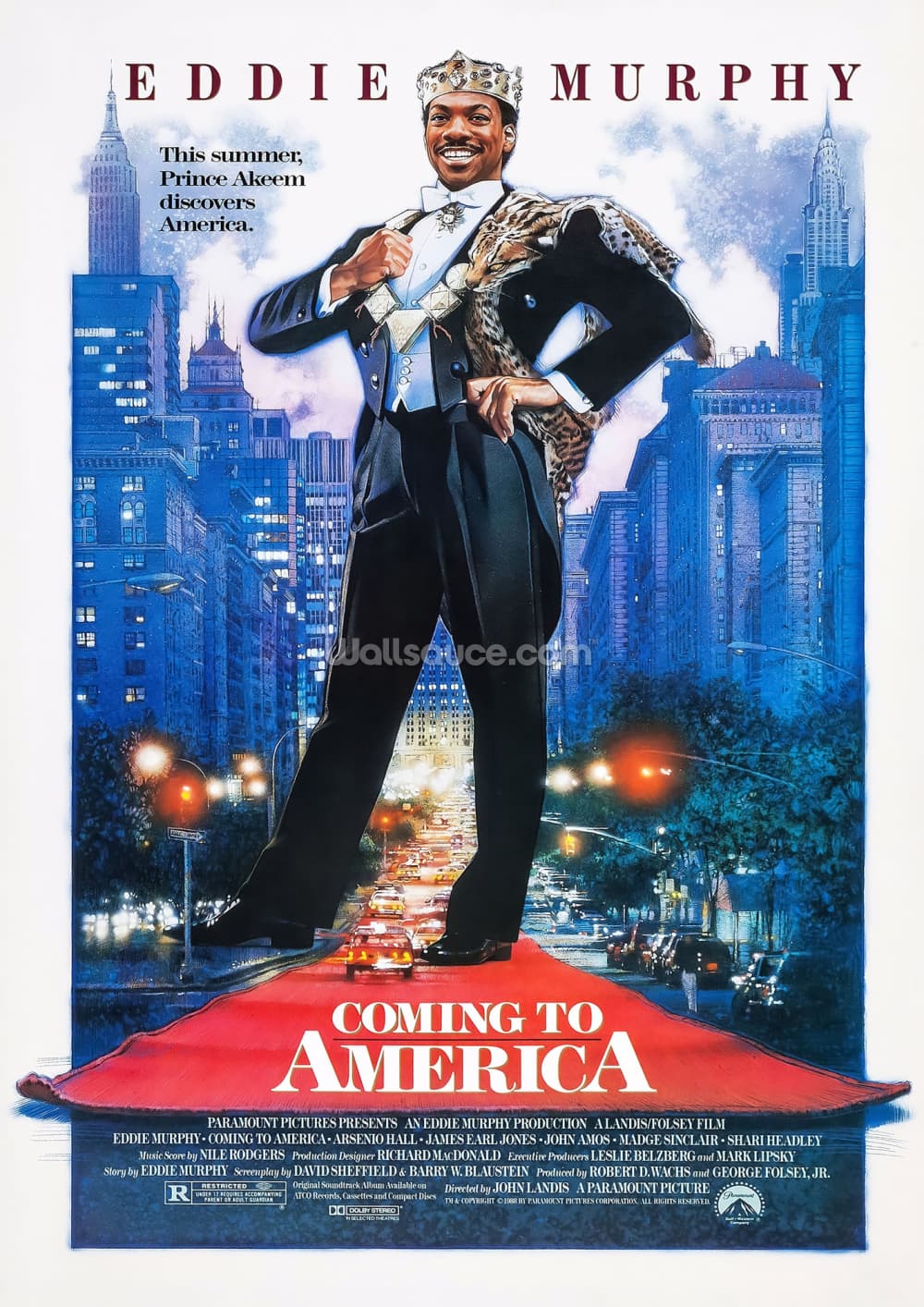
Coming to America
A prince in disguise, a fast-food job and a fairy-tale that prefers laughs to pomp.
The setup
Coming to America still feels like a party where the guest of honour refuses to wear his crown. John Landis’s 1988 romantic comedy sends a sheltered prince into Queens to find someone who loves him, not the title — and packs the trip with disguises, cameos and a gleeful refusal to take royal life seriously.
THE MOVIE
Prince Akeem Joffer / Clarence / Saul / Randy Watson is still the reason this movie works
What keeps people talking about Coming to America isn’t a single joke or a set-piece; it’s the central wager: a prince who willfully becomes anonymous to discover whether anyone will love him for himself. That premise — a royal deliberately stepping down from privilege to test love — is the film’s simple but stubborn engine.
Because the story is built around that choice, the movie can be both rom-com and modern fairy tale. It borrows the structure of Cinderella — a prince in plain clothes looking for an honest match — and then fills the space between proposition and payoff with comic detours, fish-out-of-water moments and a parade of characters.
And at the heart of it all is the fact that Eddie Murphy plays the lead and several other parts, with Arsenio Hall also contributing multiple roles. Under John Landis’s direction, that casting choice turns a straightforward romantic idea into something looser and more playful: a big, noisy comedy that keeps returning to the same quiet test of authenticity.
THE SETUP
The idea that sets Coming to America in motion
The film’s motor is straightforward: Prince Akeem leaves his wealthy homeland and arrives in Queens determined to find a bride who loves him, not his crown. That goal only sounds obvious; it neatly reframes the rom‑com quest as a test of humility.
To make that test believable, Akeem travels incognito with his attendant Semmi and takes a lowly job at a local burger place. The disguise isn’t just for laughs — it’s how the movie measures people. By stripping Akeem of status, the story forces him into ordinary interactions that reveal character.
From there the film builds through comic vignettes and cameos. Those moments don’t drive the romance so much as punctuate it: they keep the tone lively while Akeem’s central choice — to be treated like anyone else — quietly does the heavy lifting.
The setup works because it keeps the stakes intimate. It’s not about saving a kingdom; it’s about whether someone will accept a man when the trappings are removed.
THE CHARACTER
Why Prince Akeem Joffer / Clarence / Saul / Randy Watson matters
At base, Akeem matters because he’s the idea made flesh: a wealthy man who opts for anonymity to see what kind of person he is without the palace. That choice turns a potentially flat fairy-tale prince into someone who has to learn the awkward, small things ordinary life throws at you.
Eddie Murphy plays Akeem and also appears in several other guises, a strategy the film uses to widen its comic scope without losing the central story. Those multiple parts are part of the movie’s personality rather than a distraction from the romantic core.
Making that work required careful physical transformation. The production created life casts and foam-rubber appliances to realise the various characters, and some make-up sessions ran for hours. The technical effort matters because the disguises have to read clearly on screen while Akeem’s decisions remain legible.
So Akeem is memorable not because he’s flawless or enigmatic, but because the film lets him be plainly human: wealthy, awkward, sincere and willing to take a risk for a real connection.
UNDER THE SURFACE
Coming to America has more on its mind than the plot suggests
Beneath the laughs the film keeps returning to three tidy ideas: the fairy-tale search for true love, the use of disguise to test who people really are, and the contrast between wealth and everyday authenticity. Those are straightforward themes, but the movie treats them generously rather than academically.
Disguise here is a practical moral test. By hiding his status, Akeem sees how people react to him without a crown or bodyguards. That’s where comedy and consequence meet: the jokes land because the conceit also reveals character.
The wealth-versus-authenticity thread gives the romance its bite. The story isn’t interested in knocking privilege; it’s interested in whether privilege is a personality. Akeem’s decision to live small is meant to answer that question in human terms.
Finally, the film frames all of this as a cross-cultural encounter. Sending a Zamundan prince to Queens produces a gentle culture-clash comedy that keeps returning to the same moral test — who will love the man, not the myth.
THE FILMMAKING
How Coming to America was put together
Two production choices give the film its physical identity. First, the royal interiors draw on an eclectic mix of inspirations — from the flamboyance of Brighton Pavilion to Henri Rousseau’s jungle paintings — which helps the palace feel extravagant without being generic.
Second, contemporary critics singled out the production aspects for praise even when they thought the screenplay was uneven. That split — strong design, patchy script — is part of why the movie still divides opinion: it’s sumptuous in places and scattershot in others.
Those elements carry the film’s tonal shifts. When the palace is on screen, the movie luxuriates; when Akeem is in Queens, it tightens and gets scrappier. The result is a film that deliberately wears two faces.
Put simply: the filmmaking leans into contrast, using design to underline the story’s question about what wealth gives you and what it can’t buy.
PRACTICAL EFFECTS
The effects work that gives Coming to America its physical personality
A big part of the movie’s texture comes from old-school make-up and costume craftsmanship. Rick Baker produced life casts and foam-rubber facial pieces to transform the leads into multiple characters.
Those make-up sessions were not quick touch-ups: some took three to four hours. The production also used hand-woven hair, eyebrow and moustache pieces and practical costume work to realise the ensemble of faces you see on screen.
All of this is practical in the literal sense: the film relies on real, physical transformations rather than digital tricks. That effort matters because the humour depends on characters being visually distinct while remaining convincing.
In short, the film’s humour and variety owe as much to prosthetic craft and costume work as to any single punchline.
PURE 80S
Coming to America could not belong to any other decade
This film is very much a late-80s Hollywood animal: it was produced during Eddie Murphy’s peak years and was part of a multi-picture arrangement with the studio. That star-driven model explains why the movie feels built around a big personality rather than a minimalist concept.
It’s also an example of the period’s studio comedy vehicles, which gave major comedians generous budgets and ensemble casts to play with. Coming to America uses that freedom, packing in production design, extras and multiple character turns.
The film’s scale is reflective of its moment: studios were willing to bankroll broad comedies around bankable stars, and this is the sort of project that could only have been made when that approach dominated.
So while the story is timeless in its fairy-tale bones, the movie’s freedom to swing between palace pageant and street-level gags is distinctly an 80s thing.
THE LEGACY
Why Coming to America still matters
Part of the movie’s afterlife is simple: it was a major commercial success in 1988 and ranked among the year’s better-performing American films. That popularity kept it in people’s heads long after its initial run.
Its life in the industry didn’t stop there. Decades later the studio backed a sequel that brought the principal comic pair back together and revisited the characters, showing there was more story — or at least more audience interest — to tap.
The film also generated controversy off-screen: a high-profile lawsuit concluded that the picture drew on earlier material from humorist Art Buchwald, and that legal dispute ended with a monetary award to Buchwald and his partner.
Even a short-lived television pilot was attempted, which underlines how the central conceit — a prince living among ordinary people — had obvious serial potential, even if the series never took off.
THE VERDICT
Does Coming to America still hold up?
Yes — but with a two-part rider. If you watch Coming to America for the central fairy-tale idea and the way the film tests what counts as true affection, the movie still delivers. The simple premise — a prince seeking someone who loves the man rather than the title — remains clear and affecting.
The film’s machinery is visible: it uses disguise and assumed names, a low-wage job at McDowell’s and a string of comic vignettes to probe motives and measure sincerity. Those elements keep the heart of the story intact even when the screenplay wanders.
That said, contemporary reviewers pointed out the unevenness of the script even in 1988, and the film’s pleasures are often structural and performative rather than subtle. The production values — from the elaborate costumes to the prosthetic work that creates multiple characters — give the picture personality and variety.
So should you watch it today? If you want a broad, good-humoured romantic comedy that pairs a fairy-tale engine with bold production and a parade of characters, yes. If you expect a pacy, tightly plotted rom-com, this might feel indulgent. Either way, it remains distinct: a film that treats being rich as a problem to be solved by being ordinary.
Share this movie
Keep watching
More movies from the 80s
1988
Big
Big: our relationship with technology and friendship, and why this 1988 movie still matters.
Read our take →

1988
Bull Durham
Mentorship, rites of passage and a catcher called Crash — Bull Durham still teaches a lesson.
Read our take →
1988
Cocktail
Cocktail: family and greed, and why this 1988 movie still matters.
Read our take →