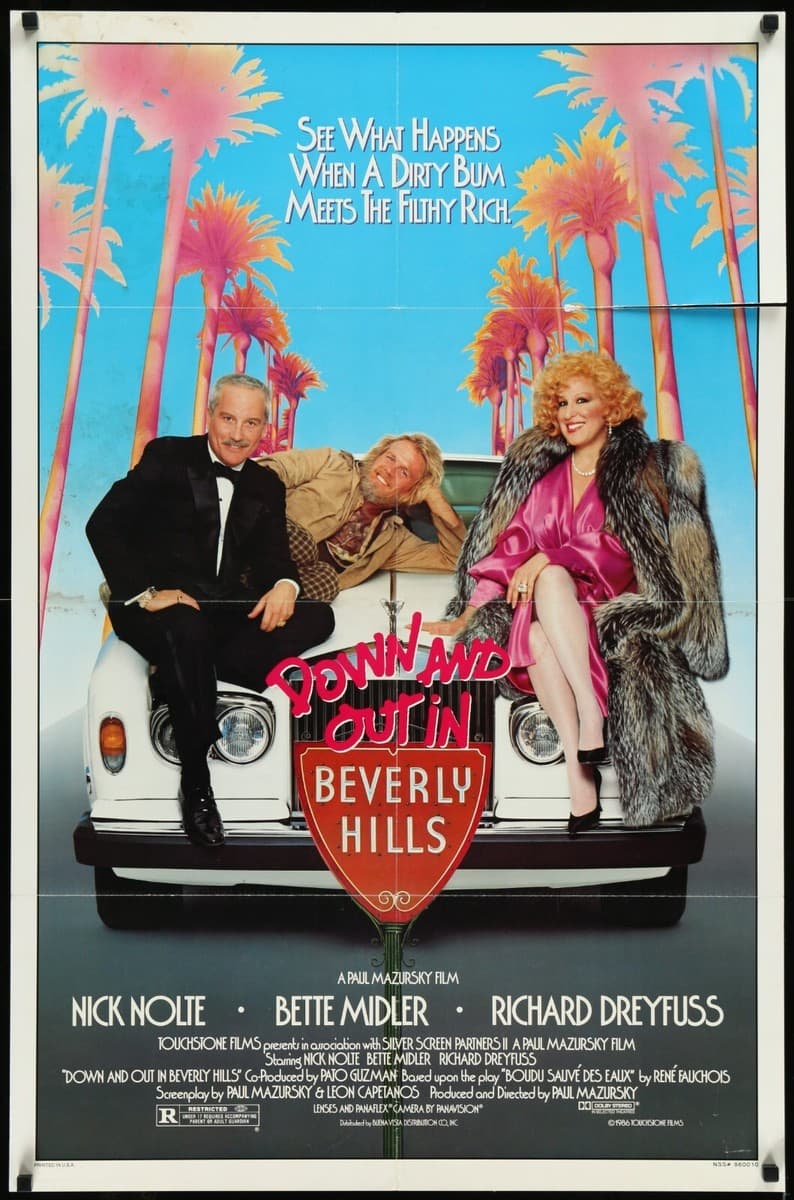
Down and Out in Beverly Hills
A tramp in a pool, a wealthy family with holes in their living room — and satire that still has teeth.
The setup
Paul Mazursky’s Down and Out in Beverly Hills is the sort of comedy that announces itself with a splash — literally. It pits a rootless outsider against an affluent Los Angeles household and, in doing so, turns polite liberal virtue into a sitcom-ready racket. Revisit it and you’ll find that the trouble it stirs is mostly human, loud and occasionally very funny.
THE MOVIE
Jerry Baskin is still the reason this movie works
If you remember one image from Down and Out in Beverly Hills it’s not the house, the car or even a throwaway one‑liner — it’s the moment a man climbs out of a swimming pool who absolutely should not be there. That man is Jerry Baskin, and his unexpected arrival is the engine that drives everything that follows.
Paul Mazursky sets up a sharp domestic laboratory: a wealthy family who consider themselves liberal, humane and comfortable, until Jerry’s presence refuses their neat categories. He’s not a neat metaphor; he’s an outsider with survival instincts, a streak of self-protection and a stubborn refusal to sign up to responsibility — and that refusal is the comic voltage the film runs on.
Mazursky’s satire keeps its focus tight. This is a comedy about manners and money as much as it is a fish‑out‑of‑water story; it runs for 103 minutes, features Nick Nolte as the disruptive guest, and frames the household’s wobbles as both funny and a little bruising.
THE SETUP
The idea that sets Down and Out in Beverly Hills in motion
The story begins with an inciting incident that’s both simple and mischievous: Jerry attempts to drown himself in the Whitemans’ pool and is rescued. It’s the kind of intrusion that can’t help but disturb a carefully ordered household — and the family’s decision to take him in is where the comedy takes off.
From that point the film uses the outsider‑as‑catalyst device: Jerry’s unpredictable behaviour and unpolished needs expose hypocrisies, anxieties and midlife flinches in the Whiteman family without turning the picture into a straight reform tale.
Mazursky layers the main thrust with lighter mechanics — montage‑driven teenage video sequences and an accumulating party set‑piece that corrals the film’s subplots into a comic climax. Those choices keep the pacing brisk and the tone swinging between affectionate and ruthless.
The premise proved flexible enough to travel beyond the film: it was adapted into a short‑lived television sitcom the following year, which reworked the movie’s central idea for broadcast.
THE CHARACTER
Why Jerry Baskin matters
Jerry Baskin is not there to be fixed. He’s an iconoclastic foil: blunt, free‑spirited and often awkwardly funny in ways the Whitemans are not. The point of his character is disruption — to show how a polite, well‑meaning household collapses into chaos when faced with something unmappable.
Nick Nolte plays Jerry Baskin, and the character’s appeal comes from being stubbornly uninterested in self-improvement. He survives by avoiding the obligations others take for granted, and that refusal pushes the Whitemans into moments of honest panic and comic exposure.
Importantly, Jerry is not only a disruptor of surface comforts; he intersects with the film’s family dysfunction. His presence uncovers tensions around marriage, parenthood and the generational stuff that the Whitemans have papered over.
There’s also a practical side to how Jerry was created: Nolte researched the role by spending time at a downtown Los Angeles mission and, as contemporaneous reports noted, adopted some extreme and visible methods of preparation. That sense of immersion shows up in the character’s rough edges.
THE PERFORMANCE
Why Nick Nolte's performance matters
Contemporary notices made a particular point of the film’s acting anchors. Critics singled out both Nick Nolte and Richard Dreyfuss as central to the film’s balance, and at least one outlet described their turns as "perfect performances."
That response matters because the movie relies on two opposing energies: a domestic actor trying to defend a comfortable life, and an outsider who refuses to play by those rules. The casting choices give the satire a push and a pull that the screenplay can then exploit.
Put simply, the way the leads were received at the time is part of why the film’s comic and dramatic moments register — reviewers noticed the chemistry between the household’s fragility and the intruder’s bluntness.
You don’t have to read acting biographies to sense that the filmmakers built the picture around those central confrontations; contemporary reaction makes that construction visible.
UNDER THE SURFACE
Down and Out in Beverly Hills has more on its mind than the plot suggests
At a glance it’s a fish‑out‑of‑water comedy: a stranger arrives and upends a household. But the film is doing more than piling up jokes; it’s a class satire that looks at how affluent people perform morality and how that performance frays under pressure.
Jerry’s arrival forces the Whitemans to confront their own contradictions. The picture is less interested in rehabilitating its outsider than in exposing the family’s anxieties — about marriage, midlife and whether their compassionate self-image matches their behaviour.
That family dysfunction is a steady emotional undercurrent. Teenage alienation, parental embarrassment and marital strain are the strings Jerry tugs at, often to comic effect but occasionally in an uncomfortable, very human way.
And because Jerry is a visibly disadvantaged figure, the film also stages questions about the visibility of homelessness — what it means to encounter someone the household would usually ignore, and what happens when you don’t know how to help.
THE FILMMAKING
How Down and Out in Beverly Hills was put together
Mazursky didn’t work in isolation. The film’s credits list Donald McAlpine as director of photography, Richard Halsey as editor, Pato Guzman as production designer and Albert Wolsky for costumes — a fairly established crew for a picture that moves between interior farce and social observation.
Those names are useful shorthand: they tell you the film was assembled with experienced hands, the kind that can keep a brisk comedy on the rails while accommodating sudden tonal shifts.
The production itself mixed location work with studio craft — photography and sets were built to support the household’s fractures as much as the punchlines.
All of this sits behind Mazursky’s direction and writing: the film’s structure and the way scenes are allowed to breathe are a product of that collaborative team.
PURE 80S
Down and Out in Beverly Hills could not belong to any other decade
The film arrived in January 1986 under Disney’s new Touchstone imprint — notable because Touchstone was the studio’s way of saying, ‘we can do adult R‑rated pictures now’ without melting the family brand. That business decision helped place the film in a particular 1980s context.
Tonally, the picture sits with a strain of 1980s comedy that turned an eye on conspicuous consumption and therapeutic culture. It targets the gap between people’s liberal self‑image and the awkward, often comical ways they actually behave.
Production-wise, Mazursky’s film reflects a mid‑80s pattern: established filmmakers working with adult‑focused sub‑brands to reach older audiences. That’s part of why the movie’s combination of social satire and broad comedy feels of its moment.
The screenplay also updates a much older European story — the Boudu material — and by relocating it to Beverly Hills it lets the decade’s anxieties about money, therapy and public virtue do some of the comedic work.
WATCHING IT NOW
What has aged — and what hasn't
Some elements of the picture still land easily. Commentators have repeatedly pointed to the casting and certain set pieces — notably scenes involving the family dog — as moments that continue to get laughs and register emotionally.
The film’s comedy depends on family dysfunction and its small humiliations; those domestic strains don’t feel like a period affectation. Teenagers being mortified by parents, or a marriage wobbling under the weight of unspoken resentments, remains relatable.
Where the film asks modern viewers to be patient is in how it treats homelessness as a narrative device. Jerry is visible in a way that forces the household to act, and that visibility is part of the movie’s interrogation of social discomfort.
Overall, the parts that age best are the human collisions — the awkward confessions, the arguments and the moments when the Whitemans’ performance of themselves drops away. Those beats are still recognisable today.
THE LEGACY
Why Down and Out in Beverly Hills still matters
The film did well enough on release to be considered a commercial success and it helped put Touchstone on the map as a home for adult‑oriented studio releases.
Beyond commercial matters, the film’s screenplay and its adaptation of European source material are points of continued discussion in assessments of 1980s Hollywood comedies that reworked older international stories for American audiences.
The idea itself — a chaotic outsider upsetting a wealthy household — proved durable enough to be turned into a television sitcom the following year, showing that the premise had legs even if the series didn’t last.
Put together, the picture’s box‑office performance, its theatrical strategy under Disney and its lineage to Boudu all explain why the movie remains part of conversations about mid‑80s cinema.
THE VERDICT
Does Down and Out in Beverly Hills still hold up?
Yes — but with a small caveat. The film’s engine is a simple, pointed idea: a man climbs out of a family pool and refuses to slide neatly into their expectations, and in doing so exposes a lot of brittle behaviour. That inciting incident still propels the picture with energy.
What keeps the movie watchable is the way it uses that outsider‑as‑catalyst setup to throw the Whitemans’ hypocrisies into relief rather than turning the story into a tidy redemption arc. The narrative mechanics — the teenage video montages and the party set‑piece — keep it lively and compact across 103 minutes.
Nick Nolte’s Jerry is the film’s disruptive centre, and contemporary reviewers singled out his and Richard Dreyfuss’s work as anchors; that critical consensus helps explain why the comic tensions hold together on a first or twentieth viewing.
If you watch it now, expect a satire that remains pointed about class, therapeutic self‑regard and family fault lines. It won’t be a flawless picture of modern sensibilities, but as a sharp, comic probe into comfortable people made uncomfortable, it still has teeth.
Share this movie
Keep watching
More movies from the 80s
1986
About Last Night...
About Last Night...: family and friendship, and why this 1986 movie still matters.
Read our take →
1986
Armed and Dangerous
Armed and Dangerous: parents protecting their children and loss, and why this 1986 movie still matters.
Read our take →
1986
Back to School
Back to School: family and corporate power, and why this 1986 movie still matters.
Read our take →