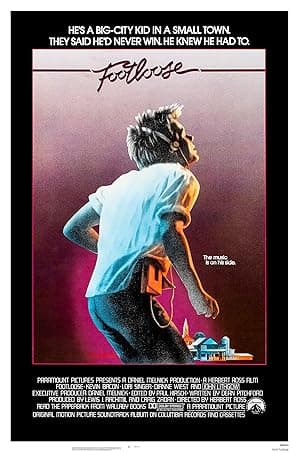
The setup
There’s a simple engine under Footloose’s shiny soundtrack: a city kid who refuses to accept a small town’s rules. Put Ren McCormack into Bomont and the rest of the movie is just the fun — and the argument — that follows. It’s cosy, loud, sometimes clumsy, but still oddly persuasive.
THE MOVIE
Ren McCormack is still the reason this movie works
Footloose starts with a premise you can explain in a single breath: a Chicago teenager named Ren McCormack arrives in Bomont and finds that dancing and rock music are outlawed. It’s ridiculous on the face of it, which is why it’s brilliant as a story motor — the set-up hands the film a built-in clash.
Ren’s outsider energy doesn’t just create friction; it writes the agenda. His arrival pushes him into direct conflict with the town’s authorities, chiefly the local minister, and that clash is where Footloose spends most of its emotional currency.
That central fight — personal freedom against communal moral regulation — is served up as a romance, a coming-of-age story and a dance movie all at once. Herbert Ross directs the whole thing (it opened in 1984), and Kevin Bacon’s Ren sits at the very centre of why the picture still gets talked about.
THE SETUP
The idea that sets Footloose in motion
The film keeps its premise tidy. Ren arrives, learns about the civic ban on dancing and rock, and refuses to let it stand. That refusal is less about municipal law than about who gets to belong and how young people mark themselves as a group.
Rather than spinning out a dozen subplots, Footloose uses a handful of social scenes — school corridors, church gatherings, town meetings — to escalate the problem. These are the places where private frustration becomes public argument.
The mechanics are straightforward and economical: Ren’s outsider status, a romance with the minister’s daughter Ariel, a physical run-in with her boyfriend and a campaign to overturn the ban. Everything funnels toward a single communal test — a planned public dance that forces the town to pick a side.
It’s tidy storytelling with clear stakes. That simplicity helps the movie move briskly and makes its moments — the small victories, the rows, the dancing — land with real weight.
THE CHARACTER
Why Ren McCormack matters
Ren isn’t mysterious. He’s a clear, combustible shape: a kid who wants freedom, a place to belong and a chance to keep the culture he comes from. That handful of desires makes him easy to root for and also useful as a narrative wedge into Bomont’s closed world.
Because he’s an outsider, Ren gets to ask the very questions the town hasn’t been willing to answer — why is dancing dangerous? Who decides what counts as respectable behaviour? That inquisitiveness is the film’s tool for exposing the community’s fears.
The story doesn’t treat him as a lone crusader. Willard, Ren’s friend, and Ren’s mother Ethel are small but meaningful touchstones: they show how the adult world can shelter, frustrate or actually help the teenagers at the story’s centre.
Put simply: Ren matters because the film is built around the choices he forces on the people of Bomont. Without him, Footloose would be an exercise in small-town caution; with him, it becomes a story about change you can dance to.
THE PERFORMANCE
Why Kevin Bacon's performance matters
Contemporary and later notices singled out Kevin Bacon’s presence in the role. The film treats Ren as a physical character — someone whose body and movement do a lot of the argumentative work — and reviewers picked up on that.
That bodily quality matters here because Footloose is part dance movie, part soapbox: when Ren moves, he’s making a point. The dance sequences act like punctuation to his arguments, and they helped make the part feel like a breakout for Bacon.
So the performance’s relevance isn’t purely emotional; it’s practical. Ren needs to convince a town, and in this film convincing is often kinetic.
UNDER THE SURFACE
Footloose has more on its mind than the plot suggests
On the surface Footloose is a teen romance and a dance movie. Below that surface, it’s chiefly interested in generational conflict: adults prescribing behaviour, and young people refusing to be packaged by those prescriptions.
Dance and music operate here as shorthand for youth identity. When the teenagers lose their freedom to move, they lose a way of being together — and the film treats that as a serious loss worth arguing over.
Religion and youth culture are placed in direct, sometimes awkward conversation. The minister’s role in policing morality forces the town to negotiate between communal values and individual expression, and that negotiation is where the film often finds its fiercest scenes.
Finally, at its heart, Footloose is a coming-of-age story. The protest against the ban is as much about growing up and claiming an identity as it is about winning the argument.
PURE 80S
Footloose could not belong to any other decade
The film’s existence is tied to a very particular moment. Dean Pitchford developed the idea from late‑1970s reporting about actual local bans on dancing, so the story grew out of a real, oddly specific cultural debate.
More importantly, Footloose was made at the start of the MTV era when films and pop singles were being sold as a package. The soundtrack strategy — releasing singles ahead of the movie — turned the songs into part of the marketing and gave the film a radio-friendly launchpad.
That approach helped cement a template that defined a lot of 1980s youth cinema: music-driven, chart-conscious pictures built around contemporary pop. Footloose reached that moment exactly — it’s a film that used pop reach as fuel.
Released in 1984 and shot in Utah towns standing in for Bomont, the movie fits into the decade’s appetite for youth stories that were at once lightweight entertainment and loud cultural argument.
WATCHING IT NOW
What has aged — and what hasn't
What still works is the basic teen story. As a piece of coming-of-age cinema, Footloose keeps its emotional centre on young people fighting for a thing that matters to them: identity, belonging and the right to be seen.
The religion versus youth culture strand also continues to read clearly. The movie stages that conflict in a way that’s still easy to follow — adults laying down rules, young people asking why — which keeps much of the film’s dramatic muscle intact.
Where it feels more of its time is in the way those themes are packaged. The film wears its 1980s commercial instincts on its sleeve, which will charm some viewers and feel dated to others.
But if you’re watching for the story of a few teenagers trying to be heard, Footloose still speaks plainly.
THE LEGACY
Why Footloose still matters
A big part of Footloose’s afterlife is musical. Its title song and 'Let’s Hear It for the Boy' earned Academy Award nominations for Best Original Song, and the soundtrack produced several Top 40 singles while topping the US Billboard 200 in 1984.
The commercial success of the music gave the film a life outside cinemas: the songs travelled on radio and MTV, and that cross-platform presence kept the picture in people’s ears long after its theatrical run.
The story’s adaptability is another marker. Footloose was turned into a Broadway musical in 1998 and ran until 2000, showing that the premise and the emotional beats could be reshaped for the stage.
Finally, the existence of a 2011 remake demonstrates that the basic idea — teenagers versus a ban, dance as expression — keeps inviting reinterpretation.
THE VERDICT
Does Footloose still hold up?
Yes — if you watch it for what it is. Footloose is a compact, music-driven coming-of-age drama built around a single, stubborn idea: a teenager from Chicago refuses to accept a town’s civic ban on dancing and rock music, and his refusal forces a community to re-examine itself.
Kevin Bacon’s Ren sits at the film’s heart; his outsider energy propels the plot, whether he’s arguing at town meetings, defending a romantic relationship with Ariel, or physically confronting the town’s enforcers. Willard and Ren’s mother Ethel fill out the social world so the conflict feels like a lived community quarrel rather than a series of staged beats.
The film’s mechanics are straightforward — school corridors, church meetings and a planned public dance are used to escalate the dispute — and that clarity is part of Footloose’s charm. The soundtrack’s success and the songs’ award recognition are not just trivia; they were integral to how the film reached audiences and remain part of why people remember it.
If you want a subtle, modern meditation, look elsewhere. If you want a brisk, occasionally clumsy but energetic story about teenagers fighting for a chance to be themselves — with music that helped the film leap out of cinemas — Footloose still delivers. Put another way: it’s less about whether every beat is flawless and more about whether the movie still makes you want to stand up and dance. Often, it does.
Share this movie
Keep watching
More movies from the 80s
1987
Dirty Dancing
Dirty Dancing: family and love, and why this 1987 movie still matters.
Read our take →
1988
Hairspray
Hairspray: family and parents protecting their children, and why this 1988 movie still matters.
Read our take →
1985
Girls Just Want to Have Fun
Girls Just Want to Have Fun: family and friendship, and why this 1985 movie still matters.
Read our take →