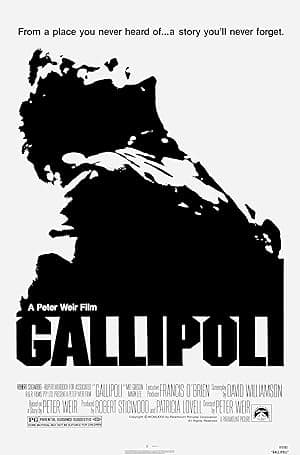
Gallipoli
A sprinting friendship that runs straight into history — and doesn't let you look away.
The setup
Gallipoli hooks you with a simple, stubborn idea: two West Australian sprinters chasing glory, and each other, into a war they barely understand. Peter Weir turns that athletic energy into a film about mateship, lost innocence and the way youthful optimism collides with the machinery of battle.
THE MOVIE
Archy Hamilton is still the reason this movie works
What you remember first from Gallipoli isn’t the uniforms or the shoreline. It’s Archy — the keen, athletic kid who believes a race can take him somewhere important.
The film follows Archy Hamilton and Frank Dunne, two West Australian sprinters who sign up in 1915 and are shipped off to the Gallipoli peninsula. Archy’s idealism and success on the track pull Frank into a friendship that steers both of them toward military service.
That instinct — ambition and loyalty turned into action — is the movie’s heartbeat. Under Peter Weir’s direction the film becomes less a textbook war story and more a coming-of-age about loss of innocence and mateship.
THE SETUP
The idea that sets Gallipoli in motion
At its simplest Gallipoli pairs two sprinters — Archy and Frank — and follows what happens when their athletic ambitions collide with the real world of war. They enlist in the Australian Imperial Force in 1915 and find the expectation of adventure very quickly tested.
Archy’s idealism and track record are the engine: his belief in something bigger draws Frank into friendship and then into service. That personal push — one young man convincing another that this is the thing to do — keeps the story clear and immediate.
Peter Weir started from his own story and David Williamson turned it into a screenplay. The result is a setup that reads like a straight line: running leads to camaraderie, camaraderie leads to enlistment, enlistment leads to confrontation with a brutal reality.
A recurring device that knits the film together is running. Those athletic sequences do more than look good: they set pace and tone, they establish character, and they keep the narrative moving toward the inevitable collision.
THE CHARACTER
Why Archy Hamilton matters
Archy is the sort of character who makes a film happen. Mark Lee plays him, and the script gives Archy a compact, readable psychology: idealism, athletic drive and a romantic view of what adventure can be.
He isn’t mysterious. That’s the point. Archy’s motivations — ambition, loyalty, a taste for the dramatic possibilities of life — are plain and direct. They’re also contagious: Frank’s involvement follows Archy, not the other way around.
Because the film sets Archy against a pragmatic foil in Frank, his optimism is constantly tested. That contrast — eager newcomer versus streetwise realist — structures most of the emotional movement you feel.
In short: Archy isn’t just a lead, he’s the lever. The movie depends on what he wants and how that want pushes everyone else.
THE PERFORMANCE
Why Mark Lee's performance matters
There’s a tidy piece of evidence here: Mark Lee was nominated for an AFI Best Actor award for playing Archy. That nomination tells you the industry recognised the part as significant and Lee’s turn as noteworthy.
Beyond the nomination, the film asks its actor to make a believable, uncomplicated sort of conviction — a young man who believes in something and carries others along. The role itself is built to be plainly felt rather than showy.
Because the character is so candidly written, the casting has to be right. The AFI nod is the clearest, simplest marker that the performance did what the film required.
So: the performance matters because the role matters. And the nomination suggests that mattered to audiences and peers at the time.
UNDER THE SURFACE
Gallipoli has more on its mind than the plot suggests
On the surface it’s a war film. Underneath it’s a stack of closely related ideas: losing your illusions, the particular strength of male friendship, and the awkward business of growing up while the world insists on sending you to fight.
Mateship is central. The film doesn’t make grand speeches about national character; instead it shows how loyalty between men can look noble even when it’s being led into disaster.
There’s also an argument about identity and the Anzac story. The movie sits in a place where national myth and personal tragedy meet — and it doesn’t let either idea dominate the other entirely.
Finally, an anti-war note runs through the film. The youthful longing for adventure is contrasted with the reality of poorly led frontline assaults, and that contrast is where much of the movie’s emotional power lives.
THE FILMMAKING
How Gallipoli was put together
A lot of Gallipoli’s identity comes from the choices behind the camera. Russell Boyd served as director of photography, and the cinematography received awards recognition — a reminder the film was built to look considered and strong.
Production design and period detail were handled by Wendy Weir and Herbert Pinter. Those decisions about sets and authenticity matter because they keep the movie grounded in a recognisable world rather than letting it drift into abstraction.
Peter Weir’s direction, working from his own story with a screenplay by David Williamson, kept the film focused on people rather than spectacle. The domestic and small-group moments are as important as the larger historical beats.
The industry agreed: Gallipoli picked up multiple Australian Film Institute awards, including Best Film and Best Direction, which underlines how the filmmaking choices resonated at the time.
PRACTICAL EFFECTS
The effects work that gives Gallipoli its physical personality
When Gallipoli needs to feel physical it does so with real, constructed space. A large purpose-built set recreating the Gallipoli peninsula was built near Port Lincoln in South Australia.
Most of the battle sequences were staged on location using those practical sets, period uniforms and large numbers of extras. This wasn’t a film that relied on miniatures or optical tricks; it was put in the dirt and shot there.
That decision matters because it keeps the action tactile. You see people in real space rather than figures placed into effects work.
Practically staged sequences make the film feel immediate — and that immediacy helps the story’s emotional stakes land.
PURE 80S
Gallipoli could not belong to any other decade
Gallipoli was released in 1981 and sits squarely inside the Australian New Wave — a period when the industry was looking back at national history and asking what it meant on screen.
It followed films such as Breaker Morant and joined a short run of high-profile historical Australian films that reshaped how the First World War was represented for contemporary audiences.
For Peter Weir and for Mel Gibson the film arrived at a decisive moment: it helped raise both their profiles internationally in the early 1980s.
That timing explains a lot about the film’s tone. It’s serious without being precious, ambitious without wearing its ambition as a showy badge — very much a product of its moment, in the best possible way.
THE LEGACY
Why Gallipoli still matters
Part of Gallipoli’s afterlife is straightforward: it won multiple Australian Film Institute awards, including Best Film, Best Direction and Best Screenplay. Those accolades anchored its reputation at home.
It also helped bring international attention to the Australian film industry and to Mel Gibson’s early career profile. That visibility opened doors for the talent involved and for the kinds of stories Australian cinema could tell.
On a more specific level, the film’s depiction of the Battle of the Nek — and its use of operatic and electronic music alongside the original score — are often mentioned when people discuss what makes its aesthetic distinctive.
Together, those elements explain why Gallipoli remains a reference point in discussions about Australian war cinema.
THE VERDICT
Does Gallipoli still hold up?
Yes. If you care about characters and small human decisions inside big historical moments, Gallipoli still delivers. The story of two West Australian sprinters — Archy and Frank — moving from the track to the front gives the film a clarity that most war dramas envy.
Archy’s idealism and athletic success are not plot ornaments: they’re the thing that convinces Frank to join him, and that push — friendship driven into service — is where the film gets its emotional momentum. The running sequences do the narrative work of carrying you along.
Peter Weir’s story, David Williamson’s screenplay, the practical staging on the Port Lincoln set and the recognised craft (including AFI awards and a Best Actor nomination for Mark Lee) combine into a film that balances intimacy with scale.
If you’re looking for spectacle for spectacle’s sake, this isn’t the film. If you want a tightly imagined examination of mateship, loss of innocence and the cost of youthful choices, Gallipoli from 1981 still matters — and it still hurts.
Share this movie
Keep watching
More movies from the 80s
1981
Das Boot
Authority, steel and a very small boat: why Der Alte still steers Das Boot.
Read our take →
1981
Escape to Victory
Escape to Victory: freedom, and why this 1981 movie still matters.
Read our take →
1981
Eye of the Needle
Revisiting Eye of the Needle and the reasons it still deserves to be watched.
Read our take →