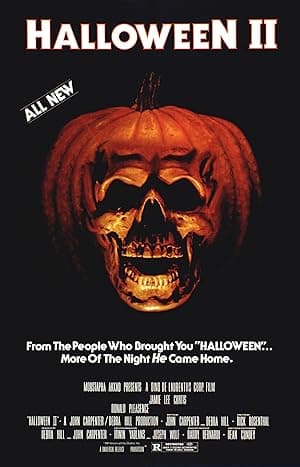
Halloween II
Laurie Strode, a hospital corridor and a revelation that rewrites everything — Halloween II doubles down and gets messy in the best 80s way.
The setup
Halloween II doesn’t ease you back into Haddonfield. It throws you straight from one front line — Laurie Strode’s ambulance ride — into another: a hospital where trauma is meant to be treated and evil keeps knocking. Rick Rosenthal’s first feature picks up the night the original left off and asks what happens when survival is only the beginning.
THE MOVIE
Laurie Strode is still the reason this movie works
There’s an immediate, bruised logic to Halloween II: it resumes the same night as the first film and keeps the pressure on. Laurie Strode is no longer a carefree teen wandering suburbia — she’s been attacked, bundled into medical care and left in a fragile, observed state while the town tries to process what just happened.
That sense of things not being over is the movie’s engine. Michael Myers slips back into Haddonfield and pursues Laurie anew, and Dr Sam Loomis picks up the chase where he left it. The film trades final-girl relief for continued pursuit; safety is only ever provisional.
Rick Rosenthal made his feature debut with this lean, 92-minute follow-up in 1981, and Jamie Lee Curtis and Donald Pleasence returned to their roles, keeping the same emotional through-line from the first film even as the story expands its terrain from streets to hospital corridors.
THE SETUP
The idea that sets Halloween II in motion
This sequel’s basic idea is deceptively simple: pick up the same night and ask what comes after surviving an attack. Instead of a new city or a long time-skip, Halloween II forces the characters and the audience to live with the immediate aftermath.
The hospital becomes the film’s new arena. Laurie is under clinical care and observation, which should imply containment — yet the violence follows, turning places of supposed safety into new danger zones.
The screenplay introduces a major new narrative element when hospital files reveal a sealed record linking Laurie to Michael. That revelation—Laurie identified as Michael Myers’s younger sister—retrofits the first film and reframes the pursuit as something more personal.
So the setup does two things at once: it prolongs a single night of terror while also changing how you read the villain’s motive, keeping tension taut without dramatically changing the story’s basic mechanics.
THE CHARACTER
Why Laurie Strode matters
Laurie Strode remains the emotional anchor. Jamie Lee Curtis returns to the part and the film keeps her in a position that feels recognisable: a survivor now under medical supervision, vulnerable and still very much the thing being hunted.
That vulnerability is crucial because it slows the movie down. Rather than cutting to a new set of victims, Halloween II forces us to stay with someone who’s been through it and watch the fallout — the sleeplessness, the questioning, the intrusion of violence into spaces meant for healing.
Then the script quietly alters the stakes. The sealed file that links Laurie to Michael turns a random target into family. Suddenly the confrontation isn’t only about stopping a killer; it’s about an intimate, retraced connection that reframes every previous moment between them.
Because the film literally continues Laurie’s night from the original, she doesn’t need to be reintroduced. That continuity lets the sequel build tension around how Laurie copes after the attack and what it means for her to be centre stage when the danger begins again.
UNDER THE SURFACE
Halloween II has more on its mind than the plot suggests
On the surface it’s a slasher: a pursuer, a pursued, quick shocks. Underneath, the film is repeatedly interested in fallout — what survival looks like when the world expects quick closure but closure never comes.
That preoccupation with survival and trauma shapes the movie’s rhythm. Laurie’s treatment and observation are as much a narrative device as a medical plot point: a way to keep her exposed while the hunt continues.
There’s also an extension-of-evil angle here. Michael Myers is not a one-night phenomenon; the sequel treats him as a force that reaches into institutions. Moving much of the action into a hospital makes that idea literal — evil intrudes where you believe you’re safe.
And then there’s the identity twist. By retroactively naming Laurie as Michael’s sister, the movie turns anonymity into lineage. That retcon reframes motive, and it adds a familial dread to the otherwise clinical pursuit.
THE FILMMAKING
How Halloween II was put together
On a production level, Halloween II shows the shape of a film built to follow-on rather than reinvent. Michael Riva is credited with the production design, which helps the movie feel like an extension of the first film’s world rather than a separate exercise.
Editors Mark Goldblatt and Skip Schoolnik provided the film with its pacing decisions: a tight 92-minute runtime that favours forward motion and compact set-pieces over indulgence.
Rick Rosenthal was making his debut as a feature director, stepping into a franchise already shaped by John Carpenter and Debra Hill. That background explains why this sequel feels like the original’s natural next breath rather than a radical reimagining.
Put together, those choices give Halloween II a pragmatic identity: it’s constructed to keep audiences moving through a night that refuses to end, and to do so with a production crew capable of keeping the tension functional and immediate.
PRACTICAL EFFECTS
The effects work that gives Halloween II its physical personality
The film’s physical make-up is rooted in practical craft. Masks for the production were supplied by Don Post, a name associated with the tactile, handmade look of many horror prosthetics of the era.
Visual and special-effects supervision is credited to Larry Cavanaugh and Frank Munoz, names that point to the hands-on team responsible for turning scripted shocks into on-screen moments.
Makeup responsibilities included artists such as Michael Germain, whose presence in the credits is a reminder that much of the movie’s impact depends on on-set prosthetics and make-up work rather than post-production trickery.
These practical teams give the film a specific, physical personality: when the movie wants to unsettle, it does so with objects you can imagine holding, altering the body in ways that felt uncompromising for early-80s horror.
PURE 80S
Halloween II could not belong to any other decade
Released in 1981, Halloween II arrived when slasher films were growing louder and more explicit. The sequel’s increased on-screen gore fits that early-80s shift toward more graphic depictions compared with the 1978 original.
It wasn’t a shoestring follow-up. The production was made with a larger, unionised budget — part of a period where studios were willing to bankroll horror sequels that promised a built-in audience.
That combination — a franchise pedigree plus a modestly beefed-up budget — produced a film that could keep the original’s mood while leaning into the decade’s appetite for intensity.
So the movie feels like an early-80s commercial horror product: closer to the mainstream in its economics, and bolder in how it shows violence, even while it remains narratively tied to the quieter menace of its predecessor.
WATCHING IT NOW
What has aged — and what hasn't
The most consequential thing that has aged is the film’s identity retcon. The sealed file that names Laurie as Michael’s sister is still the pivot point people either love or dislike; it gives later entries a clear dramatic thread to tug on, but it also forces viewers to reassess the randomness of the original.
For modern audiences who prefer their villains inscrutable, that retcon can feel like it narrows the mystery. For others, it adds a grim, almost mythic intimacy to the chase — making the violence feel like legacy as much as impulse.
On a practical level, the hospital setting still reads as a smart choice. The decision to film interiors at Morningside Hospital and Pasadena Community Hospital anchors the sequel in recognisable institutional spaces, which helps the film retain a sense of grounded, made-possible-by-places realism.
So what ages well is less about effects and more about narrative choice: the retcon remains provocative, and the confined, domestic-institutional locations still make the pursuit feel alarmingly plausible.
THE LEGACY
Why Halloween II still matters
Halloween II set a template for this franchise: immediate sequels that keep the timeline tight and the night continuous. That approach shaped how future entries approached continuity and immediate continuation.
Most consequentially, the sister twist supplied a narrative lever that later films would use, rework and sometimes undo. It’s a storytelling choice that put family at the centre of the mythology and changed how subsequent instalments handled motive and legacy.
The film also marks a transitional moment for those involved: it was Rick Rosenthal’s feature directing debut while John Carpenter remained a guiding presence as writer/producer/composer, which kept the sequel tied to the original’s creative DNA.
Finally, the hospital expansion — moving the hunt into institutional spaces — is part of the film’s afterlife. That choice has been repeatedly referenced or reinvented across the franchise, becoming one of the sequel’s recognisable contributions.
THE VERDICT
Does Halloween II still hold up?
Yes — with caveats. If what you want is a tidy escalation of the first film’s premise, Halloween II delivers: it picks up the same night, straps you back into the chase and moves the action into a setting that keeps tension tight and specific.
Its central structuring device — pursuit and containment — still works. Michael escapes and the film stakes much of its suspense on him breaching supposed safe spaces while Laurie, wounded and observed, remains exposed. That dynamic is simple, effective, and handcrafted to keep the audience nervy.
The retcon that Laurie is Michael’s sister will determine whether this sequel clicks for you. It gives the sequel emotional specificity and a grim intimacy, but it also changes how you read the randomness of the original. That’s a storytelling choice rather than an objective flaw, and your mileage will vary.
Taken together, Halloween II is worth watching today if you’re interested in a sequel that doubles down on pursuit, follows trauma into institutional spaces, and isn’t afraid to tinker with the original’s premise. It’s less a reinvention and more a tightened, sometimes messier continuation — and that mess is precisely where its personality lives.
Share this movie
Keep watching
More movies from the 80s
1981
Friday the 13th Part 2
Friday the 13th Part 2: mortality and loss, and why this 1981 movie still matters.
Read our take →
1981
Happy Birthday to Me
Happy Birthday to Me: family and the safety of home, and why this 1981 movie still matters.
Read our take →
1981
My Bloody Valentine
My Bloody Valentine: courage and parents protecting their children, and why this 1981 movie still matters.
Read our take →