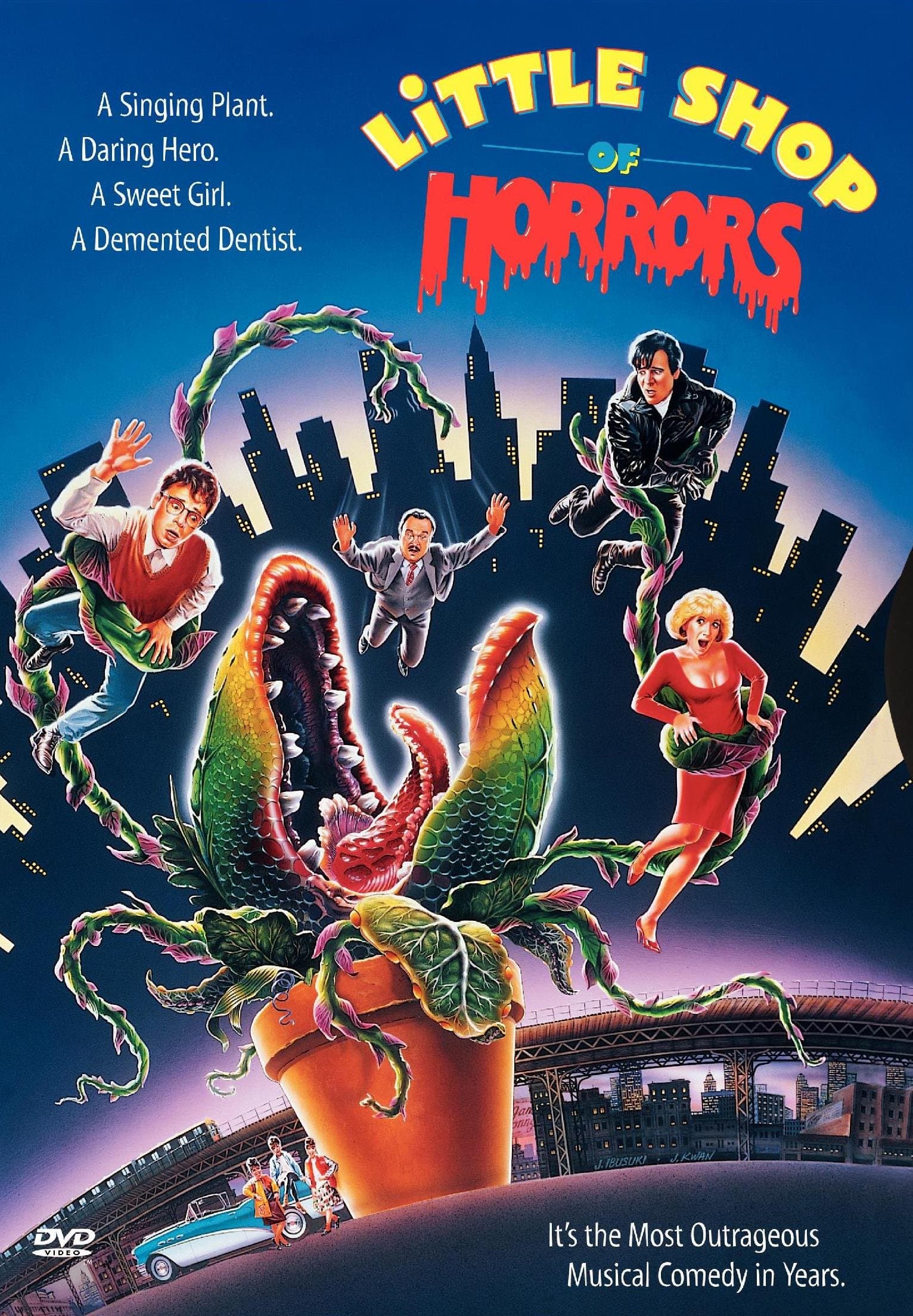
The setup
Little Shop of Horrors works because it gives Seymour Krelborn a very simple choice and then refuses to let him off the hook. Frank Oz's 1986 screen adaptation pairs a shaggy, comic rags‑to‑temptation story with audacious puppetry and a handful of musical numbers that keep stepping on the rake.
THE MOVIE
Seymour Krelborn is still the reason this movie works
This is a movie that hinges on a single awkward man making one increasingly awful choice. Seymour Krelborn — the meek florist at a failing Skid Row shop — finds an odd potted plant he names Audrey II and overnight the shop is full of customers.
The plant’s appetite changes everything. When Seymour discovers Audrey II revives and grows after ingesting human blood, feeding the plant becomes the engine of the plot and the moral pressure that defines the film. It’s not only a comic conceit; it’s a simple, nasty bargain that forces Seymour to choose between the life he wants and the cost of getting it.
Frank Oz directs this 94‑minute mashup of musical, comedy, horror and sci‑fi with an eye for theatrical detail: the story is compact, the stakes are readable, and the cast — from Rick Moranis as Seymour to Ellen Greene as Audrey and Levi Stubbs as the plant’s singing voice — supplies the odd little personality punches that keep the machine humming.
THE SETUP
The idea that sets Little Shop of Horrors in motion
The film’s inciting incident is deliciously small: Seymour pricks his finger and notices the plant’s appetite for blood. That tiny accident is the plot’s hinge — intimate, messy and entirely believable in the logic of a musical about bargains.
Once the plant demonstrates it will revive and grow after being fed human blood, Seymour’s successive decisions to feed it escalate the story. Each choice is a push deeper into moral compromise; the film keeps the pressure straightforward so the consequences feel inevitable rather than arbitrary.
That escalation includes a concrete turning point: Orin Scrivello, the sadistic dentist, dies in Seymour’s presence and Seymour conceals and disposes of the body so the plant can be fed. The sequence reframes the film from oddball musical to a tale where survival, secrecy and guilt collide.
Finally, Audrey II’s later revelation — that it is an extraterrestrial organism seeking dominance — recasts the plant. It’s no longer merely a hungry curiosity; it becomes the external voice of a hunger that drives the central conflict.
THE CHARACTER
Why Seymour Krelborn matters
Seymour is not a superhero. He’s an insecure, aspirational young man working in a failing florist’s on Skid Row who stumbles into a chance at something better. That setup makes him easy to root for — he wants a life that isn’t defined by obscurity — and the plant hands him that possibility on a plate.
What makes Seymour memorable is the way his wish for better things is constantly compromised by the method he chooses. The film’s central mechanic — feeding Audrey II human blood — isn’t abstract; it is a daily moral choice that Seymour has to make, and that pressure keeps his character honest and interesting.
Rick Moranis is credited as Seymour Krelborn, which is all the casting fact we need here: Seymour’s arc is written to be small, awkward and painfully ordinary, and that ordinariness is the point. The story doesn’t demand a grand transformation so much as choices that reveal who he already is.
Crucially, the film’s musical and scoring elements sit around Seymour’s dilemmas. The songs and score keep pushing the plot forward, turning a macabre idea into a stagey, rhythmic argument about ambition and what you’ll do to achieve it.
THE PERFORMANCE
Why Ellen Greene's performance matters
This section’s facts point to the musical interplay that makes the film sing: Levi Stubbs is credited as the singing voice of Audrey II, and the film’s new song 'Mean Green Mother From Outer Space' earned an Academy Award nomination.
That nomination highlights how central the vocal performances are to the movie’s tone — the plant’s singing voice is not background detail but a loud, theatrical presence that shares the stage with Audrey as a character.
Seen that way, what Ellen Greene brings to Audrey is a role that must live alongside a monstrous vocal presence. The film stages Audrey as the human partner in that duet of temptation and survival; the plant’s singing voice and the new song’s prominence underline how important those vocal moments are to the drama.
So while the facts here focus on Levi Stubbs and the song recognition, they point back to a performance ecology: Audrey is a human counterweight inside a musical that relies on strong, character-driven vocal moments to sell its darker jokes and its emotional beats.
UNDER THE SURFACE
Little Shop of Horrors has more on its mind than the plot suggests
On the surface it’s a madcap musical about a hungry plant. Underneath, the film is plainly interested in ambition vs. morality: Seymour’s choices are the moral test at the movie’s heart.
Greed and commerce show up everywhere — a sudden boom in customers, the shop’s rise in fortune, and how business success can blunt ethical instincts. The plant is literally profitable and morally corrosive at the same time.
Abuse and survival are threaded through the human relationships: characters make compromises to get by, and the story positions those compromises against a world that is not especially kind to its underdogs.
Finally, theatricality and show‑business hunger — and the idea of monstrosity as satire — keep the film from being merely grim. The movie stages its moral problems as a performance; the carnivorous plant is both joke and indictment, and the satire makes the point in bright, loud musical numbers rather than a whispered sermon.
THE FILMMAKING
How Little Shop of Horrors was put together
One of the film’s most reliable signatures is its production design: the production built a large, fully dressed 'Skid Row' set on Pinewood’s stages. That decision gives the movie a controlled, theatrical world to play in — stylised rather than documentary — which suits a musical that frequently tilts toward broad comedy.
Shooting on Pinewood stages in England allowed the filmmakers to treat the street as a contained stage set, where props, entrances and exits could be timed like beats in a stage show. The controlled environment helps the film sell its mixture of comedy and horror in tidy, stage‑like moments.
Frank Oz’s direction leans into that theatricality: by keeping the world deliberately constructed, the movie lets its characters and the plant act like performers on a soundstage rather than citizens in a lived-in city. That choice keeps the tone consistent — part doo‑wop musical, part campy monster farce.
These production choices are practical and tonal at once: the set’s scale and dressing provide a visual shorthand that the film trades on, making its moral and musical flourishes feel deliberately heightened.
PRACTICAL EFFECTS
The effects work that gives Little Shop of Horrors its physical personality
Audrey II isn’t one prop but a suite of animatronic stages showing progressive growth. Designer Lyle Conway created seven principal animatronic stages to sell the plant’s changing scale and personality.
Those larger plant models were complex beasts: the biggest required hydraulic pumps, synchronized cable work and sometimes up to fifty technicians on set to operate during complicated sequences. This is a very physical kind of filmmaking — lots of hands making something seem alive.
The materials and construction were painstaking: production notes document latex, plastic, thousands of handmade leaves and extensive cabling. The plant is the product of craft and repetition, not a single trick.
Even the musical moments required technical choreography: lip‑syncing the plant to pre‑recorded songs meant coordinated puppetry rehearsals and multiple puppeteers per model to achieve the precise mouth movements the film demanded.
PURE 80S
Little Shop of Horrors could not belong to any other decade
This is very much a mid‑1980s product. Released in 1986 and shot at Pinewood in late 1985, the movie sits at a moment when large‑scale practical creature effects were industry standard — the kind of project that demanded real animatronics rather than digital wizardry.
The screenplay and songs also map onto the careers of Howard Ashman and Alan Menken, who were rising figures in musical writing during the decade. Their theatrical instincts — sharp, character-driven number writing — give the film a specific 80s musical sensibility.
Casting choices also tell an 80s story: the film pairs a small lead with high‑profile comedic cameo appearances, a trend of the era where star cameos helped give mainstream visibility to offbeat projects.
Finally, the film’s adaptation history — moving from Roger Corman’s 1960 film to a 1982 Off‑Broadway musical and then to this 1986 screen version — feels characteristic of the decade’s appetite for reworking and amplifying familiar genres for new audiences.
WATCHING IT NOW
What has aged — and what hasn't
One important thing that colours modern viewings is the film’s alternate, darker ending. For years that original downbeat conclusion was only available in incomplete or black‑and‑white footage, but a fully restored Director’s Cut including the original ending was released on home video in 2012.
That restored version reopened conversations about the film’s tone and what spice of darkness its creators originally intended. Having both versions now invites modern viewers to consider how a small change in ending can shift a movie from black comedy to outright tragedy.
Beyond endings, the movie’s moral compact — Seymour’s escalating decisions around feeding Audrey II — remains a clear, readable engine. The core dilemma is simple and still sharp: at what point does getting ahead stop being worth the cost?
So while viewing habits have changed since 1986, the story’s central bargain and the way it stages greed, survival and theatrical hunger still land as watchable, discussable material for contemporary audiences.
THE LEGACY
Why Little Shop of Horrors still matters
The film earned formal recognition: it received two Academy Award nominations — one for Best Original Song ('Mean Green Mother From Outer Space') and one for Visual Effects. Those nominations point to where the movie’s strengths were most visible: songcraft and creature work.
Alan Menken and Howard Ashman wrote the new song for the film, and that addition won attention of its own — the Oscar nomination speaks to how the musical elements were treated seriously even within a campy horror comedy.
The puppetry and practical effects team also gained industry recognition, with the Visual Effects nomination acknowledging Lyle Conway and his collaborators for creating a believable, characterful plant across multiple animatronic stages.
Finally, Warner Home Video’s release of a restored Director’s Cut in 2012, including the original darker ending, prompted renewed discussion and festival screenings, ensuring the movie’s afterlife remained a subject for fans and critics alike.
THE VERDICT
Does Little Shop of Horrors still hold up?
Yes — on its own terms. The premise is compact and morally crisp: Seymour finds a strange plant, the shop booms, and when he discovers Audrey II grows after ingesting human blood, he faces a series of escalating choices that turn ambition into an ethical test. That clarity keeps the film brisk and watchable across repeated viewings.
The mixture of genres — musical, comedy, horror and sci‑fi — and the tight running time mean the film rarely overstays its welcome. The questions it asks are plain: pursue fame and success supplied by the plant, or stop feeding it and accept the consequences? Those are still interesting questions, and the movie stages them with gusto.
Practical work also matters: the plant functions as both literal antagonist and narrative catalyst, externalising Seymour’s ambition and guilt, and the visual/puppetry effort that created Audrey II was substantial enough to be acknowledged by the Academy. The result is a film where craft serves a clear idea.
If you enjoy a stagey, morally pointed musical with a nasty sense of humour, Little Shop of Horrors is still worth a watch — not because it’s spotless, but because it knows the deal it’s making with you and plays that bargain out until it’s deliciously, sometimes uncomfortably, complete.
Share this movie
Keep watching
More movies from the 80s
1986
Critters
Critters: freedom and family, and why this 1986 movie still matters.
Read our take →
1986
Maximum Overdrive
Maximum Overdrive: humanity and freedom, and why this 1986 movie still matters.
Read our take →
1986
Night of the Creeps
Night of the Creeps: the safety of home and mortality, and why this 1986 movie still matters.
Read our take →