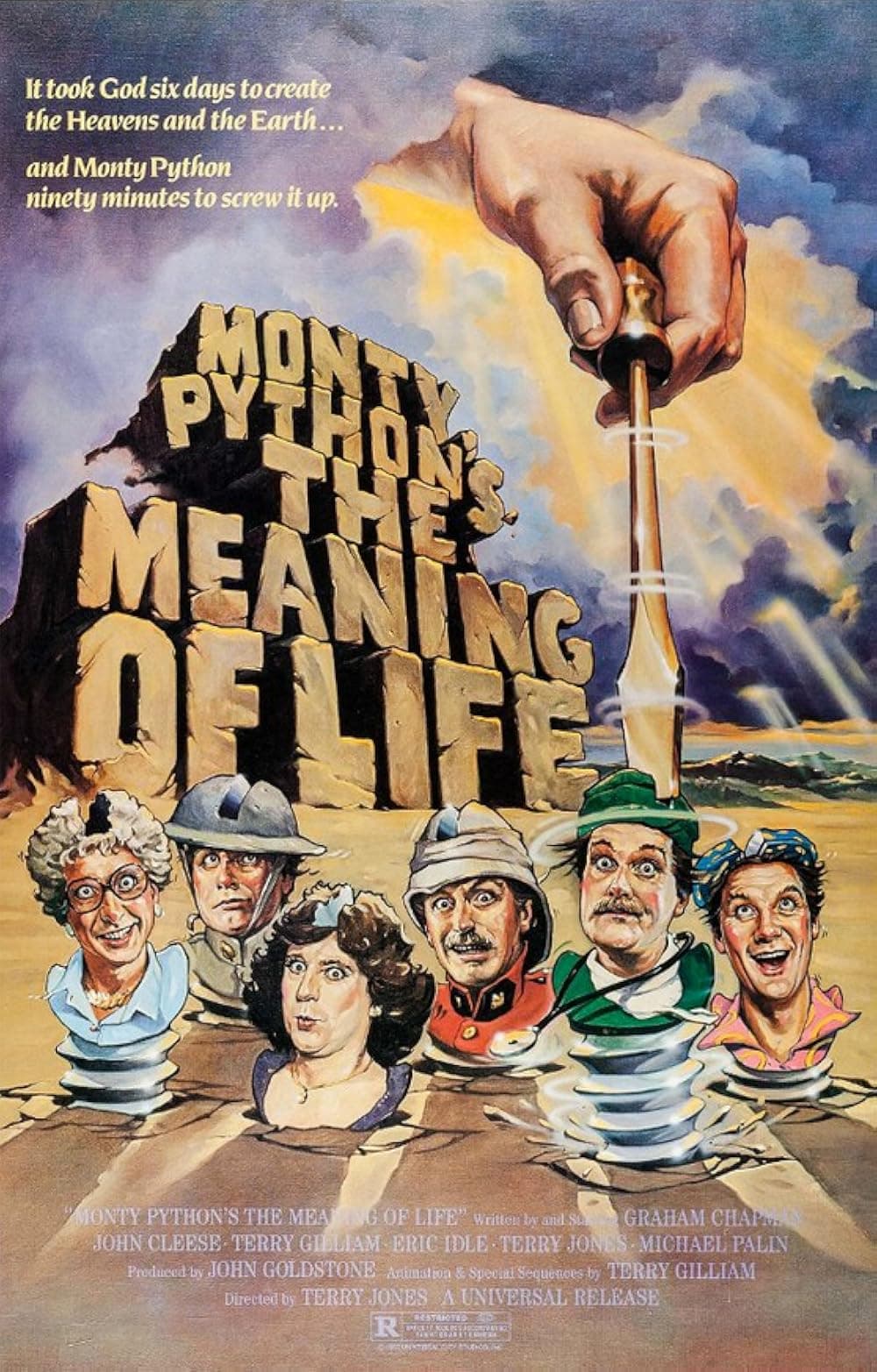
Monty Python's The Meaning of Life
A very British banquet of bodily comedy, institutional savaging and one famously explosive dinner.
The setup
Monty Python's The Meaning of Life is the sort of film that arrives like a series of slyly fatal courses — each sketch a little moral hors d'oeuvre, a main course of institutional satire and, inevitably, an eye‑watering dessert. Directed by Terry Jones and released in 1983, it doesn’t try to tell one story so much as stage an entire human life in sketch form, from birth to death, with Mr. Creosote waiting at the table. If you remember one sequence, it will probably be the one you can’t unsee; if you don’t, the rest of the meal will still leave you full of opinions.
THE MOVIE
Mr. Creosote (the gluttonous diner) and multiple other roles is still the reason this movie works
If you ask people why Monty Python's The Meaning of Life keeps being mentioned at parties, they will usually start with a single image: a man, absurdly enormous, in a restaurant and the room paying very close attention. That is Mr. Creosote — Terry Jones’s grotesque embodiment of excess — and he tells you everything you need to know about what the film wants to do.
This isn’t a straight narrative. The movie is a string of sketches loosely threaded around the stages of human life — birth, sex, illness, gluttony, death — and each one aims at a different social target. The troupe repeatedly returns to the same kinds of institutions: hospitals, churches, the army, corporate offices. It’s less concerned with a hero and more interested in picking open the machinery around people.
Jones opens the feature with something else cheeky: Terry Gilliam’s short 'The Crimson Permanent Assurance', a piratical office‑takeover prologue that punctures corporate seriousness before the main sketches get under way. Between that and the film’s musical numbers, you have a picture of a Python feature made in full confidence — a British comedy from 1983 that wants to be big, noisy and precisely rude.
THE CHARACTER
Why Mr. Creosote (the gluttonous diner) and multiple other roles matters
Mr. Creosote exists at the blunt end of a joke about appetite. He is exaggerated until grotesque so the sketch can do something sharp: convert consumption into spectacle. That grotesquerie is not merely for shock; it’s the film’s shorthand for modern overindulgence.
Because the movie is sketch‑based, a character like Creosote is allowed to be a caricature without needing to be plausible. He is an extreme that makes the surrounding restaurant, its staff and its etiquette look ridiculous by comparison. The contrast is the comedy’s point.
Terry Jones plays Creosote and several other parts across the film. The decision to have troupe members recycle into different roles — authorities, parents, performers — keeps the satire focused on institutions rather than on any single person’s arc.
Contemporary coverage singled out Creosote as one of the film’s most discussed figures, in part because the sequence is so physically specific and in part because it crystallises the film’s interest in bodily limits and spectacle.
THE PERFORMANCE
Why Terry Jones's performance matters
There’s a technical reason the Creosote sketch sticks in the mind: it is built around physical detail. Contemporary and later writing repeatedly points to Jones’s physical turn as the sequence that people talk about first when they think of the film.
That attention has as much to do with the workmanship of the piece as with shock value. The role required heavy prosthetics and a choreography of grossness that the scene depends on to land; viewers notice the performance because the scene itself is so meticulously staged.
Jones doesn’t only perform Creosote; he cycles through multiple parts in the film. Having the same faces pop up as different authorities — doctors, clergy, officers — keeps the laughs aimed at institutions, not individuals.
So when people single out Jones and the Creosote scene, they’re responding to a physically precise, theatrically committed piece of comedy that happens to be difficult to look away from.
UNDER THE SURFACE
Monty Python's The Meaning of Life has more on its mind than the plot suggests
Beneath the jokes there are a few steady obsessions: the way institutions—medical, religious, military, commercial—manage, mismanage or simply bungle human life. Those targets are consistent because the film isn’t telling a single life story; it’s indicting the systems that shape lives.
The human body itself is another repeated target: birth, sex, sickness, overeating and death recur as material. By repeatedly returning to bodily limits, the Pythons force the audience to laugh and squirm at the same time — comedy and discomfort braided together.
Absurdism threads through all of this. When mortality or meaning is on the menu, Python prefers to answer with a song, a surreal gag or a mock‑sermon rather than a solemn line. The result is an approach to big questions that refuses to be earnest and instead treats meaning as something to be mocked into sharper relief.
And then there’s the short Griffin of corporate satire that opens the film: a miniature epic about a small firm turning into a pirate ship. It’s a brisk, furious reminder that consumerism and corporate power are part of the same catalogue the film wants to ridicule.
THE FILMMAKING
How Monty Python's The Meaning of Life was put together
The Meaning of Life sits in an interesting production space: it’s a sketch film that nevertheless carries larger production ambitions than a TV show. That ambition is visible in the credits — the feature lists different cinematographers for Gilliam’s prologue and for the main feature, a sign of the film’s willingness to change gears.
Roger Pratt handled the visuals for the piratical 'Crimson Permanent Assurance' short, while Peter Hannan was credited as director of photography on the main feature. The split underlines how the Pythons treated the prologue as its own miniature film within the feature.
That choice helps explain the sharper, miniature‑epic energy of the opening short and the broader, theatrical feel of the sketches that follow. The team assembled work that could move between small‑scale model work and full studio interiors without feeling like random pieces.
Put simply: the filmmaking is organised so the film can be many things — a miniature swashbuckler, a musical number, a hospital satire — and still feel like one evening with Monty Python.
PRACTICAL EFFECTS
The effects work that gives Monty Python's The Meaning of Life its physical personality
The film’s physical gags are not digital illusions; they’re materially built. The Creosote episode, for example, depends on heavy prosthetics and make‑up work and a large collection of staged props to produce its repeated projectile‑vomiting visuals.
Those practical elements make the sequence feel tactile in a way no CGI trick could replicate at the time. The vomit props and layered make‑up were deliberate choices designed to make an audience feel the gag in the body, not just in the brain.
Gilliam’s 'Crimson Permanent Assurance' also relied on physical methods — miniature models and miniature special‑effects techniques give the short its toy‑ship flamboyance. Those miniature approaches are a clear part of that segment’s identity.
Between prosthetics, staged props and model work, the film leans on hands‑on craft to sell jokes that are often grotesque or surreal. The work is unmistakably theatrical in the old‑fashioned sense — people making physical things so a gag can land hard.
PURE 80S
Monty Python's The Meaning of Life could not belong to any other decade
Made and released in the early 1980s, the film marks a return to a sketch format for the troupe after their previous features had followed a single‑story approach. That decision feels fitting for the group at this point: they knew their strengths were sketchwise and leaned into them.
The film also carries larger production values and full musical set‑pieces in a way that speaks to early‑80s expectations for British comedies aiming at international audiences. There’s a sense the Pythons wanted to play on a slightly grander stage this time.
Practical details underline that timing: principal photography ran in mid‑1982 with release in 1983, and the film opened in the United States in March before reaching British cinemas in June. The scheduling felt like a bid to be taken seriously outside the UK while not abandoning the troupe’s core voice.
It also arrived at a festival moment: the film was screened in competition at Cannes the same year, an international stamp that sat oddly and enjoyably against Python’s deliberate pettiness.
THE LEGACY
Why Monty Python's The Meaning of Life still matters
Some of the film’s afterlife is institutional. It won attention on the festival circuit — the feature was screened in competition at Cannes and received the Grand Jury Prize in 1983 — which is an odd but telling compliment to a film that wants to mock solemn institutions.
The songs and set‑pieces had their own recognitions: 'Every Sperm Is Sacred' received a BAFTA nomination for Original Song, which speaks to how the Pythons could be sharp satirists and showmen at the same time.
The film is also regularly treated as the troupe’s final collective feature project and keeps being included in retrospectives and special releases because it collects so many of their classic moves in one place: musical numbers, grotesque physical sketches and institutional lampooning.
Finally, the characters people remember — Creosote, the maître d', the Grim Reaper, the mounted choralists — are shorthand for the film’s purposes. They’re the little flags that say, 'This is a film about bodies, systems and the horrible things people do inside them.'
THE VERDICT
Does Monty Python's The Meaning of Life still hold up?
Yes — provided you accept what it is. The film is not a novel; it’s a buffet. It stages life as a chain of sketches rather than a single arc, and it deliberately prizes ideas and institutional send‑ups over tidy emotional payoff.
If you come for the theatrical bits and the satirical swipes — hospitals treated as bureaucracies, religion mocked with musical gusto, the army reduced to ritualistic nonsense — you’ll find the film richly supplied. Recurring devices, like the restaurant’s fish tank commentary and a hostess who breaks the fourth wall, give the film a faint connective tissue that keeps it from feeling merely random.
There are sketches people will always talk about: 'The Miracle of Birth', the Catholic family musical, the organ‑transplant material and, of course, the Creosote sequence culminating in violent over‑eating. Those pieces show the range of the troupe’s techniques — from song to shock to surreal tableau.
In short: if you want Monty Python at full tilt — physical comedy, institutional satire and an appetite for the grotesque — this remains the place to go. It’s not a film that comforts you about meaning. It offers instead a sharp, filthy, musical shrug.
Share this movie
Keep watching
More movies from the 80s
1982
Annie
Annie: family and freedom, and why this 1982 movie still matters.
Read our take →
1984
Breakin'
Breakin': friendship, and why this 1984 movie still matters.
Read our take →
1982
The Best Little Whorehouse in Texas
The Best Little Whorehouse in Texas: love and our relationship with technology, and why this 1982 movie still matters.
Read our take →