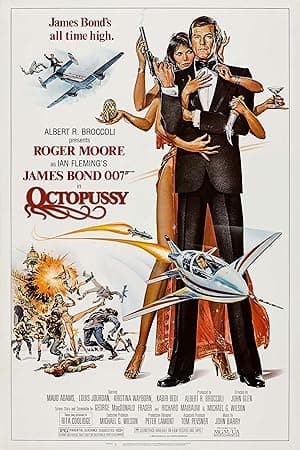
Octopussy
A Fabergé egg, a travelling circus and the Cold War — Bond still does spectacle like a Trojan horse.
The setup
Octopussy arrives with all the usual Bond trimmings — globetrotting set pieces, a murder that needs investigating and a circus that isn’t what it seems. Directed by John Glen and released in 1983, it’s a film that dresses up Cold War paranoia in sequinned disguise and expects you to enjoy both the show and the sting.
THE MOVIE
James Bond is still the reason this movie works
Remember the image: a dead agent in a clown suit, a fake Fabergé egg and a London auction that opens a very odd door. That sequence — the oddness of the clue — is the little nudge that sends Bond into a world where nothing is what it looks like.
Octopussy pairs that mystery with spectacle. Bond’s investigation, driven by the murder of 009, leads him from an auction room into the orbit of a travelling circus run by a woman called Octopussy, and from there into a plot that wants to manufacture an East–West crisis.
It’s a James Bond film through and through: Roger Moore’s Bond is the investigator at the centre of the chase, John Glen is directing, and the movie wears its thriller, action and spy credentials proudly as it runs through 131 minutes of set pieces and surprises.
THE SETUP
The idea that sets Octopussy in motion
The simplest way to describe Octopussy’s engine is this: a murder, a shuffled clue and a circus that doubles as a smuggling ring. Bond follows a trail from a London auction into the travelling show and the criminal network behind it.
That network isn’t mere petty theft. The villains — an exiled prince named Kamal Khan and a renegade Soviet general — are plotting to smuggle a sea‑launched nuclear warhead into the West. The aim is ugly and political: provoke a crisis, derail détente and plunge the world back into confrontation.
All the classic Bond mechanics are in play: a Fabergé‑egg clue adapted from Fleming, an auction sequence that starts the chase, a circus infiltration and a train/warhead device that raises the stakes from smuggling to sabotage.
The screenplay stitches Fleming material to new plot invention, so Octopussy feels like the familiar Bond world but with a different set of masks and motives.
THE CHARACTER
Why James Bond matters
Roger Moore plays Bond here, and the film presents him as MI6’s investigator who’s pulled into action by 009’s murder and the larger sabotage plot. Bond is the through‑line: follow him and you follow the story.
He doesn’t work alone on paper. The familiar MI6 team — Q, M and Miss Moneypenny — turn up in their recurring roles, providing gadgets, authority and briefings that keep the machinery of the story moving.
Because Octopussy sits in the middle of the Eon series — it’s the thirteenth official Bond picture and Moore’s sixth outing — the character arrives with expectations. The plot leverages that: Bond is the professional sent to unmask concealment and stop a manufactured international crisis.
That placement in the cycle matters. The film treats Bond as the pivot between spectacle and consequence: he’s there to enjoy the show, but also to stop it becoming a catastrophe.
THE PERFORMANCE
Why Steven Berkoff's performance matters
General Orlov is the Soviet wild card in the scheme to ignite an international incident. Contemporary critics singled out the portrayal.
One review described Berkoff’s Orlov as played with a 'Teutonic strain of fanaticism', a phrase that suggests the role was read as a kind of frenzied, ideologically driven antagonist rather than a measured military bureaucrat.
That reading shapes how the character sits in the plot: Orlov is not a subtle schemer but a dangerous combustible, the human spark the villains depend on to make their crisis believable.
In short: the way Orlov is presented — and contemporaries noticed it — pushes the film’s Cold War anxieties into a recognisable dramatic form.
UNDER THE SURFACE
Octopussy has more on its mind than the plot suggests
On the surface it’s a spy yarn with circus acts and auctions. Underneath, the film runs on a handful of repeating ideas: deception, concealment and spectacle used as a cover for something darker. The circus and the Fabergé eggs are not just props — they’re motifs of disguised intent.
Cold War anxiety is the story’s fuel. The villainous plan to smuggle a warhead and stage a provocation depends on the fragility of détente: if the world is already jittery, a manufactured incident will do the rest.
That’s where loyalty and betrayal come into play. Characters shift alliances and conceal motives; trust becomes a rare commodity, which is very Bond territory but rooted in the decade’s geopolitics.
So Octopussy isn’t just about chase sequences. It’s about how spectacle can be weaponised — and how, in that world, seeing is never the same as understanding.
THE FILMMAKING
How Octopussy was put together
Octopussy stitches its big moments from a mix of location work and studio craft. Alan Hume is credited as cinematographer and Peter Lamont as production designer, and the production moves between on‑location shooting — India and Berlin among them — and Pinewood stages.
That combination matters because the film is sequence‑heavy: the editing team (credited to Peter Davies and Henry Richardson) assembles a series of large set pieces that carry the runtime and maintain momentum.
John Glen’s hand is visible in how the film keeps returning to spectacle: he was in the saddle for several early‑1980s Bond films, and Octopussy continues that approach of trading in location-driven action.
The result is a Bond picture built as episodes of showmanship. Each sequence has to land, and the filmmaking choices are designed to make the audience feel they’re always moving toward the next reveal.
PRACTICAL EFFECTS
The effects work that gives Octopussy its physical personality
The pre‑title BD‑5J mini‑jet sequence is a neat piece of practical filmmaking. Stunt pilots flew the aircraft for filmed sequences, giving the opener an immediate physical honesty.
Some in‑hangar flying was simulated by mounting the tiny jet on a pole attached to a car and driving through RAF Northolt hangar sets. It’s a mechanical solution that keeps the action convincingly tactile.
There’s also a fair amount of classic stunt work elsewhere — the train scenes and the airborne fuselage confrontation are built from multiple practical stunt elements rather than being purely photographic trickery.
Those choices give Octopussy a physical personality: the risks and clatters feel real because real things were moved and filmed to make them happen.
PURE 80S
Octopussy could not belong to any other decade
Octopussy opened in 1983, a year that curiously hosted two very different Bond releases. The Eon picture sat next to a non‑Eon Thunderball remake, inviting direct comparison right out of the gate.
It’s also part of John Glen’s early‑1980s run: a period of Bond films that leaned into location spectacle and big action set pieces, sometimes drawing on Fleming short‑story material to stitch a full movie together.
That approach — showmanship, globe‑trotting and headline stunts — is very of its moment. The film’s construction, and the way it trades on an audience that knows the formula, feel specifically 1983 rather than timeless.
Put simply: Octopussy belongs to the early‑80s Bond cycle. It wears that membership openly and builds the movie around it.
WATCHING IT NOW
What has aged — and what hasn't
Octopussy sits mid‑series: the thirteenth Eon entry and Roger Moore’s sixth time as Bond. That placement gives the film a certain institutional quality — it’s less an attempt at reinvention and more a stable episode in a long running show.
For modern viewers that stability is a double‑edged sword. It means the film is confident in its mechanics and tone; it also means the movie expects you to carry the Bond shorthand with you into its more outlandish turns.
If you come to it as part of the Moore cycle, the film’s rhythms and the way it stages spectacle make sense. If you’re looking for radical departures, Octopussy is less interested in shaking the franchise up than in delivering a polished chapter of it.
Seen today, Octopussy reads like an elaborate episode: enjoyable for the spectacle and the plotting, but rooted in series conventions that won’t surprise those familiar with Bond’s formula.
THE LEGACY
Why Octopussy still matters
Part of Octopussy’s afterlife is simply its place in the sequence: people who follow the series know it as the thirteenth Eon film and a mid‑Moore entry, which gives it a fixed slot in Bond history.
In its release period the film picked up some recognition: Maud Adams received a Saturn Award nomination for Best Supporting Actress and the film was nominated for Best Fantasy Film, signalling that contemporaries saw it as an entertaining genre piece.
Technically, the film’s sound editing also received industry notice with a Golden Reel recognition, which matters to anyone who remembers how much of Bond is built from craft as well as flash.
And then there’s the BD‑5 mini‑jet pre‑title sequence: it’s repeatedly mentioned in Bond retrospectives as an example of the franchise’s stunt work, the sort of opener that keeps the showmanship reputation alive.
THE VERDICT
Does Octopussy still hold up?
Short answer: yes — if you like your Bond as a big, confident episode of espionage wrapped in showbiz. The film’s central logic is straightforward: a clue at an auction leads Bond into a circus‑covered smuggling ring and a plot to manufacture an East–West crisis by smuggling a nuclear warhead.
It leans on Cold War anxiety and the idea that spectacle can hide sabotage. The result is a movie that delights in disguise and escalation: from the Fabergé‑egg clue to the train and the extended airborne confrontation where Bond clings to a fuselage, the stakes keep being turned up.
Roger Moore’s Bond is the organising presence, and John Glen’s direction keeps the film moving through its 131 minutes of action and set pieces. The film still rewards viewers who enjoy the mechanics of espionage presented as theatrical set pieces.
If you want a Bond that trades in spectacle, deception and Cold War tension rather than reinvention, Octopussy remains a worthwhile watch — a polished chapter that still knows how to put on a very loud show.
Share this movie
Keep watching
More movies from the 80s
1983
Jaws 3-D
Jaws 3-D: freedom and authority, and why this 1983 movie still matters.
Read our take →
1984
Red Dawn
Red Dawn: family and freedom, and why this 1984 movie still matters.
Read our take →
1982
Star Trek II: The Wrath of Khan
Star Trek II: The Wrath of Khan: parents protecting their children and fear, and why this 1982 movie still matters.
Read our take →