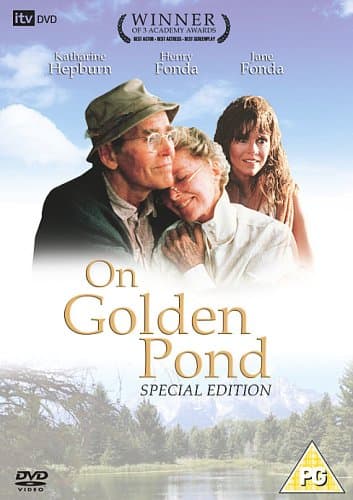
On Golden Pond
A summer cottage, a stubborn old man and a boy who quietly upends the whole family.
The setup
On Golden Pond is the kind of movie that arrives at feelings sideways: it opens on a lake and, before long, has you thinking about time, regret and the small cruelties families carry. Mark Rydell’s 1981 adaptation centres on a prickly retiree whose fear of slipping into forgetfulness forces reckonings that feel, for once, earned rather than theatrical.
THE MOVIE
Norman Thayer Jr. is still the reason this movie works
The thing that keeps On Golden Pond alive — long after the publicity and awards have settled — is its centre: Norman Thayer Jr., an irascible, scholarly retiree who spends an alarming amount of screen time talking about death and worrying he’s losing his mind. That tendency to grumble about mortality could have become mawkish very quickly, but the film places Norman in a very specific setting: he and his wife Ethel return to their much‑used New England summer cottage on Golden Pond, a place that feels lived‑in and perfectly suited to quiet reckonings.
The story’s spark is small and practical. Chelsea Thayer Wayne arrives with her boyfriend and his thirteen‑year‑old son, Billy Ray, and asks her parents to look after the boy while she travels. It’s a tidy premise — an extended family visit — that the film uses as a mechanism to expose long‑standing resentments and begin the slow business of repair.
Directed by Mark Rydell and released in 1981, the picture pairs Henry Fonda’s Norman with Katharine Hepburn’s Ethel and Jane Fonda’s Chelsea, a casting knot that gives the family scenes real weight. Put bluntly: you come for the cottage and stay because the characters make you want to.
THE SETUP
The idea that sets On Golden Pond in motion
At its simplest, On Golden Pond is a contained family drama: Norman and Ethel back at their summer cottage, holidays, neighbours and the small routines of lake life. That containedness is its strength — there aren’t contrived subplots, just a handful of tensions that the film watches closely.
The inciting move is Chelsea arriving with her boyfriend and his son, Billy Ray, and asking her parents to care for the boy while she’s away. The request is ordinary, but it forces long‑buried things into the open: Norman’s curmudgeonly behaviour, his increasing worries about memory and mortality, and the icy distance between him and his adult daughter.
What the setup buys the film is space: the gradually developing bond between Norman and Billy becomes a bridge. It’s not magic; it’s small, convincing adjustments — a shared fishing trip, a slow thaw in conversation — that allow father and daughter to find one another again.
There are notable beats that punctuate this domestic arc — a birthday visit, a dangerous moment on the lake during a fishing trip to Purgatory Cove, and repeated reminders of Norman’s health and memory — but the film rarely chases neat resolutions. It prefers the texture of repair to tidy endings.
THE CHARACTER
Why Norman Thayer Jr. matters
Norman is the film’s gravitational pull. He’s not an archetype for ageing so much as a very particular old man: a scholar who’s run out of patience, prone to bluntness, and nervy about his memory. That combination makes him difficult company and, crucially, interesting to watch — because his fears are not abstract, they’re voiced. You hear him worry. You see the small ways his irritability strains conversations with the people he loves.
Ethel exists in the same frame to temper and provoke him. She’s lively where he is brittle, consoling where he withdraws, and she nudges the family toward reconciliation instead of letting resentment calcify. That partnership gives the film its moral rhythm: it’s less about solving every problem and more about living with them gracefully.
Chelsea arrives emotionally distant and cautious, carrying the weight of whatever kept her away from her father. Her presence forces Norman to confront the consequences of his hard edges, and the film earns its moments of thaw by letting the characters do the work rather than issuing instant forgiveness.
Finally, Norman’s interactions with Billy — the teenager who becomes an accidental catalyst — show why this character matters beyond temperament. The intergenerational bond gives Norman space to express care and pride in ways he hadn’t in years, and through that small arc the movie turns private regrets into something that can be shared.
THE PERFORMANCE
Why Henry Fonda's performance matters
There’s an unavoidable historical note: On Golden Pond was Henry Fonda’s final feature film performance before his death in 1982. That fact alters the way viewers approach Norman — you watch with the knowledge that these are among an actor’s last screen pages.
Because the film lets Norman speak plainly about age and loss, Fonda’s presence turns those lines into a kind of testament rather than mere dialogue. The performance’s context — public and private — therefore becomes part of the viewing experience, whether you’re seeing the movie for the first time or the fiftieth.
UNDER THE SURFACE
On Golden Pond has more on its mind than the plot suggests
On Golden Pond is plainly about ageing and mortality — that’s on the nose — but the film’s deeper work is how those big subjects are translated into everyday interaction. Talk of death becomes a conversational tic for Norman; it’s how the film dramatizes fear without turning it into melodrama.
The family estrangement and reconciliation theme is the engine. This isn’t a single, tidy reconciliation scene; it’s a sequence of small recognitions and awkward apologies that add up. Chelsea’s tentative attempts to reconnect are a steady reminder that estrangement isn’t solved by one grand gesture.
Intergenerational friendship is where the movie finds most of its tenderness. Billy Ray’s presence does something practical: he gives Norman someone new to be to — not simply a father or husband, but a man who can teach, scold and be delighted. Those moments of shared learning and awkward affection are where the film’s warmth comes from.
Finally, acceptance and dignity in old age thread through the whole film. Rather than pretending ageing can be reversed, the story asks how people might face diminished faculties with as much self‑respect and humour as possible — a quietly moral question dressed in everyday scenes.
THE FILMMAKING
How On Golden Pond was put together
On Golden Pond wears its craft lightly. The film’s look and pace serve the characters rather than call attention to themselves — the cinematography credit goes to Billy Williams and the score to Dave Grusin, both names that anchor the movie’s unobtrusive presentation.
Production design and editing also follow that same principle: Stephen Grimes is credited for production design and Robert L. Wolfe for editing, and the choices throughout favour natural rhythms over flashy technique. The overall effect is a film that feels lived‑in and steady, the opposite of restless camera work or showy transitions.
That calm production approach is a direct match for the material. When a movie spends time on domestic, conversational beats, the filmmaking task is to hold attention without theatrics; in On Golden Pond the technical crew mostly respects that restraint.
Finally, the production companies and distributors — an ITC Films / IPC Films production released by Universal Pictures — brought a stage play to a broad audience while keeping the play’s intimacy intact, which is no small feat for an early‑80s theatrical adaptation.
PURE 80S
On Golden Pond could not belong to any other decade
Released in late 1981 and climbing the box‑office ranks during the 1981–82 season, On Golden Pond arrived at a moment when mainstream audiences were open to adult‑centred dramas. Its commercial success shows there was space in the era’s cinemas for quiet, character‑driven stories as well as blockbusters.
The casting underlines a particular 1980s appetite: the film literally brought together generations of screen stars — most pointedly Henry Fonda opposite his daughter Jane Fonda — which fed public interest and gave the film a familial immediacy that resonated beyond the plot.
It’s also a clear example of early‑80s adaptations that translated successful contemporary stage plays for wide theatrical audiences; Ernest Thompson’s 1979 play provided a compact, stage‑friendly story that the film kept largely intact while opening it to a broader public.
Shot in New Hampshire in the summer of 1980, the production’s choice of real lake locations helped preserve the play’s atmosphere while giving it a modestly cinematic sense of place without turning the location into spectacle.
WATCHING IT NOW
What has aged — and what hasn't
Modern viewers often find On Golden Pond sentimental — a charge the film has carried since release — but that sentimentality is frequently offset by the film’s reliance on character and small moments rather than spectacle. Critics have long noted this balance: where the movie trusts its people, it usually succeeds.
The themes that animate the story — family estrangement and the possibility of reconciliation — remain relatable. Watching Chelsea and Norman navigate the brittle terrain of old arguments still feels recognisable to anyone who has had to rebuild a relationship with a parent.
The intergenerational friendship at the film’s heart still lands because it is grounded in believable interaction. Billy Ray’s role as a catalyst is not a gimmick; it’s a practical device that produces honest shifts in behaviour.
Put differently: if the film’s emotional language sometimes leans toward the sentimental, its commitment to character work and the slow unpeeling of relationships keeps it from feeling like mawkish nostalgia. That restraint helps it survive repeat viewings.
THE LEGACY
Why On Golden Pond still matters
There are obvious markers of the film’s standing: it earned ten Academy Award nominations at the 54th Academy Awards and won three Oscars — Best Actor for Henry Fonda, Best Actress for Katharine Hepburn, and Best Adapted Screenplay for Ernest Thompson. Those wins underline that the industry recognised the film’s strengths in performance and writing.
Commercially, it was a substantial success in North America, finishing among the year’s top domestic grossers. That combination of box‑office reach and awards attention helped the movie remain visible beyond its initial run.
The story’s continued life — including later adaptations such as the 2001 television film — shows there’s a durable core to Thompson’s play that different performers and formats can revisit. It’s not a film that vanished once the season changed.
Ultimately, the legacy rests less on novelty and more on a dependable emotional architecture: a family story that proved adaptable, commercially viable and recognisably human to audiences and peers alike.
THE VERDICT
Does On Golden Pond still hold up?
Yes — with a qualifier. On Golden Pond works today because it trusts character and patience. The film follows Norman and Ethel at their summer cottage and sets an ordinary family visit against Norman’s real anxieties about memory, mortality and a strained relationship with his daughter; those are dramas that still land.
The developing bond between Norman and Billy is the film’s cleverest structural move: the teenager’s presence gives Norman fresh room to be himself — to show care and pride — and that dynamic carries much of the film’s emotional repair work. It’s an effective, human engine rather than a manipulative plot trick.
What may feel dated is the mannered sentimentality some viewers notice; the film can be earnest in a way that modern audiences sometimes find old‑fashioned. But sentiment here is largely anchored by tangible scenes of reconciliation and the steady presence of Ethel, who consistently counters Norman’s cynicism with warmth and common sense.
If you’re wondering whether to watch it now: go for the quiet intelligence of the setup and the slow, believable shifts in family relations. It’s a movie about getting older that prefers small, stubborn moments of grace to grand moralising — and that’s why it still matters.
Share this movie
Keep watching
More movies from the 80s

1981
Endless Love
Endless Love: family and love, and why this 1981 movie still matters.
Read our take →
1981
Reds
A movie about witness, appetite and the private cost of public conviction.
Read our take →
1981
The French Lieutenant's Woman
The French Lieutenant's Woman: love and loss, and why this 1981 movie still matters.
Read our take →