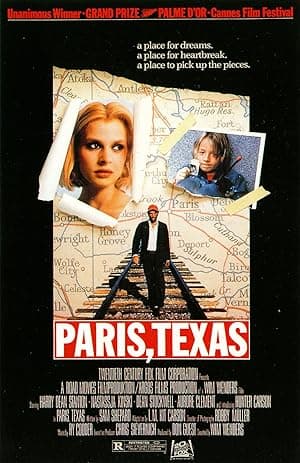
Paris, Texas
A man walks out of the desert and asks to be let back into his family — simple, ruthless and utterly centred on one figure.
The setup
Paris, Texas is the sort of film that keeps you thinking about a single person long after the credits finish. Wim Wenders’s road drama follows Travis — an almost mute man who reappears from the Texas desert and sets a slow, stubborn plan in motion to reclaim the life he abandoned. It’s a movie about distance: between people, between memory and responsibility, and between the wide-open landscapes and the private things they seem to reflect.
THE MOVIE
Travis is still the reason this movie works
People keep circling back to Paris, Texas because almost everything in the film pivots around one stubborn mystery: a man who has been gone for years showing up and asking, wordlessly, to be allowed back in. That man is Travis — Harry Dean Stanton’s character — and his return from the desert is the movie’s inciting event.
When Travis turns up, his brother Walt gets pulled into the problem: he has been raising Travis’s son, and now must decide whether to hand that life back. That practical, family-level dilemma is the engine; the bigger work of the film is how the family negotiates guilt, fractured memory and a long list of things left unsaid.
Wim Wenders directs, and the film runs long enough to let silences breathe (it’s commonly listed at around 145 minutes). It’s a road movie and a drama, yes — but it’s the portrait of estrangement and attempted reconciliation that gives the whole thing its nerve.
THE SETUP
The idea that sets Paris, Texas in motion
The plot, boiled down, is straightforward: Travis wants back in. He’s trying to rebuild a relationship with his son and confront what he did to Jane, the woman he left. That attempt to reconnect — to repair something that may not be repairable — is the film’s central conflict.
Walt’s role is immediately practical: he’s the sibling who has been holding things together, the temporary guardian who must decide whether to return parental responsibility. It’s a small human question with big emotional consequences.
The film structures this as a road movie, using travel and episodic encounters to coax out memory and motive rather than delivering neat explanations. Scenes accumulate; revelations come slowly.
Then there is a late, deliberate device: an extended Houston peep‑show sequence in which confession happens through a one‑way mirror and an intercom. That set piece is the film’s moral pivot, where words finally do the work that silence has been building toward.
THE CHARACTER
Why Travis matters
Travis is the film’s compass. Harry Dean Stanton plays him, but the character is defined less by a list of actions than by a pressure: he wants to re-enter a family life he abandoned, and that desire drags everything else into motion.
He carries guilt and fragmented memory, which makes his attempts at reconciliation awkward and fragile. The story isn’t about a triumphant comeback; it’s about someone trying, often clumsily, to make amends where the ground has shifted under everyone’s feet.
Walt’s pragmatism matters because it shows the other side of the ledger — the person who has been raising Hunter and who must weigh whether handing a child back to a father with gaps in his memory is wise. That sibling tension keeps the emotional stakes clear and human.
And the film’s peep‑show sequence reframes the problem: Jane is isolated, observed, and guarded. Travis’s attempt to speak to her while remaining unseen turns the usual reunion into something testing and strange, which makes their conversation feel like the only honest way forward.
THE PERFORMANCE
Why Harry Dean Stanton's performance matters
Contemporary and later commentary repeatedly point to Harry Dean Stanton as the film’s emotional centre. The focus is as much on what he doesn’t say as on what he does: long silences, attentive waiting, a face that registers more history than exposition could ever fit into lines.
That kind of acting choice — letting silence carry weight — is crucial because the story depends on absence as much as presence. When words finally arrive, they land differently because of the pauses that preceded them.
Reviews from the time singled out Stanton alongside Nastassja Kinski, and Hunter Carson’s naturalism as the son also drew notice. The performance landscape, broadly, is part of how the film convinces you to lean in.
Put simply: the film hands a lot of its emotional bookkeeping to the actors, and the contemporary record shows critics responding to that trust by naming Stanton and his co‑performers as key elements of the picture.
UNDER THE SURFACE
Paris, Texas has more on its mind than the plot suggests
At a glance the film charts a man trying to reunite his family. Look closer and it’s also asking what memory does to identity: if significant parts of your past are missing or mangled, who are you left being?
Estrangement and reconciliation are the obvious headline themes, but they’re braided with questions of responsibility. Fatherhood isn’t treated as a simple right or entitlement; it’s shown as a set of duties someone must actively reclaim or be judged unfit to hold.
The landscape plays a role, too — the American Southwest isn’t just scenery; it acts like an emotional mirror, reflecting the film’s loneliness and distance back at the characters. Travel here is less about freedom and more about moving through the spaces where past choices can be confronted.
So the movie’s ideas arrive through character choices and staged encounters rather than through thesis statements. That gives its themes room to breathe and to land in unexpected emotional places.
THE FILMMAKING
How Paris, Texas was put together
One straightforward production credit worth attending to is Robby Müller as director of photography. The film’s distinctive visuals are widely tied to his work behind the camera.
That credit matters because much of the movie’s tone is visual: wide, patient frames and the way scenes of travel sit with the characters. Saying Müller is integral isn’t a flourish — it’s a note about who gave the film its particular look.
Wim Wenders’s direction steers the pieces — performances, locations, sequencing — but the photography is the element that often makes the film feel like a place you can inhabit.
If you’re revisiting the movie, keep an eye on the way shots hold their breath: the filmmaking lets people and landscapes share the same emotional space, and that’s a practical directorial choice as much as an aesthetic one.
PRACTICAL EFFECTS
The effects work that gives Paris, Texas its physical personality
Some of the film’s most memorable physical choices are plain and practical. The opening includes elevated or helicopter‑based photography for wide desert passages, which gives those travel stretches a particular sweep.
More crucial to the story is the constructed peep‑show set: the one‑way mirror and the staging that prevents the characters from seeing each other. That was a deliberate production design decision rather than a coy editing trick.
That peep‑show construction is worth flagging because it shapes how the crucial confessions are delivered — through sound and reflection, not face‑to‑face gestures.
So the movie’s technical work is functional: it’s there to make the emotional design possible, whether by giving the landscape a look or by physically separating two people so they must speak differently.
PURE 80S
Paris, Texas could not belong to any other decade
The film is a West German–French co‑production from 1984 directed by Wim Wenders, a figure who had been part of New German Cinema and who, in the 1980s, was engaging directly with American landscapes and genres.
That international backbone matters: the decade made festival exposure and co‑productions an important route for arthouse films to find audiences, and Paris, Texas premiered in competition at Cannes in 1984.
It won major prizes there, including the Palme d’Or and the FIPRESCI Prize, which underlined how festival circuits were central to the film’s early life. In the 1980s that kind of recognition was a practical route to broader distribution.
Finally, the production’s choice to shoot on location across Texas — from Big Bend to Houston — ties the film to a particular era of international filmmaking where directors were going abroad to make films that mixed national styles and concerns.
THE LEGACY
Why Paris, Texas still matters
A few concrete things explain why the film stays in the conversation. It won the Palme d’Or at Cannes in 1984 and also received the FIPRESCI Prize and the Prize of the Ecumenical Jury — festival recognition that cemented its profile on the international arthouse circuit.
Wim Wenders also received the BAFTA Award for Best Direction for the film in 1985, which is another formal marker of the movie’s standing in that period.
The slide‑guitar score by Ry Cooder is regularly mentioned in discussions of important film music from the time, and that sonic identity helps the movie lodge in memory.
Finally, the film’s imagery and the way sequences are designed have been exhibited and published alongside Wenders’s photography and his broader work on the American West — evidence that the film’s visual choices have enjoyed a life beyond the screening room.
THE VERDICT
Does Paris, Texas still hold up?
Yes — if you go for character work, dense silences and a slow-building moral reckoning. The film’s whole point is that a man who turns up from the desert can’t be hurried through forgiveness; Travis’s reappearance forces others to make decisions about children, duty and memory, and the movie respects that complexity.
The narrative unfolds as a road movie, using travel across the Southwest to reveal pieces of Travis’s past and to set up the film’s pivotal confession scene: the Houston peep‑show, staged with a one‑way mirror and an intercom, where speech finally replaces absence.
Those structural choices — the episodic journey, the focus on fatherhood and responsibility, and the deliberate staging of the reconciliation — still give the film a coherence that rewards patience. Add the distinctive slide‑guitar motif and the visible care in the production, and you have a film that is both precise and haunting.
A supervised 4K restoration premiered in Cannes Classics in 2024, which is as practical an argument as any that the film remains worth seeking out. If you watch it, watch it for Travis — the movie is stubbornly, intelligently built around one man trying to put himself back where he belongs.
Share this movie
Keep watching
More movies from the 80s
1984
2010: The Year We Make Contact
2010: The Year We Make Contact: our relationship with technology and humanity, and why this 1984 movie still matters.
Read our take →

1984
A Nightmare on Elm Street
A Nightmare on Elm Street: family and the safety of home, and why this 1984 movie still matters.
Read our take →
1984
A Passage to India
A Passage to India: family and parents protecting their children, and why this 1984 movie still matters.
Read our take →