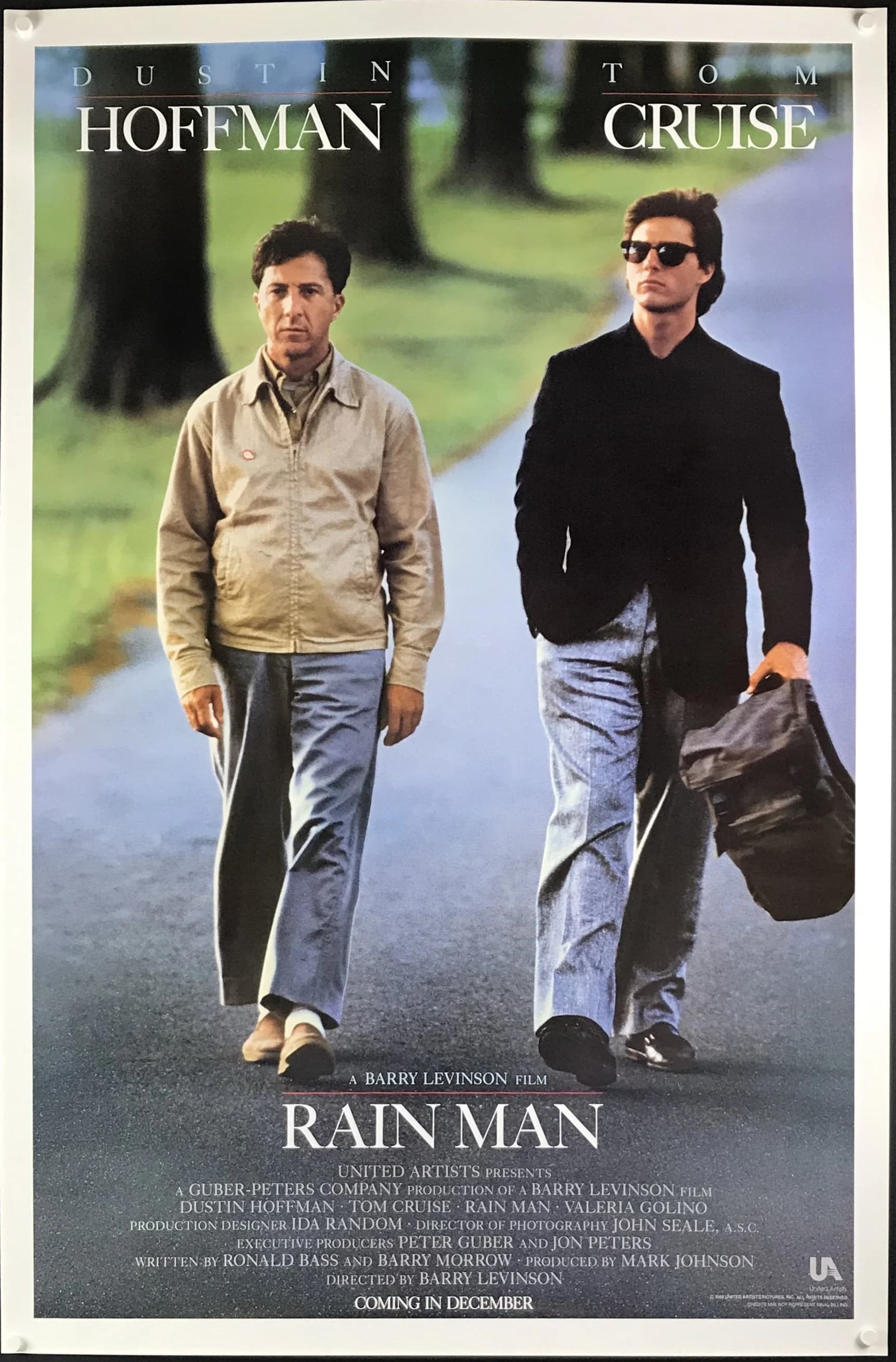
The setup
Rain Man hinges on one brilliantly odd premise: a self-absorbed car dealer discovers an older brother who’s spent years living in an institution. That brother — Raymond Babbitt — arrives with routines, astonishing recall and a way of turning Charlie’s world upside down. Barry Levinson directs, and the film keeps coming back to the strange, hard-to-ignore chemistry between those two very different men.
THE MOVIE
Raymond Babbitt is still the reason this movie works
People still talk about Rain Man because it gives us a character who won’t let the story be purely about money or melodrama. Charlie Babbitt learns that his estranged father left the bulk of the estate to another beneficiary — an older brother Charlie didn’t even know existed — and that simple set-up is proof the film wants to do more than a revenge or inheritance tale.
That ‘other beneficiary’ is Raymond Babbitt: an institutionalised adult whose life runs on routines and who also carries an extraordinary memory. When Charlie takes Raymond out of the Walbrook Institute and puts him on the road, the movie trades a straightforward plot for a string of personal reckonings.
Barry Levinson directs a 133-minute road story that keeps nudging its audience towards two big ideas: brotherhood and reconciliation, and the possibility that a materially driven bloke from Los Angeles might be forced — against his better instincts — to care.
THE SETUP
The idea that sets Rain Man in motion
Rain Man starts with a tidy, practical premise: Charlie Babbitt is a material-minded LA car dealer who discovers his late father left most of the estate to an older brother he never met. That reveal turns a private sourness — the family rift — into the catalyst for the whole film.
The beneficiary is Raymond, and he is presented not as a plot convenience but as a particular sort of person: institutionalised, routine-driven and gifted with exceptional memory and calculation abilities. Those qualities aren’t window dressing; they become the mechanics around which key scenes play out.
Motivated at first by the possibility of reclaiming cash, Charlie checks Raymond out of the Walbrook Institute and drives him across the country. The road trip does the heavy lifting: it creates conditions where two very different men repeatedly bump into one another’s limits and, occasionally, change.
Barry Morrow and Ronald Bass share screenplay credit, with Morrow credited for the story — which explains why the film treats Raymond’s specific traits as both a character detail and a structural device.
THE CHARACTER
Why Raymond Babbitt matters
Raymond isn’t just an eccentric; he’s written as an institutionalised adult with repetitive behaviours and an astonishing factual recall. The screenplay identifies him as an autistic savant, and those traits shape the film’s tone and tempo.
Put simply: Raymond is the glue that makes the brothers’ relationship feel specific. Charlie’s practicality and appetite for material success collide with Raymond’s routines and dependencies, and that clash is where the movie finds both conflict and tenderness.
Dustin Hoffman plays Raymond, and the film makes clear this is the character the story keeps circling back to. Every time the brothers’ dynamic shifts, it’s because of something Raymond does, needs or remembers.
That focus is why the reunion/reckoning beats feel earned rather than tacked on — the elder brother’s presence forces Charlie into repeated, small reckonings that add up over time.
THE PERFORMANCE
Why Dustin Hoffman's performance matters
Contemporary reviewers singled out Dustin Hoffman’s portrayal of Raymond as a critical focal point. The performance put the character — with his rules and recall — at the centre of attention in a way that audiences and critics noticed.
That attention also had a career note: critics pointed out Hoffman’s Raymond alongside Tom Cruise’s showing as evidence the film gave both of its leads room to surprise their familiar images.
So when you watch Rain Man today, a lot of the film’s emotional weight is carried by how the role of Raymond is presented and framed — and how that presentation forces the rest of the movie to respond.
Whether you’re watching for the dramatic structure or the human moments, contemporary reaction makes it clear Hoffman’s portrayal was not incidental to the film’s success.
UNDER THE SURFACE
Rain Man has more on its mind than the plot suggests
On the surface it’s a road movie about an unexpected inheritance and a literal drive across America. Underneath, it’s a film about two things that keep cropping up: brotherhood and reconciliation, and personal transformation.
Charlie begins as a career-focused, materially driven man. The repeated tensions between his pragmatic motives and Raymond’s routine-driven needs create a sort of moral schooling; the trip forces Charlie to confront emotional limitations he’d rather ignore.
The screenplay also asks questions about representation: Raymond’s savant abilities and institutional life are not just quirks but central elements the story uses to test Charlie’s priorities. That creates moments where materialism and care are set against one another, and where true attention — not profit — becomes the ethical yardstick.
So the movie’s real subject isn’t simply whether Charlie gets some money; it’s whether he can be moved by another person enough to change his behaviour for the long haul.
THE FILMMAKING
How Rain Man was put together
Rain Man is built carefully around people and places: production designer Ida Random and set decorator Linda DeScenna are credited with shaping the film’s physical environments, which keeps the world feeling lived-in rather than schematic.
Behind the camera, cinematographer John Seale and editor Stu Linder supplied the film’s technical backbone. Their work received Academy Award nominations, which is a reminder the movie’s craft was noticed as part of its overall achievement.
Those craft elements do a quiet job: they make the road trip feel continuous and keep the focus on interactions rather than flashy filmmaking tricks.
Taken together, the production and technical credits underline that Rain Man was intended as a character-driven piece realised by experienced hands.
PURE 80S
Rain Man could not belong to any other decade
Released in December 1988, Rain Man was an unusually big commercial success for a mid-sized, adult drama — it ended up the highest-grossing film released that year. That says something about late-80s audiences and what they were willing to go and see.
The film also fits into a late-1980s appetite for character-driven, awards-conscious dramas that could still play to mainstream viewers. Its screenplay and publicity leaned into that space between prestige and crowd appeal.
There’s also a late-80s origin note to Raymond himself: Barry Morrow has said the character was inspired in part by a 1984 meeting with savant Kim Peek, a detail that connects the script to contemporary interest in real-life extraordinary minds.
Finally, the casting choices — like Tom Cruise heading into the film on the back of earlier 80s work — helped position Rain Man as a mainstream adult drama with serious award ambitions.
WATCHING IT NOW
What has aged — and what hasn't
When modern viewers and reference works look back, two elements keep being flagged as real strengths: Dustin Hoffman’s portrayal of Raymond and the brothers’ relationship. Those aspects anchor the film when contemporary viewers re-evaluate it.
The brotherhood at the film’s core still reads as specific rather than schematic: Charlie’s pragmatic motives consistently clash with Raymond’s routines, and those clashes produce the scenes that tend to linger in the mind.
The fact that Raymond was inspired in part by Barry Morrow’s meeting with a real savant also gives the film a rootedness that helps it survive decades of changing tastes.
So while tastes and language around disability have evolved, these particular story and character choices remain the reasons many people still find the movie worth revisiting.
THE LEGACY
Why Rain Man still matters
Rain Man earned serious institutional recognition: it picked up the Golden Bear at the Berlin Film Festival and then went on to secure eight Academy Award nominations, winning four major prizes including Best Picture, Best Director and Best Actor.
Those awards are an important part of why the film is still discussed: they reflect the era’s tastes and the way the movie bridged critical respect and mainstream success.
The film was also a major commercial success, and that combination — awards plus box-office — is why Rain Man keeps turning up in lists and retrospectives about 1988.
Ultimately, Rain Man matters because it managed to be both a commercially successful road drama and a film taken seriously by festivals and awards bodies, and those twin facts keep it in the conversation.
THE VERDICT
Does Rain Man still hold up?
Yes — with a sensible caveat. If you watch Rain Man for its story structure, the road-trip framing remains an effective way to force two very different men into repeated reckonings: Charlie’s quest for cash turns into a much messier test of his capacity for care.
If you watch it for character work, much of the film’s staying power comes from Raymond as a specific figure — an institutionalised savant whose memory and routines drive scenes and shape Charlie’s responses — and from the way that focus compels the story to slow down and pay attention.
Contemporary praise and later retrospectives point to Dustin Hoffman’s portrayal and the brothers’ relationship as enduring strengths, and those are precisely the elements that uphold the film today.
So should you watch it now? Yes, if you want a late-80s adult drama that treats a difficult relationship with patience and keeps its eye on human particulars rather than spectacle. Rain Man still works when you let it be a movie about how two stubborn men find, in each other, a reason to change.
Share this movie
Keep watching
More movies from the 80s
1988
Big
Big: our relationship with technology and friendship, and why this 1988 movie still matters.
Read our take →
1988
Bull Durham
Mentorship, rites of passage and a catcher called Crash — Bull Durham still teaches a lesson.
Read our take →
1988
Cocktail
Cocktail: family and greed, and why this 1988 movie still matters.
Read our take →