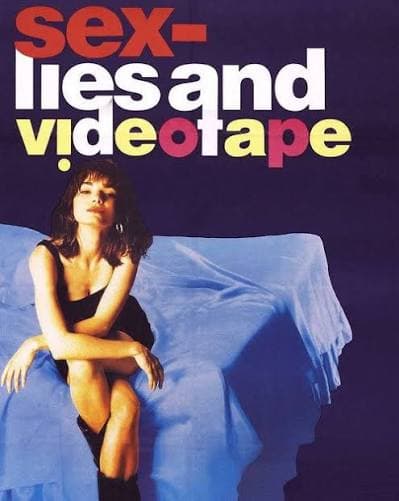
Sex, Lies, and Videotape
A quiet man with a camera upends a household — and asks us what counts as intimacy.
The setup
There are films that shout and films that listen. Sex, Lies, and Videotape is emphatically the latter. Steven Soderbergh’s low-key drama hinges on one odd, persistent choice: a soft‑spoken loner who gathers filmed confessions and, by doing so, pulls apart the ordinary secrets of a marriage.
THE MOVIE
Graham Dalton is still the reason this movie works
If you remember one image from Sex, Lies, and Videotape, it isn’t a billboard or a speech: it’s the idea of someone quietly asking women to talk while a camera waits. That person is Graham Dalton, the old college friend who turns up and takes a room in John and Ann Mullaney’s house.
Graham’s habit of filming women as they speak about sex does a strange double job: it pulls people toward confession while also keeping them at arm’s length. The camera becomes a kind of emotional tool — a way of getting closer by staying a little removed.
It helps that Steven Soderbergh wrote and directed the whole thing and kept the running time neat at 100 minutes. The result is a small drama whose engine is less about plot fireworks and more about how a single, peculiar behaviour can unsettle a household.
THE SETUP
The idea that sets Sex, Lies, and Videotape in motion
At its simplest: Graham moves back to Baton Rouge and into the Mullaney home. His presence feels, at first, like a benign reunion — until the extent of his videotaping becomes clear.
Those taped interviews are the film’s recurring trick. They’re not just colourful details; they act as evidence and as a push. When private admissions exist on tape, they change how people behave and what they hide.
That shift is where the drama lives. The movie keeps its set-up tight so the characters’ choices — whether to confess, defend or withdraw — come into sharp focus without any need for melodrama.
THE CHARACTER
Why Graham Dalton matters
Graham is not an obvious lead. He’s soft‑spoken, oddly solitary and defined by a single, repetitive act: he records women as they talk about sex. That habit makes him less a pursuer than a collector of confessions.
Because his recordings are more emotional strategy than crude seduction, Graham functions like a mirror held up to the others. He doesn’t force answers so much as provide a place where truth — or the appearance of it — can be watched back.
It’s also worth noting that the role drew attention at the festival circuit: the part earned James Spader the Best Actor prize at Cannes, which mattered for how the film was received and discussed.
THE PERFORMANCE
Why James Spader's performance matters
There’s a concrete piece of evidence that tells you how critics reacted to Graham as a character: James Spader won the Best Actor prize at Cannes for the role.
That kind of festival recognition isn’t just a trophy; it signalled that reviewers were paying attention to the film’s central figure and the way he holds a scene.
If you’re watching the movie now, bear that in mind: the role was the axis on which contemporary coverage turned, and the award explains why conversations about the film often come back to Graham.
UNDER THE SURFACE
Sex, Lies, and Videotape has more on its mind than the plot suggests
At surface level it’s about affairs and the unravelling of a household. Underneath, the film keeps returning to one practical question: what does a camera do to intimacy? The recordings both distance the speaker and make certain moments unbearably intense.
Voyeurism, then, isn’t portrayed as simple prurience. It’s a mechanism for mediated desire — a way of experiencing someone that is inevitably incomplete and oddly addictive.
Confession and exposure are paired themes. When private material exists in a form that can be replayed, the idea of owning your own story becomes complicated. The tapes change who gets to speak, and who gets to be believed.
All of this sits up against the slow reveal of marital deceit: secrets about sex and fidelity are not just private failures, they become social facts once recorded.
THE FILMMAKING
How Sex, Lies, and Videotape was put together
The movie was made with modest means but deliberate choices. Principal photography took place in Baton Rouge starting in August 1988, and the production used Panavision Panaflex cameras and lenses — gear that gave the film a professional sheen despite its independent budget.
Records note a low‑budget, independent shooting approach and a post‑production workflow that included initial editing on videotape. That detail matters because the story itself hinges on recorded footage; the film’s own construction echoes its subject.
Soderbergh is credited as both writer and editor, which helps explain the film’s tight focus: the director was shaping the material at the scripting and cutting stages, keeping the drama compact and concentrated.
PURE 80S
Sex, Lies, and Videotape could not belong to any other decade
There’s a clear historical thread: Miramax acquired the U.S. rights and released the film in August 1989, and that commercial path helped lift the profile of American independent filmmaking around the turn of the decade.
Part of the movie’s era‑specific identity comes from how it travelled: a small, conversation‑driven drama making waves in festivals and then finding a theatrical foothold was precisely the kind of story that nudged independent cinema from the margins toward wider attention.
So while the film isn’t a period piece in the costume sense, its route to audiences and the conversations it sparked are very much products of the late 1980s film world.
THE LEGACY
Why Sex, Lies, and Videotape still matters
Festival recognition sealed the film’s place in cinema conversation: winning the Palme d’Or and earning Spader a Best Actor prize are facts that historians repeatedly return to when charting late‑20th‑century American indie cinema.
Awards and an Academy Award screenplay nomination helped establish Steven Soderbergh’s national profile, while the film’s Independent Spirit Awards reinforced its credibility within the independent community.
Crucially, the movie’s commercial return — a substantial theatrical gross for a tiny budget — is often cited in accounts that explain why distributors started paying attention to small, risky projects.
All of which means Sex, Lies, and Videotape matters not only for its story but for the way it proved a business model and a critical route for films that didn’t belong to the old studio machinery.
THE VERDICT
Does Sex, Lies, and Videotape still hold up?
Yes — with a rider. If you watch it expecting fireworks, you’ll be disappointed. But if you sit down for a compact study of how a camera changes conversations, the film still has the goods. The central inciting move — Graham arriving at the Mullaney home and revealing that he records women’s candid talk about sex — remains a provocative dramatic pivot.
The videotapes themselves are what keep the film alive. They’re not a mere gimmick: recorded confessions function as both proof and provocation, destabilising relationships and forcing characters to face dishonesty about intimacy and fidelity.
There’s also a practical reason to watch: James Spader’s Graham is the pivot around which contemporary critics coalesced, and that attention helps the film feel like a deliberate experiment rather than an accidental curiosity. The fact that critics singled out the four principal actors in early reviews reinforces how the movie’s emotional logic relies on its cast’s performances.
So should you watch it today? If you care about films that examine mediated intimacy, about the ethics of being seen and the cost of speaking when speech can be replayed, then yes. It’s a small, sharp picture whose particular question — what does a camera do to closeness? — still sounds worth asking.
Share this movie
Keep watching
More movies from the 80s
1989
Best of the Best
Best of the Best: mortality and lifespan and family, and why this 1989 movie still matters.
Read our take →
1989
Black Rain
Black Rain: family and parents protecting their children, and why this 1989 movie still matters.
Read our take →
1989
Born on the Fourth of July
A patriot’s faith, broken and rebuilt — Ron Kovic keeps the film honest.
Read our take →