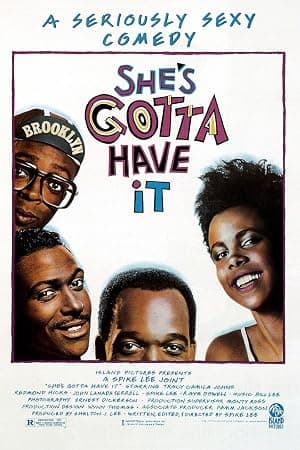
The setup
She's Gotta Have It arrives like someone cutting to the front of a conversation and refusing to apologise for it. Spike Lee’s first feature is centred on Nola Darling — a Brooklyn artist who dates freely, speaks to camera, and forces the film to reckon with what a woman’s choices mean to the men around her. It’s short, sharp and still maddeningly alive.
THE MOVIE
Nola Darling is still the reason this movie works
The engine of She's Gotta Have It is simple and stubborn: Nola Darling keeps her own terms. She’s a Brooklyn graphic artist who dates more than one man at once and refuses to be confined by a single label.
Spike Lee builds the film around Nola’s voice. She talks to camera, the story loops back on itself with flashbacks, and we see the same relationship from different points of view, which keeps the focus on choices rather than on a tidy plot.
That insistence — a woman shown as sexually candid and independently minded, occupying a comic-drama that won’t collapse into a lecture — is what still makes the film worth revisiting. It gets into arguments without ever feeling like it’s lost the person they’re arguing about.
THE SETUP
The idea that sets She's Gotta Have It in motion
At the centre is a neat premise: follow Nola Darling, a young artist in Brooklyn, who refuses the usual romance script by keeping several lovers at once and by making her own rules about commitment.
Rather than tell the tale in one straight line, the film keeps nudging us sideways. Flashbacks and direct addresses fold the story inward, so we’re repeatedly invited to re-evaluate the same people and the same events.
That structure does two things at once. It keeps the film brisk — the running time is compact — and it stops you from taking any single viewpoint as the absolute truth.
So the setup isn’t just a dating situation; it’s a device that asks you to pick a perspective and then makes you question it.
THE CHARACTER
Why Nola Darling matters
Nola Darling — played by Tracy Camilla Johns — is the film’s organising force. She’s an artist, candid about sex, and importantly, unwilling to tuck herself into someone else’s neat little box.
The point isn’t that she’s flawless; it’s that the movie gives her space to be complicated. That refusal to be monogamous is the fulcrum of the conflicts that follow, which means the plot continually returns to her decisions rather than merely reacting to them.
Nola isn’t isolated. The film surrounds her with friends and confidantes — characters like Clorinda Bradford and Dr. Jamison — whose responses help test and define what Nola will and won’t tolerate.
The result is a character who functions less as a moral example and more as a person whose life forces everyone around her to state their terms.
UNDER THE SURFACE
She's Gotta Have It has more on its mind than the plot suggests
On the surface it’s a romantic comedy-drama about relationships and quarrels. Underneath, the film is a conversation about female sexual autonomy: it stages a woman insisting on the freedom to choose and then watches what that freedom does to the people and rules around her.
The film also teases out questions about polyamory and commitment. It doesn’t hand you a manifesto; instead, it dramatizes the collisions that occur when different people expect different things from the same relationship.
Crucially, those personal arguments are framed within everyday Black urban life. The setting and the social interactions are part of the texture — the film is attentive to how gender, image and reputation circulate in that milieu.
And finally, it’s very much a small, auteur film — a director’s first feature that foregrounds a strong point of view rather than striving for crowd-pleasing neutrality.
THE FILMMAKING
How She's Gotta Have It was put together
This is an unmistakably independent picture: a first feature that reads as a personal statement. Spike Lee wrote, directed, produced and edited the film under his Forty Acres and a Mule banner, which gives it that auteurish stamp.
The movie’s production story is part of its identity. Shot quickly and on a tight budget, it still chose to present itself in a deliberate way, favouring a stripped-back aesthetic over anything glossy.
Those decisions are sensible for a film that wants the audience to listen to characters rather than be dazzled by spectacle. The practical economy of the filmmaking supports the conversational tone of the piece.
Seen this way, the craft choices are political as much as practical: the film makes room for voices and arguments because the director built it around those voices and arguments.
PURE 80S
She's Gotta Have It could not belong to any other decade
Arriving in 1986, the film sits at the crest of a burgeoning American indie scene: a microbudget picture that managed to break out of the local circuit and find attention beyond it.
Part of that breakout came from festival exposure. After premiering in San Francisco the film played in Cannes’ Directors' Fortnight and won the youth jury prize — an unusual level of international visibility for a tiny, low-budget release at the time.
That festival recognition helped underline the era’s new distribution possibilities: small films could travel and be discussed in serious venues, not just tucked away in art-house corners.
And the film’s life beyond the 80s — including a contemporary TV reworking — speaks to how the decade produced stories that could be rethought for later audiences rather than merely locked in a period mood.
THE LEGACY
Why She's Gotta Have It still matters
The film’s festival prizes and awards matter because they marked a tiny film as worth watching. It won the youth jury prize at Cannes and later received the Independent Spirit Award for Best First Feature — acknowledgements that helped it punch above its weight.
It’s also the movie that put a young filmmaker firmly on the map; many accounts trace Spike Lee’s rise back to this film as the moment he established himself as an independent auteur with a distinct voice.
The story didn’t stop in the 80s: the material was later adapted into a multi-episode contemporary TV series, which shows the original’s ideas had enough life to be re-addressed in a different form.
Most concretely, the Library of Congress preserved the film in the National Film Registry, signalling that it carries cultural, historical or aesthetic value worth keeping on the record.
THE VERDICT
Does She's Gotta Have It still hold up?
Yes — but with a useful rider. The film works because it keeps the argument about Nola’s choices front and centre: she dates multiple men, speaks directly to us, and forces those around her to state their demands for control, commitment or affection.
You don’t need an appetite for 80s nostalgia to appreciate that. The structure — non-linear memory and first-person addresses — makes the film brisk and focused: it’s interested in opinions and consequences more than tidy resolutions.
That tension between autonomy and the men’s expectations is the dramatic engine. Jamie Overstreet stands as the steady, commitment-minded option; Greer Childs is framed as the image-conscious suitor whose insecurity turns possessive. The supporting women keep Nola’s decisions honest and communal rather than private.
If you want a short, thoughtful piece about gender, desire and personal liberty wrapped in a low-budget, director-driven package, this is still worth watching. Nola doesn’t promise easy answers — and neither does the film. That’s exactly why it keeps you talking.
Share this movie
Keep watching
More movies from the 80s
1986
About Last Night...
About Last Night...: family and friendship, and why this 1986 movie still matters.
Read our take →
1986
Hannah and Her Sisters
Hannah and Her Sisters: love and greed, and why this 1986 movie still matters.
Read our take →
1986
Lucas
Lucas: friendship and family, and why this 1986 movie still matters.
Read our take →