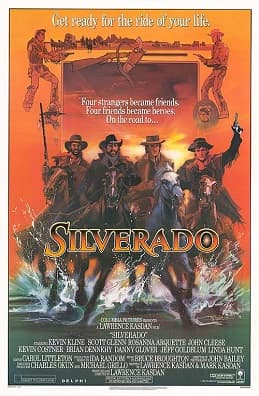
The setup
Silverado is the kind of 1980s studio Western that remembers how to have a good time and still take its moments seriously. Lawrence Kasdan stitched together an ensemble road to the frontier — Paden, Emmett, Jake and Mal — and the movie earns its length by letting these men collide, argue and eventually belong to one another. If you want to revisit a Western that’s about friendship as much as gunplay, this is the one people keep coming back to.
THE MOVIE
Paden is still the reason this movie works
Silverado arrives as an old-fashioned Western that behaves like a group holiday. The engine is simple: four largely unrelated men—Paden, Emmett, Jake and Mal—end up on the same road to a frontier town and have to sort out corrupt officials and land-grabbers as they go.
Lawrence Kasdan stages the introductions separately so the audience gets to know each man on his own terms before they become a unit. That sequence — a jail break here, a wagon-train complication there — does the hard work of turning strangers into travel companions.
And at the centre of it is Paden. Introduced as a wary, itinerant figure who keeps stepping in for underdogs, he’s the character who prevents the film from drifting into caricature. He’s reluctant to attach, but the movie hinges on the fact he repeatedly chooses to act anyway.
THE SETUP
The idea that sets Silverado in motion
The plot is built from a neat premise: four men, each with their own problems, travel toward the frontier town of Silverado and find the town’s troubles are bigger than any one of them. That tidy premise keeps the film moving without forcing it into one linear arc.
Kasdan introduces the principals separately — the film’s inciting sequence gives us Paden, Emmett, Jake and Mal in their own smaller emergencies before stitching them together — which lets the story breathe in short, self-contained set pieces.
Those set pieces are the film’s rhythm: a jail break, a wagon-train complication, saloon confrontations. Each episode links the protagonists a little more tightly and raises the stakes as they head for the town-centred showdown.
Because the structure is episodic, the movie can be lungs-deep in action one minute and quietly human the next. It’s an old-school mechanic that suits a story about people choosing one another under pressure.
THE CHARACTER
Why Paden matters
You can say a lot about a film by where it puts its moral reluctance. Paden is introduced as the wary drifter who keeps stepping in for the underdog; he’s not looking for glory or attachment, yet he repeatedly chooses to help. That habit makes him the movie’s ethical compass.
Kevin Kline is credited as Paden, and the script gives that character the small economy of a proper Western lead: sparse words, decisive acts and a tendency to show up at the worst possible moment. The result is a character who holds scenes together by what he refuses as much as by what he does.
Paden’s relationship with Stella — who runs the Midnight Star saloon in Silverado — provides the film with its most human counterweight. Where the action can threaten to be all set pieces and standoffs, that connection gives Paden a reason to care beyond the next fight.
All of this ties into the movie’s broader idea of chosen family. Paden doesn’t start out seeking friendship, but the film is invested in how loyalty accumulates in danger: strangers become comrades because they must, and then because they want to.
UNDER THE SURFACE
Silverado has more on its mind than the plot suggests
Friendship and chosen family are the film’s beating heart. The journey stitches unlikely companions together until loyalty feels like the point — and the movie trusts that the audience will care about that domesticity among outlaws.
The film also treads the old Western fault line between law and vigilantism. Silverado asks whether men who take justice into their own hands are heroes or merely replacing one corrupt order with another. It’s an argument given shape by the town’s corrupt officials and those who refuse to play by their rules.
Racial tension and revenge are explicit concerns, too. These threads complicate the simpler buddy-and-gun framework and remind the story that frontier violence has consequences beyond spectacle.
Finally, Silverado wears its tribute to classical Westerns openly. It borrows the genre’s set pieces and rhythms while updating them with 1980s studio sensibilities — ensemble casting, broader scope and a taste for both action and warmth.
THE FILMMAKING
How Silverado was put together
One of the practical decisions that shapes Silverado is the production’s commitment to an on-location feel: principal photography took place in New Mexico, and the production built an entire town set near Santa Fe. That choice gives the film a solidity that studio backlots rarely match.
The credits list John Bailey as director of photography and Carol Littleton as editor; Ida Random is named as production designer. Those roles are the scaffolding that lets Kasdan stitch episodic sequences into a feature-length narrative.
Building a full town rather than relying on existing sets or smaller constructions also allowed the production to stage sequences with a sense of place — which matters when a frontier town is less a backdrop than a character with its own corrupt heartbeat.
All of this points to a film that was assembled like a proper studio picture: craftsmen in defined roles, a large set to serve the story and a director who wanted both the broad sweep of an epic and the micro-moments of an ensemble piece.
PRACTICAL EFFECTS
The effects work that gives Silverado its physical personality
Silverado’s most visible physical achievement is the town itself: the production constructed a full-scale set near Santa Fe for the shoot.
That decision isn’t just decorative. Having a town that exists as a working environment lets extras, horses and action scenes interrelate more naturally than if the production had to stitch together smaller locations.
Because the set was substantial, it also had a life beyond this film; the construction was reused in later Western productions, which speaks to the scale of the original build.
In short: the movie’s physical personality owes a lot to that investment in a town you can move through, fight in and make into the centrepiece of several large set pieces.
PURE 80S
Silverado could not belong to any other decade
Silverado sits comfortably in a mid-1980s moment when studios briefly remembered the Western. It arrived in 1985, the same year Clint Eastwood’s Pale Rider reminded audiences the genre still had punch.
But Silverado is not a dusty relic. It reflects 1980s studio production values: a sizeable budget for a period Western, on-location shooting and a star-driven ensemble intended to draw a wide audience.
That ensemble approach — a mix of established and rising names — is very of its time. The film uses recognizable faces to broaden appeal, then lets the story’s episodic mechanics give each character a moment to register.
Seen this way, Silverado is a product of its decade because it mixes retro genre love with modern (for the 80s) production muscle: an attempt to make the Western feel large and contemporary in one go.
THE LEGACY
Why Silverado still matters
Part of Silverado’s afterlife is practical: the production’s town set was built at scale and later reused in other Westerns, which means the film left a tangible footprint on subsequent productions.
Another durable piece of the film is its music and sound. Bruce Broughton’s original score was released by Geffen and later expanded by Intrada, and the film received Academy Award nominations for Best Original Score and Best Sound.
Those nominations aren’t the whole story, but they are proof the film’s craft — particularly in sound and music — met a level of industry recognition.
Combine the production investment, the soundtrack circulation and the film’s willingness to wear its Western influences openly, and you have a movie that continues to be referenced by people who care about how modern studio Westerns were made.
THE VERDICT
Does Silverado still hold up?
Yes — with a rider. Silverado works because it knows what it is: a 133-minute ensemble Western that links episodic set pieces into a larger town-centred conflict. If you come for a straight, efficient plot you’ll notice the film likes detours; if you come for company, it rewards you.
The core pleasure is the company the film keeps. The inciting sequence that introduces Paden, Emmett, Jake and Mal gives each man room to breathe, and the movie’s commitment to friendship and chosen family keeps its action grounded in people rather than spectacle.
Technically and materially the film holds up in the ways the production intended: a large set near Santa Fe gives the town of Silverado weight, and Kasdan’s studio-scale approach keeps the film feeling deliberately crafted rather than thrown together.
So should you watch it today? If you enjoy Westerns that mix old-fashioned motifs with 1980s ensemble storytelling — and if you like a lead who prefers to do the right thing rather than talk about it — Silverado still repays the time. It’s a competent, occasionally affectionate revival of the genre whose best feature is how it turns a few strangers into something like a family.
Share this movie
Keep watching
More movies from the 80s
1987
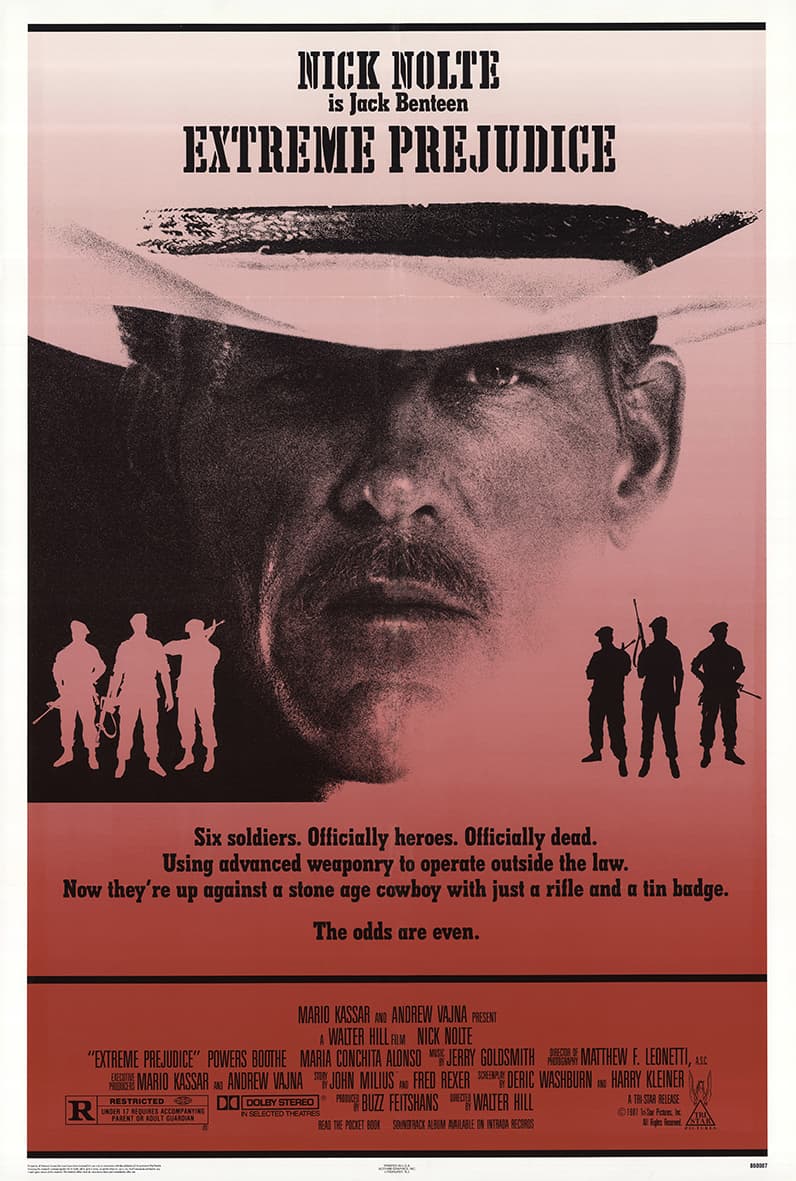
Extreme Prejudice
Extreme Prejudice: greed and authority, and why this 1987 movie still matters.
Read our take →
1988
Young Guns
Young men, a murdered mentor and a young Billy the Kid riding herd on revenge and loyalty.
Read our take →
1985
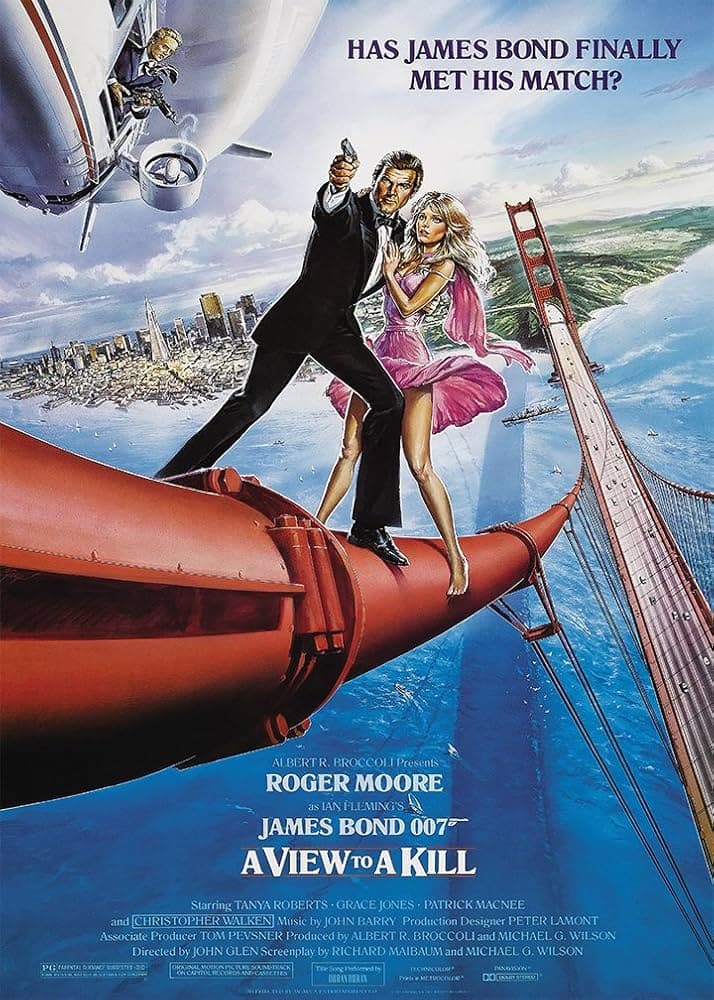
A View to a Kill
A View to a Kill: freedom and courage, and why this 1985 movie still matters.
Read our take →