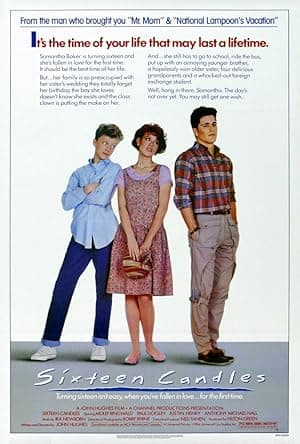
Sixteen Candles
Teenage longing, family oblivion and one very awkward bet — with Samantha Sam Baker keeping the whole thing human.
The setup
Sixteen Candles still turns up in conversations because it remembers what being sixteen actually feels like: small, conspicuous and desperate for notice. John Hughes sets that ache at the movie’s centre and then refuses to let us forget it — which is why Sam Baker matters more than the jokes, the embarrassments or the dance scenes.
THE MOVIE
Samantha 'Sam' Baker is still the reason this movie works
People still talk about Sixteen Candles because it gives you one thing teenagers recognise instantly: the sensation of being visible to everyone and yet unnoticed by the people who should care most. The story sets that up neatly — Sam’s sixteenth birthday is overshadowed by her sister’s wedding — and then builds the whole movie around the small humiliations that follow.
John Hughes wrote and directed the film and packs it into a brisk 93 minutes of adolescent ups and downs. The plot’s quieter engine is a private slip-up: Sam’s answers to a sex quiz find their way into the hands of Jake Ryan, the older boy she quietly admires, and the possibility of connection becomes the thinnest thread of hope she can cling to.
So yes, there are pratfalls, daft setpieces and a subplot about a foolish bet. But at the centre is Sam — insecure, watchful and hoping simply to be noticed. That single motivation is why the film still feels watchable to people who remember the sting and to anyone who’s ever wanted someone to look up and say, ‘I see you.’
THE SETUP
The idea that sets Sixteen Candles in motion
Sixteen Candles doesn’t waste time on an elaborate premise. The core situation is simple: Sam’s sixteenth birthday is largely forgotten by her own family because her older sister’s wedding has taken over the household. That domestic neglect is the quieter problem the film keeps returning to.
Hughes then threads a rom-com engine through that loneliness. The small but crucial incident is Sam’s private sex‑quiz answers ending up with Jake Ryan, the older boy she admires. That accidental exposure becomes the film’s emotional hinge — the moment when Sam’s private longing might, maybe, meet someone else’s attention.
The movie lives and breathes on contrasts: Sam’s inward hope versus the worldly obstacles arrayed around her — distracted parents, high‑school pecking order, rival romances. Those repeated near-misses are the story’s preferred currency; setpieces are built from embarrassments rather than from seismic plot shifts.
And then there’s Farmer Ted’s subplot — the ‘Geek’ and his ill-considered bet — which the film plays mostly as broad comic business. That element is loud, deliberately absurd and has drawn fresh scrutiny in later years for how the joke is constructed and handled.
THE CHARACTER
Why Samantha 'Sam' Baker matters
Sam Baker is the emotional thermometer of the film. She’s written around one plain need: to be noticed on a day when everyone else has something else on their minds. That narrow aim keeps the film focused and gives even minor scenes a charge — she isn’t fighting for world peace, she’s fighting for recognition.
Her family are mainly scripted as forces of neglect or distraction: parents, grandparents and an older sister wrapped up in wedding chaos. Those relationships aren’t rendered as cruelty so much as thoughtlessness, which makes Sam’s isolation feel mundane and therefore very familiar.
That domestic forgetfulness matters because it frames every high-school humiliation. A girl whose family won’t celebrate her birthday has no small reserves left when the schoolyard gets awkward. The storytelling choice to keep Sam observant and inward — rather than loudly rebellious — is what gives the film its bittersweet edge.
Finally, Sam’s role mattered for the film’s makers too: Sixteen Candles helped raise Molly Ringwald’s profile and established a template for Hughes’s teen-focused films where a sympathetic central teenager anchors the story.
THE PERFORMANCE
Why Molly Ringwald's performance matters
Contemporary reviewers singled out Molly Ringwald’s central performance as an anchoring, sympathetic presence for the film. That’s the solid, evidence-backed point to start from.
What that description allows you to infer — without inventing praise beyond the facts — is that the movie’s emotional stakes depend on Sam feeling believable. If the centre felt hollow, the small embarrassments and near-misses would slide into mere gag scenes.
Ringwald’s casting helped make Sam feel like a recognisable teenager rather than a cartoon. Critics at the time picked up on that grounding and credited the film’s ability to hold both the comedy and the more tender moments.
So when Sixteen Candles still lands for viewers, a large part of the credit goes to having a central performance that keeps the audience invested in Sam’s hopes and disappointments.
UNDER THE SURFACE
Sixteen Candles has more on its mind than the plot suggests
Beneath the jokes the film consistently circles a handful of simple ideas: adolescent longing, the desire to be recognised and the awkward rituals that measure social status in high school. Those themes repeatedly return in different guises — family, parties, dances — until you realise they’re the movie’s steady concern.
Family neglect is one of those guises. Sam’s invisibility at home isn’t melodramatic; it’s ordinary, and that ordinariness is what makes her longing feel real. The wedding weekend simply amplifies how small her birthday becomes.
Social hierarchy also powers much of the comedy and the hurt. The contrast between outsiders and the popular kids shapes the obstacles Sam encounters and the triumphs she dreams of. The film trades in those hierarchies to create stakes that every teen can recognise.
Finally, the script doesn’t shy away from trickier currents — questions around representation and scenes that later viewers have questioned on consent grounds. Those elements complicate the movie’s simpler pleasures and are part of why conversations about it remain active.
PURE 80S
Sixteen Candles could not belong to any other decade
Sixteen Candles was released in May 1984 and sits squarely within John Hughes’s early 1980s cycle of teen films that treated suburban adolescence as a proper subject. The film’s concerns — small domestic humiliations, school pecking orders, the ache of being overlooked — match the era’s appetite for character-led youth stories.
It uses contemporary pop music and soundtrack choices to plant the story in its moment, so the teen milieu feels of its time rather than generic. That soundtrack rooting helps the film read as an 80s object even when the emotional beats are timeless.
As a modestly budgeted teen picture distributed within the studio system, its success helped reinforce the idea that youth-targeted comedies were commercially viable in the decade. In short, its combination of subject, sound and scale belongs to the 1980s film landscape.
And practically speaking, the movie’s Chicago‑area suburban locations and short running time are part of that package: concise, local and focused on the small dramas of ordinary families.
WATCHING IT NOW
What has aged — and what hasn't
Some aspects of Sixteen Candles still read easily: the small humiliations, the family forgetting the birthday, the anxious hope of a teenager wanting to be seen. Those narrative bones — ordinary moments turned meaningful — continue to hold up because the emotion behind them is straightforward and recognisable.
At the same time, parts of the film have not aged well. The Long Duk Dong character has been repeatedly cited in later discussions as an offensive Asian stereotype, and that role provoked protests from Asian‑American viewers even at the time. That element sits uneasily with the rest of the movie and complicates how contemporary audiences experience it.
There are also sequences and bits of business — notably some comic material around the ‘Geek’ subplot — that later viewers have questioned on consent and ethical grounds. Contemporary reviews noted the movie’s strengths while also flagging uncomfortable moments; later retrospectives have only sharpened those concerns.
Taken together, the result is mixed: the movie’s human centre and its depiction of ordinary adolescent longing still work for many viewers, but certain characters and comic choices feel dated and problematic when they’re looked at without nostalgia.
THE LEGACY
Why Sixteen Candles still matters
The picture was a breakout commercial success for John Hughes as a director and helped make Molly Ringwald a visible face of 1980s teen cinema. That lift mattered: it put both the filmmaker and several young cast members on a path to become recurring figures in youth-oriented films of the decade.
Those career effects are measurable: the film boosted profiles and won Young Artist Awards for Molly Ringwald and Anthony Michael Hall late in 1984, recognising their work as young actors.
Beyond careers, the film continues to be included in retrospectives and lists of notable 1980s teen pictures — partly because it crystallised a certain suburban adolescent sensibility, and partly because it’s a tidy example of Hughes’s early interests.
That ongoing attention is not uncritical. The film is also revisited for its problematic elements, so its place in the canon is a careful, conversation-ready one rather than an unexamined celebration. A proposed TV sequel called 32 Candles was even reported to have been under development in the early 2000s, showing how the title and concept kept lingering in entertainment circles.
THE VERDICT
Does Sixteen Candles still hold up?
Yes — but with reservations. If you want a compact, character‑driven teen picture about the ache of being overlooked, Sixteen Candles still delivers. Its central engine is exact and small: Sam’s birthday is forgotten by her family, and that neglect makes every schoolyard embarrassment cut a bit deeper.
The film’s emotional arc relies on a modest, believable mechanism: Sam’s private sex‑quiz answers accidentally reach Jake Ryan, the taciturn senior she admires, and that odd slip creates a genuine possibility of connection. The movie trades in near-misses and ordinary setpieces — a chaotic bus ride, the school dance, the wedding weekend — rather than grand gestures, which keeps it intimate.
At the same time, viewers should be prepared to meet elements that haven’t aged well. The comedic subplot around the ‘Geek’ attracted scrutiny even in contemporary reviews and has been a focus of later criticism. The Long Duk Dong character and certain sequences that raise consent questions complicate the experience for modern audiences.
So watch it for Sam: her story is the film’s reason to sit through the sillier, less comfortable moments. If you can hold both feelings at once — enjoying the small, real scenes while noticing the problematic bits — Sixteen Candles is still worth seeing. It’s a reminder that great teen movies are not necessarily flawless; they’re the ones that know how badly being young can feel, and then give that feeling a shape you recognise.
Share this movie
Keep watching
More movies from the 80s
1985
Better Off Dead
Better Off Dead: family, and why this 1985 movie still matters.
Read our take →
1985
Girls Just Want to Have Fun
Girls Just Want to Have Fun: family and friendship, and why this 1985 movie still matters.
Read our take →
1985
Just One of the Guys
Just One of the Guys: growing up, and why this 1985 movie still matters.
Read our take →