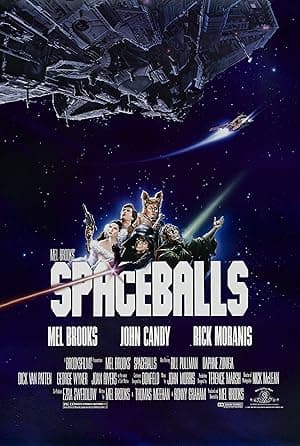
Spaceballs
A madcap space spoof where a reluctant hero, a man-dog and a merchandising gag steal the show.
The setup
Spaceballs is often remembered for its gags and chewy affection for the movies it lampoons. Rewatching it now, what sticks is a surprisingly straightforward engine at the centre of the nonsense: Lone Starr and the oddball crew who drag him into the mess. Mel Brooks’s send-up cares about jokes, yes, but it also wants you to care — even if that care is delivered with a wink.
THE MOVIE
Lone Starr is still the reason this movie works
If you remember one thing about Spaceballs beyond the aural gag of a giant inflatable villain, it’s that the whole ridiculous enterprise turns on a reluctant pilot called Lone Starr. He’s the practical heartbeat in a film that otherwise delights in piling on jokes and pop-culture winks.
The plot that drags him into the inferno is simple: a hired pilot and his ‘mawg’ sidekick get pulled into a rescue mission to save a princess from a shamelessly oxygen-greedy Planet Spaceball. That clean setup — rescue, pursuit, a wedding gone wrong — gives the comedy somewhere to land.
Mel Brooks wrote, produced and directed Spaceballs as a full-on parody of the era’s blockbuster space operas. Released in 1987 and running a taut 96 minutes, it’s aimed at laughs first, but it’s Lone Starr (played by Bill Pullman) who keeps the mayhem from collapsing into pure chaos.
THE SETUP
The idea that sets Spaceballs in motion
At heart the movie is an uncomplicated rescue-adventure: Lone Starr and Barf are hired to stop the kidnapping of Princess Vespa and to prevent Druidia’s atmosphere being stolen. That basic travelogue gives Brooks a route-map for his jokes.
The inciting moment — an attempted abduction on the day of a royal wedding — is deliciously tidy: it provides urgency, a reason to chase, and a neat way to spoof familiar blockbuster openings without getting bogged down in plot mechanics.
What keeps the setup from being one long sketch is how recurring devices are threaded through the action. Brooks returns to a running gag about merchandising, reverses heroic clichés for comic effect, and lets parody of inter-franchise conventions power a lot of the laughs.
Behind the jokes is a screenplay that didn’t spring fully formed. Brooks worked the script with collaborators across a couple of years and many drafts, which helps explain why the film manages to balance set-piece parody with a shape that feels like an actual movie.
THE CHARACTER
Why Lone Starr matters
Lone Starr isn’t meant to be a grand, mythic hero. He’s a reluctant action man with a practical motive — money first, gravitating into loyalty and attraction later. That small arc keeps the film grounded amid the silliness.
Bill Pullman plays him, and the role works because the character operates as an anchor. When everything else is performing an affectionate takedown of space opera tropes, Lone Starr provides a recognisable throughline: he’s the guy audiences can follow when the jokes pile up.
He’s also defined by who he travels with. Barf, his ‘mawg’ companion, exists as comic counterpoint and a physical presence whose costume elements are part of the joke. That sidekick relationship gives Lone Starr something to react to — and the movie something to play against.
Put simply: Lone Starr matters because he’s the reason we care which direction the gag parade is moving. Without him, the film risks feeling like a sketch show taped together; with him, it feels like a parody with a spine.
THE PERFORMANCE
Why Bill Pullman's performance matters
Mel Brooks acknowledged that casting Bill Pullman was a risk. That admission matters because it shows Brooks was looking for a particular balance — someone who could carry straight-man duties without disappearing under the jokes.
The reporting around production notes that Pullman supplied the comic timing Brooks wanted for the role. In a film that can spin into broad silliness at any moment, timing keeps the humour readable and the scenes moving.
It’s not about showy displays. What matters is reliability: the audience needs to believe a somewhat ordinary pilot amid extraordinary nonsense. That steadiness lets the film flip between small domestic beats and full-on parody set pieces.
So, even though Spaceballs is deliberately busy, Pullman’s casting gives the movie a consistent central presence to bounce off the surrounding lunacy.
UNDER THE SURFACE
Spaceballs has more on its mind than the plot suggests
On the surface Spaceballs is a joke machine sending up blockbuster space opera. Underneath, it’s doing more than imitation: it stitches together different sci‑fi conventions and gleefully pastiches them, so the humour feels wider than a single target.
That broad pastiche allows Brooks to poke at the mechanics of big franchise storytelling — the heroic gestures, the swooping set pieces — while keeping the tone light and theatrical.
There’s also a very explicit satire about merchandising and commercialisation. The movie repeatedly winks at the money-making machinery behind franchises, turning consumer culture into a running joke rather than a throwaway gag.
Taken together, the film’s pastiche, franchise parody and merchandising satire make it less a one-joke send-up and more a layered comedy that knows what it’s lampooning.
THE FILMMAKING
How Spaceballs was put together
The production deliberately mixed quality science-fiction visuals with intentionally tacky comic set pieces. That contrast is a design choice: the film both sends up and participates in the visual language of big space adventures.
Terence Marsh led production design while Peter Donen looked after visual effects, and their collaboration is what lets the movie switch from affectionate pastiche to deliberate silliness without losing coherence.
That mixture — half competent sci‑fi craft, half theatrical gag — helps the parody land. If everything were either ultra‑slick or all cheap jokes, the balance Brooks wanted would be lost.
So the filmmaking is less about showboating and more about orchestration: it keeps the world recognisable enough to be funny when Brooks pulls a gag on it.
PRACTICAL EFFECTS
The effects work that gives Spaceballs its physical personality
Spaceballs leaned on a mix of miniatures, optical compositing and physical creature work to create its look. That combination gives the film a hands-on, tactile feel that suits Brooks’s brand of physical comedy.
It was the first feature to use Kodak’s 5295 film stock across all live-action bluescreen compositing — a technical detail that shaped how the space sequences were assembled.
Characters and props were often literal, not just jokes. The Dot Matrix robot was a brass-plated suit performed by Lorene Yarnell while Joan Rivers supplied the voice, so the character is both a physical presence and a vocal gag.
Elsewhere, the Eagle 5 spaceship started life as a real Winnebago modified for shooting, and John Candy’s Barf costume included practical mechanics — a powered tail and remotely controlled ears — that made the man‑dog visually specific.
PURE 80S
Spaceballs could not belong to any other decade
Spaceballs arrived in 1987 as Mel Brooks’s return to directing after several years away, and it was conceived explicitly as a lampoon of the blockbuster science‑fiction films that dominated the previous decade.
That timing matters. The late‑70s and early‑80s boom in big space movies gave Brooks fresh material to send up — the film reads like a comedic report on an era’s blockbuster habits.
Its release in the summer of 1987 also positioned it among audiences who had recently lived through those franchises, so the jokes hit quickly because the references were still fresh.
Although contemporary reception was mixed, the film found an audience over time through home‑video and festival screenings, which helped cement its place as a memorable, if divisive, piece of 1980s cinema.
WATCHING IT NOW
What has aged — and what hasn't
Initial reviews were mixed, but the film’s afterlife is where its reputation lives: repeated festival screenings and many home‑video reissues show that it has remained of interest to viewers long after theatrical release.
Some of the movie’s practical choices age better than others. The physical comedy, props and outright theatricality still play; elements like the Dot Matrix puppet are reminders of a time when a character was built as much from costume and voice as from CGI.
The film’s running gag about merchandising and its willingness to mock franchise culture often feel oddly modern — the idea that blockbusters are market machines has only become more visible since the 1980s.
So, while not every joke lands in every era, the film’s structure and recurring jokes give it a durability that explains why it keeps turning up on reissues and retrospectives.
THE LEGACY
Why Spaceballs still matters
Spaceballs has continued to be revisited in home‑video form — from anniversary Blu‑rays to a remastered Ultra HD release — which keeps the film available and in circulation for new viewers and returning fans.
It also expanded beyond the film itself: an animated series in 2008 revisited the universe, showing that Brooks’s spoof could be stretched into episodic storytelling.
More recently the property has attracted renewed industry attention, with a sequel announcement in 2024 that included casting and production updates tracked through 2025–2026, demonstrating that the movie still has commercial and creative life.
That durability isn’t about blanket influence; it’s about a movie that made a particular kind of joke well enough to be repeatedly reissued, reworked and reconsidered.
THE VERDICT
Does Spaceballs still hold up?
Yes — if you come for affectionate parody and a fast-moving gag economy. The film’s rescue plot gives Lone Starr and Barf somewhere to go, which matters because Brooks’s satire works best when it has a structure to puncture.
The movie’s jokes often rely on recognising the blockbuster machinery it lampoons: there’s the opening crawl spoof, repeated sequence-level set-piece parodies and a persistent in-world gag about merchandising that keeps the satire threaded through the action.
Bill Pullman’s Lone Starr and the man-dog dynamic with Barf provide a readable centre; Brooks himself admitted Pullman was a risky choice, but one that secured the timing the film needed to stop the parody from dissolving into noise.
If you’re wondering whether to watch it now: go for the energy and the craft. Spaceballs doesn’t pretend to be more serious than it is, but its mix of character, recurring jokes and unmistakeable affection for the source material still makes it worth the trip.
Share this movie
Keep watching
More movies from the 80s
1986
Critters
Critters: freedom and family, and why this 1986 movie still matters.
Read our take →
1988
Critters 2: The Main Course
Critters 2: The Main Course: fear and mortality, and why this 1988 movie still matters.
Read our take →
1986
Star Trek IV: The Voyage Home
Humpback whales, a stranded starship crew and Admiral Kirk’s habit of ignoring the rulebook — in other words, proper Star Trek business.
Read our take →