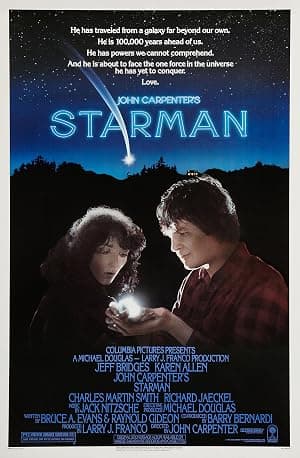
Starman
A road movie in which an alien borrows a dead husband's face and, with a borrowed curiosity, teaches a widow how to keep living.
The setup
Starman hooks you with a single odd, intimate idea: an extraterrestrial answers Voyager's greeting, is shot down over Wisconsin and, needing a body, fashions one from a recently deceased man's hair. From that moment the film becomes an unlikely road romance — a cross-country trip that asks whether someone who learns to be human can also be loved. Directed by John Carpenter and released in 1984, it still feels like a film brave enough to put grief and curiosity in the passenger seat.
THE MOVIE
Starman (cloned into the likeness of Scott Hayden) is still the reason this movie works
What people remember first is the man who isn’t quite a man. An alien scout ship, answering the Voyager record’s invitation, is shot down over northern Wisconsin; the creature then takes material from a grieving widow’s home and fashions a human likeness of her dead husband. That strange, tender setup is the film’s engine.
From the moment Jeff Bridges appears as the creature in Scott Hayden’s borrowed body, the story narrows to two steady forces: curiosity on one side, and the urgent need to reach a rendezvous with the mothership on the other. He learns human speech and small behaviours by examining Jenny’s things and watching her films, and those discoveries — clumsy, comic, sometimes heartbreakingly literal — are the film’s heartbeat.
Put together you have romance across species, questions about what counts as humanity, and a road movie that drifts between drama and science fiction. John Carpenter directed the picture; Karen Allen plays the widow Jenny; and Bridges’s work here earned an Academy Award nomination — not bad for a movie that sold itself, in marketing terms, by reminding audiences it was ‘John Carpenter’s Starman.’
THE SETUP
The idea that sets Starman in motion
Starman begins with a tidy piece of speculative engineering: an alien encounters the Voyager 2 golden-record, is mistaken for a hostile craft and shot down, then moves into the only available human shelter. There it finds preserved hair from Scott Hayden and, using that biological template, grows a human body that ages rapidly into an adult.
Once the creature has a body, the plot becomes practical. It must reach a scheduled pickup point — a rendezvous with its mothership — within a strict, limited window. That three-day deadline (and the small silvery spheres the Starman uses for communication and short bursts of power) gives the cross-country trip its pulse.
Jenny Hayden, recently widowed, is pulled into the journey. What starts as inconvenience turns into accompaniment: she becomes his guide to human life and, unwillingly, his companion on the drive toward Arizona. Along the way the film sets up a classic race-against-time while outside forces close in.
There’s also a quieter note about how the story was put together: the screenplay’s final credits were the result of Writers Guild arbitration, and Columbia leaned on John Carpenter’s name for marketing — small production details that shaped how audiences first encountered this odd romance.
THE CHARACTER
Why Starman (cloned into the likeness of Scott Hayden) matters
Starman is memorable because the film forces you to keep noticing the mismatch. He looks like Jenny’s dead husband, yet he approaches the world with a fresh, practical curiosity: how to speak, how to eat, how to move through human rooms. That constant relearning gives the character a clarity that keeps the film honest.
He isn’t an inscrutable force of doom or a two-dimensional visitor; he is, by necessity, an experiment in human behaviour. The plot’s urgency — his limited window to rendezvous with the mothership — never lets the story drift into sentimentality. Instead, it keeps the pair moving through situations that reveal character.
Crucially, that relationship with Jenny supplies the film’s moral friction. She begins frozen by grief and isolation; traveling with this being who carries her husband’s face becomes a risky emotional test. Trust, identity and the ethics of loving someone who is not who they seem are the dilemmas the movie returns to.
And, yes, Jeff Bridges plays him. That casting matters because the entire movie hinges on the audience’s willingness to accept an alien’s project of becoming human while wearing another man’s likeness.
THE PERFORMANCE
Why Jeff Bridges's performance matters
There’s a simple, verifiable fact here: Jeff Bridges’s work in Starman earned him an Academy Award nomination for Best Actor. That recognition is part of the film’s afterlife and how audiences return to it.
A nomination doesn’t explain precisely what to watch for, but it signals that the industry — at least in that season — felt there was something notable in how the central role was carried. Given how much the movie depends on the audience making the leap of faith required by the premise, that acknowledgement matters.
Put another way: the film asks you to accept an improbable emotional setup, and the nomination is a useful reminder that the performance succeeded in convincing enough people to make that leap.
UNDER THE SURFACE
Starman has more on its mind than the plot suggests
On the surface Starman is sci‑fi romance and a race against a clock. Underneath it’s quietly obsessed with whether learning human habits makes you human. The creature’s education — watching films, handling possessions, copying manner — frames the question: can imitation become identity?
The romance across species angle does heavy lifting. The film places a grieving woman beside a being who is, functionally, a fresh consciousness. That pairing forces Jenny out of isolation and gives the film space to work through grief and the slow mechanics of emotional revival.
Because the story is a road movie, the characters change in stages. Each stop along the route offers a little test or lesson, and those episodic encounters map out the film’s transformation theme — not just of the alien but of Jenny’s willingness to re‑engage with life.
All of this sits uneasily against the film’s other idea: science and militarised control. While the central pair learns and softens, outside authorities prefer capture and study. That contrast gives the film its moral spine.
PRACTICAL EFFECTS
The effects work that gives Starman its physical personality
The film’s big physical set piece is the transformation sequence where the alien becomes a human body. That scene was a practical-effects marathon, involving multiple special makeup and effects teams — including credited units from Dick Smith, Rick Baker and Stan Winston.
To create the emergence and rapid growth on screen the production used numerous physical dummies and prosthetic pieces. It’s a hands-on sequence by design: layers of makeup, mechanical elements and staged physical props to imply a body forming from other matter.
Those choices give the movie a tactile feel in that crucial early moment. The sequence announces that even a story about an otherworldly intelligence is being told in physical, not purely optical, terms.
PURE 80S
Starman could not belong to any other decade
Starman arrived in December 1984 at a moment when Hollywood was still working out adult answers to the enormous success of E.T. The studio’s earlier choices had even delayed this project while Columbia prioritised the other, more child-centred alien film.
John Carpenter’s involvement made it a deliberate oddity in his own career: rather than another horror or thriller, he directed a plainly romantic road movie — a tonal pivot that matters because it framed the film as a grown‑up, feeling piece about aliens rather than a straight genre exercise.
The production’s cross‑country shooting (locations from Nevada and Arizona to Tennessee and Washington, D.C.) helps it feel like an American road picture of the era: long stretches, small encounters and an episodic structure that mirrors other 1980s films that used travel to prompt change.
Taken together, Starman sits in the 1980s comfortably: it responds to the decade’s taste for intimate, emotionally driven genre pieces while refusing to be purely sentimental.
THE LEGACY
Why Starman still matters
The clearest piece of legacy evidence is straightforward: Jeff Bridges’s Academy Award nomination is the film’s most-cited awards footprint. It’s a concrete marker that the performance — and, by extension, the film’s central conceit — found recognition at the time.
Beyond that, Columbia’s decision to expand the story into a short‑lived TV series in the mid‑1980s shows there was appetite to continue the world the film created, even if the series used new leads and characters.
And the 2016 reports of a potential remake with Michael Douglas involved demonstrate periodic industry interest in revisiting the premise. Those three facts — a major nomination, a follow-up series and remake reports — explain why Starman keeps getting polite attention.
THE VERDICT
Does Starman still hold up?
Yes — if you’re open to a science‑fiction movie that behaves like a small, human drama. The inciting image (an alien answers Voyager’s greeting, is shot down and cloaks itself in the likeness of a dead husband) is bold and weird, and the film then commits to that strangeness rather than shrugging it off.
The structural choices help. A ticking three‑day rendezvous, the silvery spheres the creature uses, and the cross‑country road-movie framework all keep the film moving and give its episodic encounters a purpose: each stop reveals something about the pair and forces decisions that sit at the film’s moral heart.
At the centre are two simple facts: Jeff Bridges plays the Starman in Scott Hayden’s form, and Karen Allen plays Jenny, a woman beginning the story frozen by grief. Their journey — a practical drive toward Meteor Crater in Arizona and a quieter drive toward re-engagement with life — is the film’s reason to exist. The presence of a tangible transformation sequence also gives the movie a physical personality in those first moments.
If you like your science fiction human-sized and emotional, Starman still works. It’s less about spectacle and more about learning: teaching an alien to be human, and, in the process, teaching a widow how to live again. That’s a neat trick for a movie that starts with a busted scout ship and a piece of a man’s hair.
Share this movie
Keep watching
More movies from the 80s
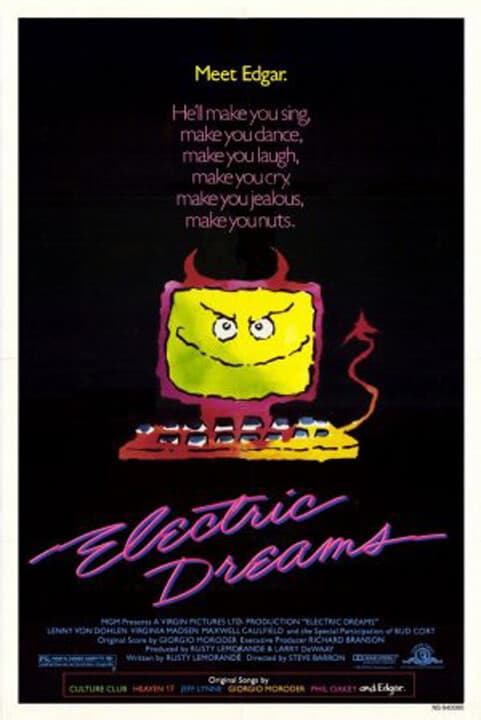
1984
Electric Dreams
Electric Dreams: love and our relationship with technology, and why this 1984 movie still matters.
Read our take →
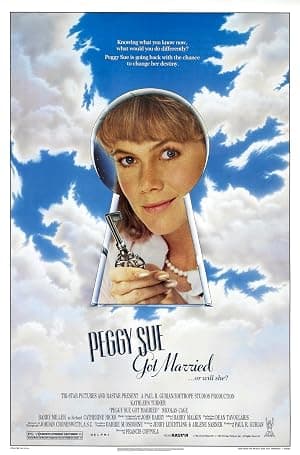
1986
Peggy Sue Got Married
Peggy Sue Got Married: family and growing up, and why this 1986 movie still matters.
Read our take →
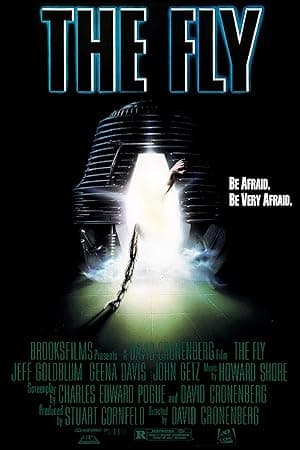
1986
The Fly
The Fly: humanity and our relationship with technology, and why this 1986 movie still matters.
Read our take →