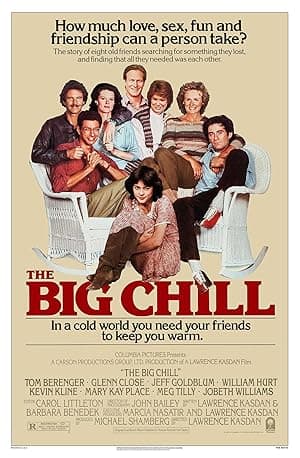
The setup
If you remember The Big Chill at all, you probably remember a house full of old friends and an even older playlist. Lawrence Kasdan’s 1983 reunion drama hinges not on action but on talk — a weekend at Harold and Sarah Cooper’s where grief, nostalgia and the compromises of middle age are argued over cigarettes, breakfast and the occasional dance. Sam Weber is the informal centre of that conversation: he’s the character you keep returning to when you want to understand why the film still feels so human.
THE MOVIE
Sam Weber is still the reason this movie works
The Big Chill starts with a shock that feels quietly domestic: a funeral. Alex’s suicide pulls a group of former college friends back under one roof and gives Kasdan something a little sharper than mere nostalgia to talk about.
What follows isn’t a plot so much as a weekend of company — the Cooper house becomes a small theatre for old arguments, grudges, flirtations and the awkward accounting every generation must do. That house-party engine gives the film permission to turn small gestures — shared meals, late-night drinks, the ritual of records — into real drama.
And at the middle of all that is Sam Weber. He’s the presence you notice first and last: the friend who helps you see the group as a living thing, not just a scrapbook of former selves. Kasdan directs the whole thing with that one practical idea in mind — people in a room reacting to one another — and it’s what makes the movie worth revisiting.
THE SETUP
The idea that sets The Big Chill in motion
There isn’t a chase or a scheme hiding beneath The Big Chill’s calm surface. The engine is simple: an event — a funeral — gathers a set of people, and the movie watches what they do when they’re left in a big house together.
Kasdan keeps the drama domestic on purpose. Most of the film’s moments are conversation-driven and anchored in tiny rituals: making coffee, handing someone a record, sitting on a back porch and not saying very much. Those small actions are the plot.
Kasdan even trimmed away material that might have turned the movie into a different shape. Flashback sequences were filmed — including scenes with Kevin Costner — but Kasdan decided the present-tense weekend was the point of the film; Costner remains visible only as Alex’s corpse in the opening.
That restraint makes the storytelling feel insider-simple: you don’t need grand events to reveal a lot about who these people became.
THE CHARACTER
Why Sam Weber matters
Tom Berenger’s Sam Weber is the friend you watch when you’re trying to read the rest of the room. He isn’t modelled as the loudest or the smartest; he’s a hinge — the person whose choices, small talk and silences allow other characters to reveal themselves.
Sam matters because the film is, at its heart, about friendship: not the mythic kind but the practical, sometimes messy persistence of it. Watching him around the others gives the reunion its scale. It’s through characters like Sam that the past keeps sneaking into the present.
The Big Chill sits in a conversation started by smaller ensemble pictures — those reunion-of-activists movies that trade on shared history — and Sam is the kind of character that makes that format feel alive rather than schematic.
In short: he’s the thread you follow when everyone else is talking. Lose him and the weekend becomes a series of anecdotes; keep him and the group reads like an actual community.
UNDER THE SURFACE
The Big Chill has more on its mind than the plot suggests
On paper the movie is a reunion comedy-drama. Underneath, it’s a film about disillusionment — people who once believed in big political projects now measuring their lives against mortgages and business deals.
Nostalgia is everywhere, but Kasdan doesn’t treat it as comfort. The soundtrack and the constant exchange of memories act as a kind of emotional currency: music keeps the past present, and the friends keep testing whether the past still pays.
Mortality sits beside that nostalgia. Alex’s death reframes the weekend: this isn’t just reminiscing for fun, it’s a reckoning. The presence of suicide gives the chatter weight; suddenly the small compromises of adult life feel more consequential.
Above all, the film watches friendship as something that survives time, even when ideals fade. The persistence of memory — the way people remember themselves and each other — is where the film finds its real feeling.
THE FILMMAKING
How The Big Chill was put together
Kasdan’s movie feels intimate because the crew assembled to make it favoured clarity over flourishes. That was a deliberate choice: the film’s energy comes from ensemble exchange, so the work of the cinematographer, editor and production designer is quietly functional.
John Bailey is credited as director of photography and Carol Littleton as editor. Their jobs were the practical ones — showing the room and letting conversation land without drawing attention to camera tricks.
Ida Random provided the production design that makes the Coopers’ house read as lived-in and private, the necessary stage for private conversations. The house-as-stage approach is one reason the film keeps its focus on people rather than plot.
Put simply: the filmmaking choices support talk. The movie would fall apart if the space didn’t feel convincing, and the credited crew are the people who made that happen.
PURE 80S
The Big Chill could not belong to any other decade
Released in 1983, The Big Chill landed at a moment when the baby-boomer generation was starting to look back and ask what happened to the promises of the 1960s. The film taps that conversation directly: it’s essentially a middle-age reckoning for people who once imagined changing the world.
Its success was also a sign of the times. The movie was made for a modest sum and went on to perform strongly at the box office — a reminder that adult ensemble dramas could find an audience in the early 1980s.
Kasdan was coming off a very different kind of film — his earlier directorial work had a looser, noir-ish energy — and The Big Chill feels like a more personal, semi-autobiographical turn after that. It’s a grown-up picture from a director who wanted to sit with a generation’s questions.
Even the production’s pace and location choices (principal photography wrapped in early 1983 using a single primary house) help the film read as a piece of its moment: domestic, reflective and attuned to a generation’s anxieties.
THE LEGACY
Why The Big Chill still matters
There are a few straightforward reasons The Big Chill keeps getting mentioned. It earned major recognition on release — including three Academy Award nominations and the People’s Choice Award at its Toronto premiere — which cemented its standing at the time.
The soundtrack deserves its own footnote: the film’s compilation of 1960s and 1970s pop, soul and R&B helped reintroduce that music to 1980s listeners and the soundtrack’s chart success became part of the movie’s afterlife.
Beyond awards and albums, the film’s model of adult ensemble drama fed into later television and cinema: shows like Thirtysomething and other ensemble reunion pieces took cues from a picture that made grown-up friendships dramatic material.
And its place in cultural preservation has been sealed recently: in 2025 The Big Chill was selected for preservation in the U.S. Library of Congress National Film Registry as a title considered significant for its cultural and historical value.
THE VERDICT
Does The Big Chill still hold up?
Yes — but with a specific caveat. The Big Chill works because it’s honest about what it wants to do: gather people, let them talk, and let music and memory stitch the moments together. The funeral that opens the film isn’t a gimmick; it’s the moral shove that makes those talks feel necessary rather than indulgent.
If you enjoy films that are powered by conversation and small domestic rituals — eating, drinking, putting on a record — this is a model of the form. Kasdan chose not to soften the film with later flashbacks that were shot and then removed; that decision keeps the focus on the present tension between youthful ideals and adult compromise.
There are parts that feel very of their time, and that’s part of the point: the movie is about a generation’s reckoning. Glenn Close’s recognition by the Academy and the soundtrack’s success are reminders that the film resonated widely on release, and it still surfaces the arguments that matter when friends evaluate where they’ve landed.
So watch it for the conversations, for the way a houseful of old friends can feel like an entire world, and for Sam Weber — the character who gives the group its emotional centre. It’s not a film that dazzles with spectacle; it asks you to listen. That turns out to be a pretty good business model for a movie about memory.
Share this movie
Keep watching
More movies from the 80s
1983
Flashdance
Flashdance: family and mortality and lifespan, and why this 1983 movie still matters.
Read our take →
1983
Yentl
Yentl: family and love, and why this 1983 movie still matters.
Read our take →
1984
Amadeus
A tale of genius through the jealous eyes of a faithful man — and a confession that never lets you look away.
Read our take →