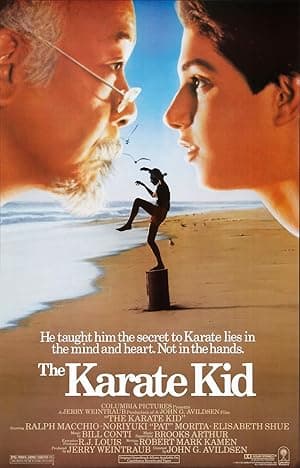
The Karate Kid
A teenager, a handyman, and the long, strange apprenticeship that taught a generation how to stand up for themselves.
The setup
The Karate Kid is often remembered for a few famous images — a balance drill, a tournament crowd, a curt, wise old man. But what keeps people returning is a very simple thing: a teenager trying to find his feet and the unlikely mentor who shows him how. Directed by John G. Avildsen and released in 1984, it still feels like a movie about learning — not just kicks, but manners and balance and patience.
THE MOVIE
Daniel LaRusso is still the reason this movie works
Think of the film and your mind snaps to the kid who moves across the country and immediately finds trouble. Daniel LaRusso is that kid: new school, new life, and a target for Cobra Kai’s students. The story hooks you because it gives that simple, relatable pressure a face — and then makes us care about how Daniel handles it.
When the bullying escalates, help arrives from an unexpected place: Mr. Miyagi, the apartment handyman who steps in and ends up training Daniel. That exchange — a rough, generational friendship that turns into mentorship — is the film’s heartbeat.
That heartbeat is framed by John G. Avildsen’s direction, a 126-minute running time that lets the relationship breathe, and a cast led by Ralph Macchio and Noriyuki 'Pat' Morita. It’s a familiar shape: newcomer fights back, learns discipline, and heads for the tournament — but it’s the human centre that keeps the shape interesting.
THE SETUP
The idea that sets The Karate Kid in motion
At its simplest, the film places an ordinary teenager in an uncomfortable, even hostile, new environment. Daniel has moved from New Jersey to the Los Angeles area and, as a newcomer, draws the attention of the Cobra Kai dojo’s students.
Those encounters escalate: what starts as taunting becomes repeated bullying and physical assaults, and the personal stakes grow quickly. That escalation gives the film a clear, forward-driving problem: Daniel needs a way to defend himself and to belong somewhere.
Mr. Miyagi arrives not as an instant solution but as a steadying presence. An apartment-complex handyman by trade, he intervenes on Daniel’s behalf and — surprisingly — agrees to teach him karate.
Behind those choices sit the film’s origins: a project sparked by a producer’s idea and a screenplay that borrows from its writer’s martial-arts experience, which gives the training scenes a lived-in quality rather than empty stunt work.
THE CHARACTER
Why Daniel LaRusso matters
Ralph Macchio’s Daniel is built from three very human wants: to belong, to stop being picked on, and to prove himself when it counts. That trio keeps the movie honest — the problems feel specific, not theatrical.
He’s not an expert, and he rarely acts like one. Mostly he’s reacting — to school, to rivalry, to a new crush — which makes his small victories feel earned. The movie asks us to care because his desire is recognisable: who among us hasn’t wanted to fit in or show we can stand up for ourselves?
Daniel’s arc matters because it’s practical as well as emotional. Training becomes a way to measure change: the awkward kid practicing a drill is easier to root for than a polished prodigy.
And crucially, the film keeps the stakes personal. He’s not after glory so much as dignity; that keeps the story warm rather than smug.
THE PERFORMANCE
Why Noriyuki "Pat" Morita's performance matters
Noriyuki 'Pat' Morita is credited as Mr. Miyagi, and his portrayal carried enough weight at the time to draw significant awards attention.
Contemporary reporting and the awards circuit recognised that portrayal with an Academy Award nomination for Best Supporting Actor, a concrete sign that his turn did something notable beyond the film’s plot mechanics.
That nomination matters because it moves Mr. Miyagi from the realm of a supporting trope into something the industry singled out as important — a mentor figure who helped define the movie’s emotional shape.
Whether you remember him for his quiet teaching or for the way the film hinges on their partnership, the nomination is evidence the role resonated beyond the playground and the tournament mat.
UNDER THE SURFACE
The Karate Kid has more on its mind than the plot suggests
On the surface it’s a fight film, but underneath it’s focused on mentorship and intergenerational friendship: an older hand showing a teenager how to carry himself. That relationship gives the set pieces real emotional weight.
It’s also a coming-of-age story. Daniel’s training is literally and figuratively about balance — learning to control emotions, to focus, and to make small disciplined changes that add up.
Bullying and self-defence are handled as more than spectacle. The film posits that learning to defend yourself responsibly requires discipline, not aggression, which puts it on the side of self-control rather than revenge.
There’s an undercurrent of cultural exchange too: the film stages an East–West contrast through the martial-arts teaching and what Daniel takes away from it, which gives the lessons a philosophical as well as physical edge.
THE FILMMAKING
How The Karate Kid was put together
Technically the film is credited to a small, focused team: James Crabe as director of photography and William J. Cassidy as production designer. Those credits point to a production that relied on experienced hands to deliver a believable, lived-in world.
John G. Avildsen, the director, brings a steady, familiar approach to the underdog-sports template, allowing scenes to breathe so the training beats and small gestures matter.
Because the movie is anchored in character, the technical work tends to serve clarity over flash: design and photography support the performances and the training rhythms rather than competing with them.
That collaborative, modest construction is part of its personality — the film looks like it wants you to watch people, not be dazzled by technique.
PRACTICAL EFFECTS
The effects work that gives The Karate Kid its physical personality
The film’s physicality is supported by credited special-effects and stunt teams rather than flashy optical trickery. Special-effects work is listed under Frank Toro, which points to a modest SFX contribution.
Stunt performers and coordinators are also named in the credits, including Pat E. Johnson among the credited stunt team and referee. That roster underlines that the fighting and falls were handled with professionals on the ground.
Those staffed roles matter because they let the film stage believable blows and tournament sequences while keeping actor safety and clear action in focus.
In short: the movie’s physical moments rely on practical stuntcraft and credited effects personnel to keep things convincing rather than on spectacle for spectacle’s sake.
PURE 80S
The Karate Kid could not belong to any other decade
The Karate Kid arrived in the summer of 1984 and quietly became a sleeper hit — its box-office take was substantial enough to mark it as one of that season’s surprises.
It landed at a moment when youth-centred coming-of-age tales and sports pictures were enjoying a cultural moment. The film folded neatly into that trend: a teenager, a coach, and a competition at the end.
It also fed the decade’s appetite for martial-arts interest: the movie helped sustain popular curiosity about karate and related programming through the 1980s.
Production itself was compact and efficient — principal photography began in late 1983 on a roughly 45-day shoot with locations around the San Fernando Valley and nearby areas, which kept the film feeling immediate rather than overworked.
WATCHING IT NOW
What has aged — and what hasn't
Some parts of The Karate Kid have stuck in the public mind in a way that transcends nostalgia. Retrospectives and later criticism regularly point to the mentor–student relationship and the film’s training beats — 'wax on, wax off' and the crane kick among them — as elements that keep people talking.
Those moments work because they’re concrete and repeatable: a simple physical lesson stands for a larger moral or emotional shift. They’re the kind of moments friends quote to each other — shorthand for patience and practice.
As a teen drama, its central relationships still play: the training and the slow build to the tournament keep the film’s propulsion human rather than merely plotty.
Not everything ages the same for every viewer, but the movie’s memorable set pieces and its focus on patience and discipline are the bits most likely to survive repeated viewings.
THE LEGACY
Why The Karate Kid still matters
The film’s success created a multi-film franchise, with direct sequels and later installments that kept returning to the Miyagi–Daniel relationship. That continuity is part of why the original remains a reference point.
Pat Morita’s Academy Award nomination for Best Supporting Actor gave the movie a seriousness it might otherwise have lacked, signalling that the industry recognised more than just a crowd-pleasing teen drama.
Specific set pieces — the training sequences, catchphrases and the All Valley tournament — have recurred in popular culture and spin-offs, turning scenes from the film into touchstones that other works can riff on.
The film’s standing has also been marked by preservation and retrospective attention, culminating in official efforts that treat it as an important piece of American cinema history.
THE VERDICT
Does The Karate Kid still hold up?
Yes — and the answer is simpler than you might expect. The core conflict is everyday and immediate: a new kid is targeted by a gang of students, and he needs to learn to stand up for himself. That premise still reads cleanly and clearly.
What helps the film survive is the method: a wise older man intervenes and teaches not flashy moves but steady, repetitive lessons. The training sequences double as physical conditioning and as lessons in discipline, which means the film rewards patience over spectacle.
The screenplay draws on the writer’s own martial-arts experience, which gives some of the drills and rhythms an authentic feel, and the All Valley Karate Championships remain a tidy, emotional climax where everything the characters have been working toward is put to the test.
If you watch it now for the teacher–pupil relationship and the specific training beats, you’ll find the parts that mattered then still work now. It’s a warm, economical coming-of-age: not flawless, but genuine. In short, it still teaches what it set out to teach.
Share this movie
Keep watching
More movies from the 80s
1986
The Karate Kid Part II
A seaside sequel about duty, dancing and learning when not to fight.
Read our take →
1985
The Last Dragon
The Last Dragon: courage and power, and why this 1985 movie still matters.
Read our take →
1985
The Protector
The Protector: family and parents protecting their children, and why this 1985 movie still matters.
Read our take →