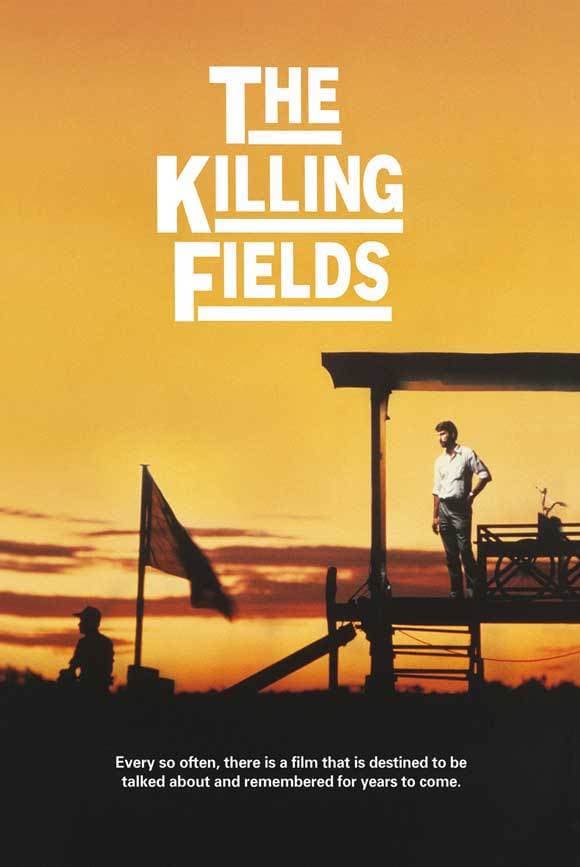
The Killing Fields
A reporter’s conscience, a translator’s survival — and a film that forces you to keep looking.
The setup
The Killing Fields grabs you by a relationship rather than a headline. At its centre is Sydney Schanberg, the driven New York Times correspondent whose decisions — and the guilt that follows them — give the film its pulse. Roland Joffé’s 1984 drama turns reporting and friendship into a moral engine that still demands attention.
THE MOVIE
Sydney Schanberg is still the reason this movie works
What people remember most about The Killing Fields isn’t a firefight or a political speech. It’s the way the film fixes on one relationship: a New York Times correspondent and the Cambodian colleague who keeps him alive and, later, haunts him. That bond — equal parts professional dependence and personal affection — is the movie’s anchor.
Bruce Robinson’s screenplay reached the screen from Sydney Schanberg’s own reporting, so the movie feels less like a detached historical pageant and more like the expanded anatomy of a single journalist’s story. That choice keeps the film narrowly, humanly focused even as it handles very big, terrible events.
Roland Joffé stages all of this across a long running time with Sam Waterston as the correspondent and Haing S. Ngor as the colleague whose fate propels Schanberg’s conscience. Friendship, survival and survivor guilt are not just themes here — they’re what the plot is built around.
THE SETUP
The idea that sets The Killing Fields in motion
At its simplest, the film uses journalistic routine — reporting, embassy contacts, evacuation attempts — as the mechanism that decides who stays and who leaves. Those everyday professional rhythms become dramatic pressure-cookers: a missed opportunity, a delayed clearance, or a decision to keep reporting can change a life.
That device keeps the story taut. Rather than inventing melodrama, the plot follows the small, believable choices of people doing their jobs as the wider polity collapses around them.
Because the movie is rooted in history, those procedural beats also carry heavy moral weight. The fall of Phnom Penh and the chaotic evacuations are not set-pieces for spectacle but the events that force characters into survival choices and separations.
It’s a focused structure that lets the film do two things at once: show how reporting happens in a crisis, and measure the human cost of those routines.
THE CHARACTER
Why Sydney Schanberg matters
Sydney Schanberg is not an abstract ‘man of the press’ archetype. He is written and staged as a driven correspondent whose choices — professional, procedural and personal — shape the film’s moral ledger.
Because the screenplay comes from Schanberg’s own article, the picture of him feels intimate and particular rather than generic. He’s the axis around which the story’s questions of duty and guilt turn.
That’s why the friendship with his Cambodian colleague is crucial: it’s not just companionship on deadline, it’s the human consequence of every dispatch and evacuation attempt.
Put bluntly: remove Schanberg and you remove the film’s reason to keep asking uncomfortable questions about what reporters can and should do in a collapsing state.
THE PERFORMANCE
Why Sam Waterston's performance matters
The industry took notice: Sam Waterston earned an Academy Award nomination for his portrayal of Sydney Schanberg.
That nomination matters because the film asks its lead to carry moral weight — to be the face of professional ambition colliding with personal remorse — and the recognition shows the role registered with awards voters.
Treat the nomination as a signal rather than a certificate. It tells you the filmmakers leaned on Schanberg as the movie’s moral focal point and that Waterston supplied the kind of presence such a role needs.
In short: whether or not you respond to the performance personally, it’s central to how the film frames its questions about reporting, responsibility and guilt.
UNDER THE SURFACE
The Killing Fields has more on its mind than the plot suggests
On the surface it’s a historical drama about Cambodia’s collapse; under the surface it’s a study of how friendship, survivor guilt and professional duty fracture under extreme pressure.
Journalistic ethics are threaded through the film — not as academic debate but as immediate, wrenching choices: who do you try to save, who do you write about, and how do those actions reverberate later?
At the same time, genocide and survival are handled as stubborn facts of the story world. The film stages forced evacuations, internment and labour conditions in ways that keep the human stakes front and centre.
Finally, memory and testimony matter because this is, in part, a film about witnessing. The characters’ accounts, and the film’s reliance on a reporter’s point of view, turn testimony into the only surviving record of what happened.
THE FILMMAKING
How The Killing Fields was put together
Although the story is rooted in Cambodia, much of the production recreated that world in Thailand. That practical choice allowed the film to stage large, difficult sequences while working from a single production base.
The crew choices mattered. Chris Menges’s cinematography and Jim Clark’s editing were singled out in contemporaneous coverage, and that attention isn’t incidental: the film depends on composed images and rigorous cutting to move between reporting sequences and the harsher realities the characters face.
Those technical contributions help the movie hold together across its long running time. The film needs a steady formal hand to keep the journalistic material coherent while also delivering scenes of displacement and horror.
Put another way: the filmmaking is the scaffolding that lets a personal story sit inside a larger historical catastrophe without losing emotional focus.
PRACTICAL EFFECTS
The effects work that gives The Killing Fields its physical personality
The film doesn’t rely on optical trickery so much as on physical staging. For its 'killing fields' sequences the production used staged, realistic-looking corpses and field setups to convey mass execution sites.
That tactile approach extends to the refugee and labour-camp conditions the film recreates: prosthetics, make-up and production design are the tools the filmmakers used to make the horrors feel immediate.
Fred Cramer is credited as the special effects supervisor and Tommie Manderson as chief make‑up and prosthetics supervisor, names attached to the practical work that shapes the film’s unsettling textures.
The decision to foreground practical production design and make-up rather than rely on post-production effects keeps the film physically grounded — which, for material like this, makes a grim kind of sense.
PURE 80S
The Killing Fields could not belong to any other decade
This is very much a mid-1980s British film: a high-profile Goldcrest production associated with David Puttnam that brought recent Southeast Asian history into mainstream Western cinema conversation.
It also belongs to a small group of Western features from the era that dramatised the late-Vietnam-war orbit and its aftermath, often placing journalists at the story’s centre. That casting of reporters as protagonists feels particularly eighties in its approach to storytelling.
The film’s release and awards-season presence around 1984–85 did something practical: it helped bring the Khmer Rouge period to wider Western attention at a moment when many viewers were still processing the wider region’s recent past.
So while the themes are older than the decade, the decision to treat a reporter’s account as the organising principle is very much of its time — a British, mid-80s way of turning recent history into dramatic cinema.
THE LEGACY
Why The Killing Fields still matters
Awards-wise, the film did well: it received seven Academy Award nominations and took home three Oscars, including recognition for supporting acting, cinematography and editing.
It also earned major BAFTA attention and later found a place on notable film lists compiled by bodies such as the BFI and AFI — markers that it remained part of cinema conversations beyond its initial run.
Perhaps most importantly, the film helped widen Western public awareness of the Cambodian genocide. For many viewers at the time, it supplied a narrative frame and emotional language for events that had been difficult to grasp.
Those three outcomes — awards recognition, institutional remembrance, and a measurable contribution to public awareness — explain why the film keeps being returned to in discussions about cinema and history.
THE VERDICT
Does The Killing Fields still hold up?
Yes — with a clear rider. If you want a film that treats recent history as a moral problem and uses one man’s reporting to interrogate responsibility, The Killing Fields delivers that in a way most contemporary dramas simply do not attempt.
The movie’s central contrast — Schanberg’s attempts to report and evacuate versus Dith Pran’s capture, forced labour and eventual escape — remains a powerful dramatic engine. The tension between doing one’s job and saving a friend is the film’s repeated, unavoidable question.
Sam Waterston anchors the piece as Schanberg and the structure of journalistic routines and evacuation sequences gives the story a hard, credible spine. At the same time Haing S. Ngor’s casting as Dith Pran and the role’s later industry recognition underline how essential that relationship is to the film’s force.
So watch it for the moral pressure-cooker the filmmakers build, for the way the film makes professional choices feel like life-or-death ones, and for the uncomfortable ledger of survivor guilt it keeps open long after the credits roll.
Share this movie
Keep watching
More movies from the 80s

1984
2010: The Year We Make Contact
2010: The Year We Make Contact: our relationship with technology and humanity, and why this 1984 movie still matters.
Read our take →
1984
A Nightmare on Elm Street
A Nightmare on Elm Street: family and the safety of home, and why this 1984 movie still matters.
Read our take →
1984
A Passage to India
A Passage to India: family and parents protecting their children, and why this 1984 movie still matters.
Read our take →