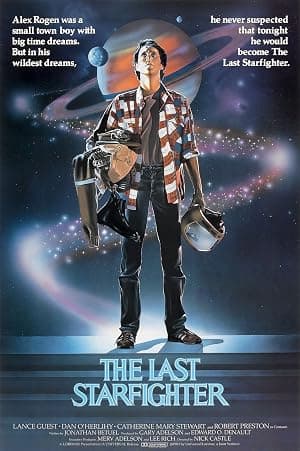
The setup
The Last Starfighter hands you a familiar 80s set-up — small-town kid, outsized destiny — and then makes the arcade machine the handshake between those worlds. It’s a coming-of-age that still prefers clear, bold choices over cleverness for its own sake, and it’s one of the few 80s SF pictures that lets a young player actually be rewarded for his skill. In short: it’s still worth talking about.
THE MOVIE
Alex Rogan / Beta Alex is still the reason this movie works
The opening hook of The Last Starfighter is practically a single, irresistible sentence: a teenager in a trailer-park beats the high score on an arcade game and is offered a ticket out. That exchange — joystick skill turned into real-world opportunity — gives the film its emotional engine and its central gamble.
When Centauri turns up to reveal the truth behind the Starfighter cabinet, the movie shifts from small-scale wish-fulfilment to a proper adventure. Alex is suddenly pulled into a conflict that requires him to choose between the cramped obligations of home and a much larger responsibility.
That tidy, vigorous premise — home life, a chance to escape, and the test that proves you’re ready — is why Nick Castle’s 1984 picture keeps getting mentioned. It’s lean, it moves, and Lance Guest’s Alex is the figure the whole thing hangs from.
THE SETUP
The idea that sets The Last Starfighter in motion
The film keeps its central mechanics delightfully simple. An arcade cabinet doubles as a recruitment simulator: someone good enough at the game is someone good enough to pilot for the Star League. It’s a neat, literal way to translate youthful practice into adult opportunity.
That mechanical neatness matters because it lets the story focus on the human trade-offs. Alex is asked to choose between the people and duties who expect him on Earth and a sudden obligation to defend an interstellar alliance from a traitor named Xur and the Ko-Dan Armada.
The movie also sets up a tidy dramatic convenience: a Beta unit, an android duplicate, stays behind to impersonate Alex while the real boy serves with the Star League. It’s a tidy way to keep family stakes present without slowing the space action.
All told, the film’s premise works because the recruitment idea is both plausible inside the movie’s rules and because it gives the lead a believable reason to leave: skill becomes mobility, and mobility becomes responsibility.
THE CHARACTER
Why Alex Rogan / Beta Alex matters
Alex is the neat hinge the film needs: he’s recognisable as a kid who wants more for his life and also believable as someone who could be scouted by a videogame. That combination — aspiration plus practical skill — keeps the audience rooting for him.
The Beta duplicate is more than a plot trick. Having an android stand in keeps Alex’s choices in focus: the story continually asks what it costs to leave home, and what staying would mean. The presence of Beta makes those questions concrete.
Because the movie is comfortable being a family picture, Alex is written with clarity rather than complication. You understand his motivation in a single scene and that focus lets the rest of the film do the fun stuff: space battles and the responsibilities that come with them.
Lance Guest plays both parts, human and stand-in, which is why the character works as both wish fulfilment and someone the film trusts to carry a straightforward narrative.
THE PERFORMANCE
Why Lance Guest's performance matters
Contemporary reviews and later write-ups tend to single out Lance Guest for giving the film a grounded lead — the sort of centre of gravity a space adventure needs if it’s not going to float away into pure spectacle.
That grounding matters because the movie’s pleasures are split between home life and interstellar duty. If Alex didn’t feel readable as a kid from a trailer park with an ache to prove himself, the emotional exchanges at home (and the stakes of leaving them) would fall flat.
Put plainly: having a sympathetic, sensible protagonist lets the story move quickly between earnest family moments and broad space-opera set-pieces without losing the audience.
So yes: whatever else the film is — a tech milestone, a neat conceit — it succeeds by trusting its lead to keep the human throughline intact.
UNDER THE SURFACE
The Last Starfighter has more on its mind than the plot suggests
At a glance it’s an adventure about spaceships. Underneath, it’s a coming-of-age story: a young person leaves home and is suddenly responsible for other people’s lives. That shift from practice (gaming) to duty is the film’s moral pivot.
The trailer-park setting is purposeful. It’s shorthand for constraint — economic and social — and it makes Alex’s decision to go all the more meaningful. He isn’t escaping glamour; he’s taking on responsibility that his circumstances wouldn’t otherwise offer.
There’s also a specifically 80s idea threaded through the film: technology as a route upward. The game isn’t just a diversion; it’s a job interview. That notion of youth-tech mobility sits at the movie’s emotional core.
Finally, the film refuses to make the stakes purely personal or purely cosmic: it mixes both. The personal reason to leave and the public reason to fight end up bolstering each other, which is why the narrative feels satisfyingly whole.
THE FILMMAKING
How The Last Starfighter was put together
Nick Castle directed Jonathan Betuel’s screenplay with a team that clearly knew when to keep things simple and when to go big. The production design and cinematography support a split personality: grounded scenes on Earth, and proper space-opera environments when Alex leaves.
That mix is deliberate. The movie doesn’t try to paper over its smallness; it contrasts the familiar with the strange so the leap feels earned. Production designers and the editor help the film switch gears without losing pace.
You can hear that careful construction in how scenes move: domestic setup, then efficient removal of baggage so the action can breathe. It’s a modest, effective directing choice that keeps the audience invested in both halves.
In short, the film is built to serve the story’s two obligations — home and space — and it mostly succeeds by treating each on its own terms.
PRACTICAL EFFECTS
The effects work that gives The Last Starfighter its physical personality
Where the movie really stakes a claim is its use of computer-generated imagery. Contemporary records place roughly twenty to twenty-seven minutes of CGI in the finished film — a substantial amount for an early-80s feature.
Those sequences were produced by Digital Productions and its founders using Cray-class supercomputers and bespoke digital pipelines. That was cutting-edge hardware for the time and gave the space combat a crisp, three-dimensional feel that practical miniatures alone couldn’t easily match.
Because the CGI was a deliberate, visible choice, it shapes how modern viewers experience the film: the digital work defines the look of the starfights and marks the movie as an early experiment in cinema’s digital future.
It’s a specific technological personality, not a generic claim about effects being better or worse — the film chose to use digital methods and it became part of its identity.
PURE 80S
The Last Starfighter could not belong to any other decade
The arcade cabinet as a plot device plugs the film directly into early-80s youth culture — a moment when videogames were new enough to feel like portals to other lives. Making a game the point of recruitment captures both anxieties and optimism about technology from that era.
Alongside that cultural link, the movie sits in the period’s technical story. It’s often grouped with other early CGI milestones — films that experimented with digital 3D to do things model work couldn’t easily accomplish. That technical ambition is an 80s fingerprint.
The film’s production dates and its mid-1984 release place it squarely in that moment when Hollywood was testing new tools and new ideas about how youth and technology could intersect on screen.
So it’s not just nostalgia: both the premise and the technical choices make the movie feel of its time in a way that’s relevant to its themes.
WATCHING IT NOW
What has aged — and what hasn't
Interest in the film has been renewed by careful home-video restorations — including a 4K scan with archival extras — that foreground its place in the history of computer-generated effects. Those restorations make it easier to view the film as an artefact of technological ambition rather than just a dated curiosity.
Narratively, the family-friendly bones remain intact. The running time and clear storytelling give contemporary viewers a brisk, straightforward experience that doesn’t demand specialized context to be enjoyed.
If you come for the ideas — a kid turning gaming into opportunity, and the weight of responsibility that follows — those elements still read cleanly. The film’s strength is in its clarity, which helps it survive changes in taste.
Where the movie is most likely to divide modern audiences is how you feel about early-digital visuals. But thanks to restorations and the film’s readable story, it still works as a piece of 80s science fiction with something concrete to say.
THE LEGACY
Why The Last Starfighter still matters
Part of the film’s afterlife comes from its technical place in history: it was an early notable use of digital 3D animation in Hollywood features, and that milestone keeps it in discussions about how CGI entered mainstream filmmaking.
There’s also a quieter legacy in its soundtrack: Craig Safan’s score has been reissued in expanded and remastered editions, which suggests a continuing appetite for the film’s musical identity.
The movie also holds a specific footnote in career histories: it was Robert Preston’s final feature-film role, which adds a bittersweet corner to its legacy.
Finally, a devoted cult following and repeated sequel or reboot proposals over the years show the story hasn’t been forgotten; it continues to invite imagination about what else might have followed Alex’s first mission.
THE VERDICT
Does The Last Starfighter still hold up?
Yes — with a caveat. If you watch for story and character, it still does the job. The premise is clean: a kid from a trailer-park beats an arcade high score and is recruited by Centauri to defend the Star League. That clarity lets the film be both a family adventure and a coming-of-age tale without awkward detours.
The movie benefits from keeping its moral questions simple: Alex’s desire to escape and to prove himself is straightforward, and the presence of Grig and Centauri give him practical support as he converts gaming skill into real responsibility. Those relationships hold the film together.
Technically, the film is interesting rather than seamless. It used a significant chunk of early CGI produced on Cray-class machines — a historical curiosity that now reads as part of its personality. The recent 4K restoration makes that part of the film easier to assess on modern displays.
So if you’re in the mood for brisk, old-school SF where a game can change a life and the lead is written plainly enough to carry both home and space stakes — give it a watch. The Last Starfighter is less about dazzling reinvention and more about a tidy, enjoyable bridge between ordinary aspiration and interstellar duty.
Share this movie
Keep watching
More movies from the 80s
1984
Ghostbusters
A ragged band of scientists, a sardonic frontman and a city that refuses to behave — Ghostbusters still sells the joke.
Read our take →

1986
Critters
Critters: freedom and family, and why this 1986 movie still matters.
Read our take →

1982
Swamp Thing
Swamp Thing: freedom and fear, and why this 1982 movie still matters.
Read our take →