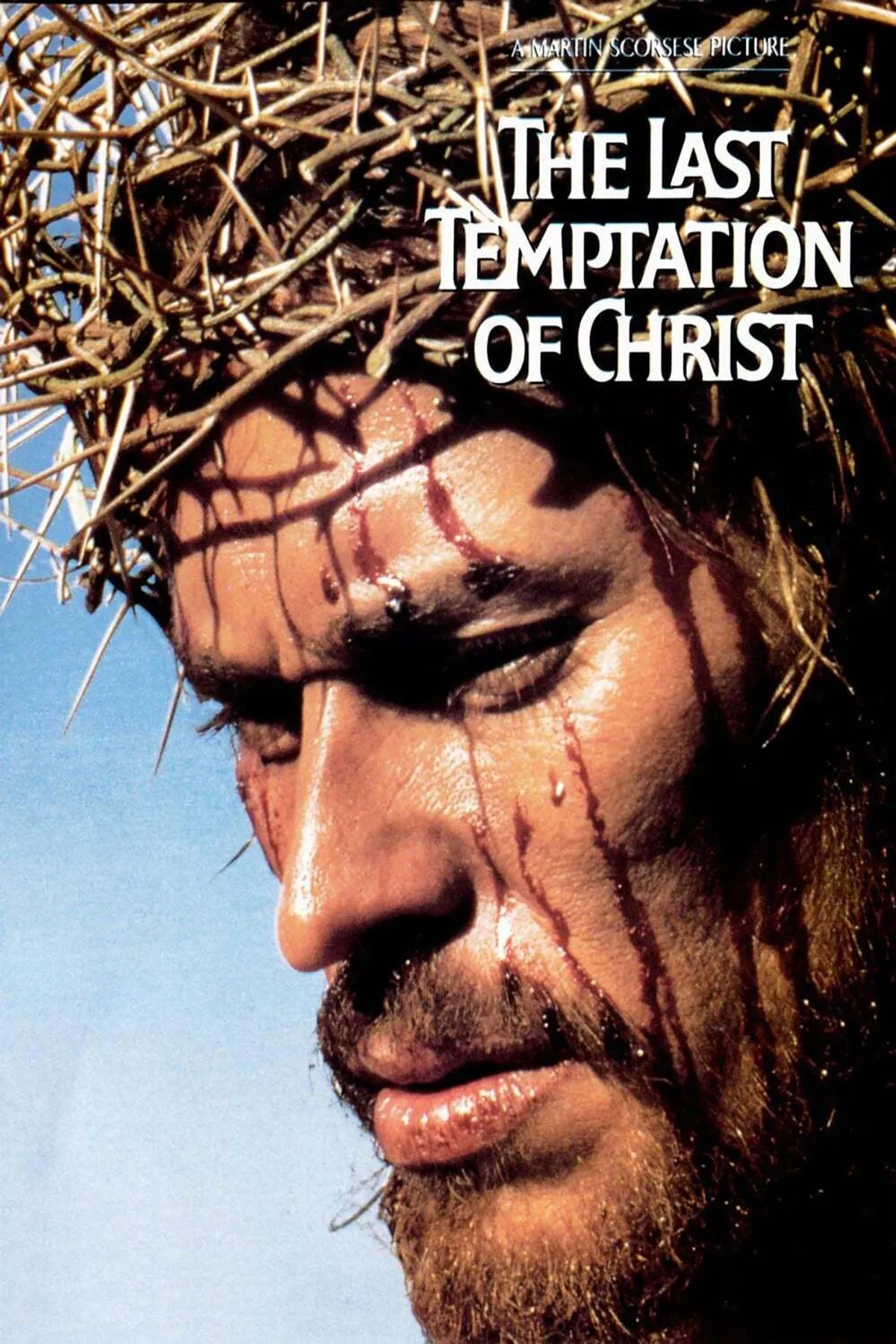
The Last Temptation of Christ
A fierce, searching film about a man who can’t stop being human — and the choices that make him more than that.
The setup
Scorsese took on the gospel and made something stubbornly human. The Last Temptation of Christ isn’t a tidy religious picture; it’s a long, inward pull between desire and duty, staged around a Jesus who feels like a carpenter you might know rather than an untouchable symbol. That particular bet — to put the struggle of being both flesh and spirit at the centre — is exactly why the film still matters.
THE MOVIE
Jesus is still the reason this movie works
Right from the prologue the film announces itself as an experiment: a fictional sideways look at the tug-of-war between spirit and flesh. That’s the engine — not spectacle, not sermon — and it keeps returning the camera to the question of what a person must give up to be something other than a person.
The narrative follows Jesus as a working carpenter who carries recurring physical and spiritual torment, and the movie trusts those bodily, often painful experiences to carry its psychological drama. You watch choices being made in real time: prayer, doubt, temptation, resolve.
Martin Scorsese directs the whole enterprise with the seriousness of someone who understands both the source material and the risk of tackling it. With Willem Dafoe as Jesus, Harvey Keitel as Judas and Barbara Hershey as Mary Magdalene, the cast is pointed at the film’s human centre rather than at any devotional distance.
THE SETUP
The idea that sets The Last Temptation of Christ in motion
At its simplest the film adapts Nikos Kazantzakis’s novel and frames the material as a fictional exploration — a way in to dramatise the tension between the spiritual and the bodily.
Rather than presenting a smooth, miraculous biography, the story keeps returning to Jesus as an ordinary man at work: a carpenter who lives with pain, visions and doubt, and who must gradually confront what being the Messiah will demand.
Crucially, a lot of the film’s momentum is internal. Extended sequences play out inside Jesus’s mind: visions and temptations that imagine the ordinary life he might have had if he’d chosen otherwise.
That setup matters because it turns grand events into choices the audience can recognise. The gospel moments are still there, but the interiors — the imagined roads not taken — are what let the film ask awkward, persistent questions.
THE CHARACTER
Why Jesus matters
This Jesus matters because he is palpable. He isn’t introduced as doctrine first; he is introduced as a man whose body and voice insist on being part of the story.
The film presents him as conflicted and searching — a Christ who feels the pull of ordinary life alongside the pull of a larger calling. That tension is the dramatic heartbeat: every gesture and silence counts because it might be a refusal or an acceptance.
Other characters are framed around that central dilemma. Judas reads as an earthy, frustrated supporter who keeps testing Jesus’s methods; Mary Magdalene is written as a formative emotional presence whose history with him becomes part of the film’s account of longing.
Naming the actress and the actor matters less than the roles they play in shaping how we understand Jesus: not an abstract saviour but a man making agonising decisions about identity and vocation.
THE PERFORMANCE
Why Willem Dafoe's performance matters
Contemporary critics singled out Dafoe’s portrayal, and his work has been highlighted in long-form appreciations since; Roger Ebert praised the film and specifically mentioned Dafoe, later including the picture in his 'Great Movies' series.
The Criterion Collection’s materials also present the principal cast as delivering outstanding performances, which is useful to note: the restoration package frames the movie as a performance-driven piece rather than a purely conceptual provocation.
What that evidence allows you to expect is a performance that foregrounds the character’s interior life — someone whose physicality and choices carry the film’s questions. The conversation around Dafoe’s Jesus has consistently been about the role as an act of sustained, inward focus.
So if you come to the film expecting a theatrical, declamatory messiah you won’t find it. Expect instead a performance repeatedly put to the test by doubt, by bodily suffering and by those imagined alternatives that keep returning throughout the film.
UNDER THE SURFACE
The Last Temptation of Christ has more on its mind than the plot suggests
At the top of the list is the clash between humanity and divinity: the film refuses to let either side win cleanly. It stages both the holiness and the very human cost of that holiness.
Temptation and sacrifice operate as two sides of the same coin. The imagined ordinary life — the temptations — is not an indulgence but a way of dramatizing what a sacrificial path actually asks someone to abandon.
Faith and doubt are threaded through the narrative in a way that treats questions as part of belief, not opposed to it. Doubt isn’t a failure here; it’s a persistent presence that forces decisions to remain meaningful.
Finally, identity and vocation come up repeatedly. The film asks whether being chosen erases who you were before, or whether a person can carry their ordinary past into a larger destiny.
THE FILMMAKING
How The Last Temptation of Christ was put together
The film’s craft pedigree is notable: Michael Ballhaus handled cinematography and Thelma Schoonmaker edited the picture — a pairing that marks this as a director’s film with serious technical collaborators.
Criterion’s director‑approved restoration, supervised by Ballhaus and Schoonmaker, underlines that the filmmakers regarded texture and timing as essential to how the story should be received.
Production design and costume work were also organised for scale: credits list a production designer and a costume designer, and the shoot made use of substantial location and studio resources to create believable settings.
All of this matters because the film isn’t content to gesture at its story. Its technical choices are enlisted to keep scenes intimate even when the stakes are public: the craft is there to make inner experience feel visible.
PRACTICAL EFFECTS
The effects work that gives The Last Temptation of Christ its physical personality
The credits show that stunt coordination and a roster of stunt performers were in place, which signals the presence of staged physical sequences that required careful, real-world choreography.
Production also involved constructing sets and making use of local studio facilities in Morocco, so the environments were largely physical rather than purely photographic or abstract.
That kind of practical, hands-on production creates a tangible sense of place: when an actor moves through a constructed space the audience accepts the stakes differently than if everything were suggested.
In short, much of the film’s physical personality comes from ordinary production craft—sets, stunts, studio work—rather than from anything that reads like modern visual trickery.
PURE 80S
The Last Temptation of Christ could not belong to any other decade
The film’s release landed squarely in the late-1980s culture wars. Its reception—organised protests, attempts at local bans and coverage in major outlets—made it part of broader debates about art and blasphemy at that moment.
That controversy tells you something about the decade: arguments about what studios should release and what public demonstrations could achieve were very much live in 1988, and this film became a focal point.
But the movie itself isn’t spectacle designed to rile a crowd; it’s a deliberate, long study of interior life. The clash with the period came from how seriously it treated those interior questions, and how some audiences read that seriousness as transgression.
So the film is of its time because it provoked a particular public conversation in 1988 about responsibility and representation in art — a conversation that helps explain why the film felt urgent then.
THE LEGACY
Why The Last Temptation of Christ still matters
Part of the film’s afterlife is institutional: Scorsese received an Academy Award nomination for Best Director, and the picture gathered further recognition with Golden Globe nods, signalling that the industry took its seriousness seriously.
The Criterion Collection’s director‑approved restoration and special‑edition release is another sign that the film continues to be preserved and revisited in cinephile circles; those editions keep the conversation about the movie alive.
Beyond awards and restorations, the film remains a go-to example when people want to talk about art that deliberately tests religious narrative by placing human doubt at the centre.
That combination—serious festival and awards attention, plus curated preservation—means the movie still attracts study and discussion rather than simply fading away.
THE VERDICT
Does The Last Temptation of Christ still hold up?
If you’re wondering whether to watch it now, the short answer is yes — provided you want a long, serious film that prioritises interior struggle over tidy answers. The movie adapts Kazantzakis’s novel and stages the conflict between spirit and flesh as an on-going, often painful negotiation.
It intercuts public gospel events—healings, confrontations with authority, the road to crucifixion—with extended interior sequences that imagine an ordinary life Jesus might have led. That mix is the film’s point of difference: it dramatizes choice rather than replacing it with doctrine.
Willem Dafoe is at the centre of that experiment: the narrative treats Jesus as a conflicted, searching man whose bodily sensations and voices propel the drama. Judas and Mary Magdalene are written as people who pull and test him, which keeps the moral questions vivid rather than abstract.
Finally, the film’s continued recognition—Roger Ebert’s praise, the Criterion restoration and industry nominations—suggests that this is a picture people return to when they want a serious, art‑house approach to scripture. If you want a film that asks rather than tells, give it your time.
Share this movie
Keep watching
More movies from the 80s
1988
Black Eagle
Black Eagle: courage and parents protecting their children, and why this 1988 movie still matters.
Read our take →
1988
Dead Ringers
Revisiting Dead Ringers and the reasons it still deserves to be watched.
Read our take →
1989
Black Rain
Black Rain: family and parents protecting their children, and why this 1989 movie still matters.
Read our take →