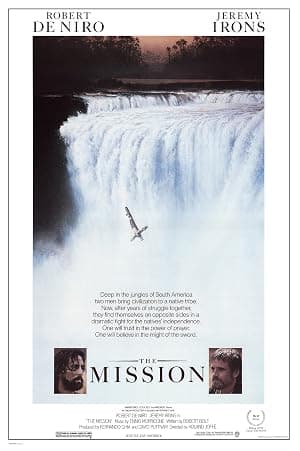
The setup
There are films that preach and films that argue. The Mission is neither exactly: it sets a converted mercenary and a quietly persistent Jesuit against the politics of empire and asks which language — steel or song — will protect a vulnerable people. Roland Joffé stages that argument with a simplicity that still hits.
THE MOVIE
Captain Rodrigo Mendoza is still the reason this movie works
Call it strange casting or the beating heart of the story: The Mission centres on a man who can’t live with what he’s done. Captain Rodrigo Mendoza arrives at the mission after killing his half-brother, and his punishment becomes the film’s pulse — a very physical form of atonement that forces everything else to rearrange around him.
Roland Joffé gives us two ways of touching the Guaraní: Father Gabriel’s patient, musical approach and the blunt instruments of empire. The film lets those approaches collide; what looks like a theological dispute is really a contest over whose authority will decide the fate of a vulnerable people on a frontier between empires.
That set-up — Jesuit missionaries building a community with the Guaraní in mid-18th-century South America, a converted mercenary seeking redemption, and a political crisis that threatens the mission — is why The Mission still feels watchable rather than merely dated. It’s a drama about choices, and Mendoza is the figure who makes those choices visible.
THE SETUP
The idea that sets The Mission in motion
At its simplest, the film follows Jesuit missionaries who have established a mission among the Guaraní on the contested border between Spanish and Portuguese territories in the mid-1700s.
A personal crime — Mendoza’s murder of his half-brother — turns him toward the mission and anchors the human side of the story; his penance and conversion reshape loyalties inside the community.
That personal drama sits beside a broader, political pressure: a European boundary treaty hands the mission’s land to Portugal, and Portugal’s tolerance of slavery suddenly places the Jesuits in an impossible bind.
The film’s engine is that collision: private repentance and communal survival forced against formal legal and imperial decisions, with church authorities drawn into a negotiation that determines the mission’s future.
THE CHARACTER
Why Captain Rodrigo Mendoza matters
Mendoza is not a cipher. He arrives with blood on his hands — a mercenary and slave hunter whose killing of his own brother forces a very public reckoning — and that history is what makes his arc watchable. His struggle with guilt and belonging is what turns abstract questions about empire into something you can feel.
Because his atonement is enacted in the open, his choices push the story into sharper relief. He doesn’t just repent in private; his penance reshapes the mission and forces other characters, and the church itself, to respond.
And that’s the neat trick: the film’s central tension is not only political but personal. Mendoza’s path from hired sword to member of the mission community reframes loyalties, and through him the audience sees the stakes of the larger conflict.
If the movie holds together, it’s because this character gives Joffé somewhere to put the moral weight. Everything — the music, the papal negotiations, even the question of violence versus nonviolence — lands harder because Mendoza has skin in the game.
THE PERFORMANCE
Why Ray McAnally's performance matters
Not every viewer agreed on the casting choices in The Mission, but the papal legate who enters the story to adjudicate the mission’s status did get singled out in awards talk.
Ray McAnally’s turn as Cardinal Altamirano was recognised at the BAFTAs, and that acknowledgement matters because his character embodies the institutional side of the moral dilemma — a reminder that these questions are also bureaucratic and political, not only spiritual.
The fact that critics were split about performances is part of the film’s texture: it never presents its characters as unquestionable moral types, so debate about the acting reflects the story’s willingness to put opposing impulses on screen.
In short: Altamirano is the visible face of the church’s legal conscience, and McAnally’s recognition at awards venues shows how that role helped shape the film’s reception.
UNDER THE SURFACE
The Mission has more on its mind than the plot suggests
On the surface it’s a period drama about a mission on an imperial frontier. Underneath it’s arguing about who gets to decide people’s fates: the temporal machinery of empire or spiritual, pastoral responsibility.
Atonement and redemption are not window dressing; they’re the means by which the film personalises big political questions. Mendoza’s individual punishment forces a communal question: how do you protect the vulnerable when treaties and empires say otherwise?
That friction turns the film into an argument about means as well as ends. Father Gabriel’s peaceful methods and the mission’s cultural exchange sit uneasily beside the idea of armed defence, especially once survival seems to demand weapons.
And woven through it all is the fragile question of indigenous survival: the mission is presented as a site of cultural encounter where the Guaraní’s future depends on the decisions of outsiders — priests, soldiers and distant bureaucrats.
THE FILMMAKING
How The Mission was put together
One of the film’s most tangible credits is its cinematography. Chris Menges’ work was a prominent element of the film’s identity and earned the Academy Award for Best Cinematography — a clear mark that the visual choices mattered to how the story read on screen.
Beyond the camera, the production brought experienced craftspeople into play: Stuart Craig is credited for production design and Jim Clark for editing, names that sit in the principal creative lineup and in awards conversations.
Those technical pieces matter because the film asks you to believe in a remote, fragile community and the political systems around it. The technical recognition the film received suggests those pieces were persuasive for many viewers and voters.
Finally, the editing and score were also part of how the film made its case; award coverage from the period highlights both editing and original score as elements that contributed to the film’s overall impact.
PURE 80S
The Mission could not belong to any other decade
The Mission arrived in 1986 as part of a particular British filmmaking moment that favoured ambitious, historically anchored dramas produced with festival recognition in mind. Roland Joffé and producer David Puttnam were central figures in that trend.
Its festival trajectory — competing at Cannes and taking the Palme d’Or in 1986 — and the subsequent awards run fit the 1980s model of prestige cinema: films built to travel from festivals into awards season and regional releases.
That combination of political subject matter and festival visibility is very much of its time. The film’s pedigree and the way it was positioned — as a serious, moral historical drama — reflect how British producers and directors sought international credibility in the mid-1980s.
So while the story itself is eighteenth-century, the way the film was made, marketed and celebrated is a product of 1986 and the industry strategies around prestige filmmaking then.
THE LEGACY
Why The Mission still matters
The film’s shelf-life is anchored in tangible recognition: it won the Palme d’Or and a technical prize at Cannes in 1986, and its cinematography took home the Academy Award. Those honours kept the film in conversation beyond its initial release.
At the BAFTAs the film picked up multiple awards too, including recognition for original score and editing, which underlines how the movie was judged as a complete production rather than a single standout element.
Ennio Morricone’s score in particular has had an ongoing presence in film-music discussions and appears on compilations of notable scores; that musical afterlife is part of why people still bring the film up.
Put together, the festival wins, the awards for image and music, and the remembered central characters — Mendoza, Father Gabriel and the Church’s representatives — help explain why the film remains a frequent title in retrospective conversations.
THE VERDICT
Does The Mission still hold up?
Yes — with qualifications. The Mission remains compelling when you watch it as a moral argument staged on a human scale: a converted mercenary whose public penance reshapes loyalties, a priest who believes in peaceful cultural contact, and a political crisis that forces institutional choices.
The core dilemma — whether obedience to church and imperial authority outweighs responsibility to protect an endangered community when treaties empower slavery — still reads powerfully. The film makes that court of conscience visible rather than abstract.
Some contemporary viewers were split about casting and dramatic effectiveness, and that difference of opinion survives. But the film’s technical credentials — award-winning cinematography and a score that keeps turning up in retrospectives — mean it’s often persuasive on its own terms.
If you care for films that set big ideas against intimate human stories, and you want to see a drama where a man’s need for redemption forces an entire community to decide what kind of authority they’ll answer to, then The Mission is still worth watching.
Share this movie
Keep watching
More movies from the 80s
1986
About Last Night...
About Last Night...: family and friendship, and why this 1986 movie still matters.
Read our take →
1986
An American Tail
An American Tail: family and freedom, and why this 1986 movie still matters.
Read our take →
1986
At Close Range
At Close Range: family and authority, and why this 1986 movie still matters.
Read our take →