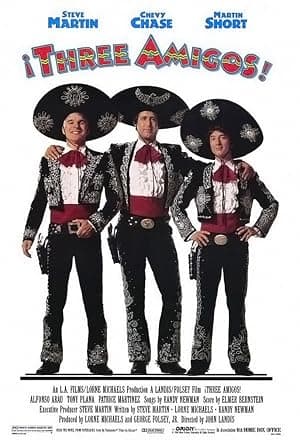
Three Amigos
A vaudeville-sized comedy about showmen who must learn to be something more than a good performance.
The setup
Three Amigos is the kind of film that looks like a joke on paper — silent-era stars, a village in peril, a telegram that gets mishandled — and then keeps insisting that the joke has heart. Directed by John Landis and written by Steve Martin with Lorne Michaels and Randy Newman, it’s equal parts parody, pastiche and a slightly daft lesson in what happens when performance meets real life.
THE MOVIE
Lucky Day is still the reason this movie works
You know the image: three elaborately dressed screen cowboys wandering into a town that has no idea they're actors. That setup — silent-era film stars wrongly recruited to save a Mexican village — is the engine that keeps Three Amigos running.
The story is nudged into motion by a terrified villager's telegram, mangled by a telegrapher, which summons the Amigos. That mistake is the neatest joke in the premise: a troupe used to staged heroics now has to answer the call when somebody genuinely needs help.
At the centre of it all is Lucky Day, played by Steve Martin, who leads the trio's attempt to turn showmanship into actual action. With John Landis in the director's chair and the film released in 1986, Three Amigos wears its comedy as loudly as its costumes — and keeps returning to the question of what happens when an on-stage persona meets the real world.
THE SETUP
The idea that sets Three Amigos in motion
Set in 1916, the premise is tidy: the Three Amigos are famous for their silent serials, and a small Mexican village believes those films are real. That confusion — the villagers taking fiction for fact — gives the movie its central comic engine.
What follows is less a straight adventure and more a game of staged tactics in the real world. The film deliberately cuts between the Amigos’ glossy on-screen serials and the ‘real’ sequences in the village so the contrast between polished illusion and messy reality can land both jokes and plot beats.
The central conflict asks whether men who make heroics as part of their act can actually be heroic when bullets fly. It’s a neat question for a comedy: it lets pratfalls coexist with honest stakes.
Mistaken identity, theatrical improvisation turned into strategy, and a handful of musical set-pieces are the mechanics the movie uses to move from joke to payoff without getting bogged down in explanation.
THE CHARACTER
Why Lucky Day matters
Steve Martin plays Lucky Day, and he is written and positioned as the trio’s ostensible leader — the man who has to bridge the gap between applause and action.
That translation of showmanship into real competence is the film’s recurring joke and emotional pivot. Lucky Day is the charted route from confident patter to the awkward, sometimes reluctant kind of courage the story needs.
A practical detail helps sell the idea: production notes state Steve Martin performed his own rope tricks in several sequences. Those small physical commitments make the idea of a performer trying to be a doer feel tangible rather than merely quoted.
The story’s concern with friendship and reluctant heroism runs through Lucky Day: he’s the figure who must convince his mates — and himself — that celebrity can be more than an act when people are in trouble.
UNDER THE SURFACE
Three Amigos has more on its mind than the plot suggests
On the surface it's a send-up of Western tropes and silent-film melodrama. Underneath, the film keeps nudging at a few recurring ideas: identity, the thin line between pretending and being, and how friendship survives embarrassment.
Mistaken identity is the obvious one — the villagers believe the movies depict genuine deeds — but the richer play comes from the tension between performance and reality. The Amigos’ on-screen bravado becomes a series of improvisations when faced with actual danger.
The movie explicitly parodies Westerns and silent-era cinema, borrowing bits of those earlier forms not as museum pieces but as material to be reworked for modern jokes. That mixture gives the film a layered comic texture: sometimes it’s lampooning a genre, other times it’s holding up that genre as a template the characters try to live into.
And because the trio are friends — performers who bumble yet stick together — the film’s sentimental moments are earned rather than tacked on. The reluctant-hero theme keeps the laughs honest.
THE FILMMAKING
How Three Amigos was put together
One of the neat production choices is the decision to actually shoot the silent-movie sequences on a studio back lot. That meant the film could nod credibly to early-studio filmmaking rather than suggesting it from afar.
Using the Universal back lot and building standing sets gave those black-and-white moments a different texture to the village material, which helps the cutaway gag work: you can see the films-within-the-film were made differently, and that difference is part of the joke.
It’s a practical, somewhat old-fashioned choice that suits a movie whose comedy reaches back to earlier cinematic forms. The filmmaking here is trying to have its parody and its reference both look like actual artifacts.
PRACTICAL EFFECTS
The effects work that gives Three Amigos its physical personality
Some of the film’s energy comes from practical, hands-on work. Production notes record that Steve Martin performed his own rope tricks in both the silent-film scenes and the fiesta sequences — a small commitment that pays off on screen.
On the other end of the scale, the production built a mission/fortress set for El Guapo on a nearby desert location. Those constructed elements weren’t just temporary: they remained as part of the local attraction after shooting wrapped, which is a neat reminder that the movie left a physical mark on its location.
These are the kind of tactile choices that make the film feel lived-in. The gags may be theatrical, but the props and sets are solidly practical.
PURE 80S
Three Amigos could not belong to any other decade
This is an 80s comedy in the sense that it springs from TV sketch comedy talent stepping into big studio pictures. The writers and producers — including figures closely linked to Saturday Night Live — bring that sketch-to-feature sensibility with them.
It’s also typical of mid‑80s studio comedies that married star-driven performers to sizeable production values: the costume work, the constructed sets and big sight gags for group players felt like a specific mode of Hollywood at that moment.
There’s another, darker contextual detail: the film was released during a period when John Landis was involved in a high-profile legal matter stemming from an earlier accident, and contemporary reporting notes the trial overlapped the movie’s post-production. That overlap is part of the film’s history even if it doesn’t change what’s on screen.
Released in December 1986, Three Amigos sits squarely in that era’s tendency to gamble on broad, palatable comedies featuring familiar faces from television.
WATCHING IT NOW
What has aged — and what hasn't
The basic friendship at the heart of the film still reads clearly. The bond between the three performers — their fractious but loyal rapport — is the kind of comic relationship that translates across decades.
The premise of actors being mistaken for their screen selves and forced to face real danger is a tidy one that hasn’t lost its sting. It still allows the film to move between broad comedy and genuine jeopardy without collapsing into pure farce.
The movie’s production pedigree — backing from figures like Lorne Michaels and partnerships with Home Box Office and L.A. Films, distributed by Orion — helped it reach audiences and stay in circulation, which matters when a film’s afterlife depends on TV and home-video runs.
THE LEGACY
Why Three Amigos still matters
The film endures largely because its central premise — actors mistaken for their roles — has remained a handy shorthand for a particular comic situation. It’s still used as a point of comparison in discussions of later actor-as-hero comedies.
Practical exposure helped too: regular television airings and repeated home-video releases kept the movie visible to casual viewers, while periodic critical reappraisals usually note its amiable tone even if opinions about its jokes vary.
Lists and retrospective round-ups have kept it in the popular conversation; for instance, older compilations of comedy lists have included Three Amigos among amusing entries, which signals a continued, if modest, recognition.
Put simply: it’s not universally celebrated, but it’s been a persistent presence in the comedy catalogue enough times for the odd line and character name to stay in circulation.
THE VERDICT
Does Three Amigos still hold up?
Yes — with a couple of caveats. If you come for broad, self-aware comedy about performers who must become real people, Three Amigos still delivers. The film’s core question — can screen bravado survive face-to-face danger? — remains the engine that drives both jokes and the occasional surprisingly sincere beat.
Steve Martin’s Lucky Day anchors that engine: the plot relies on him and his two co-stars believing they can turn an act into action, and that leap from vaudeville bravado to reluctant heroism is where the film earns its warmth.
The movie’s structure — intercutting film-within-film serials with the village sequences, the mistaken-identity plot mechanics and the musical set-pieces — keeps it lively across its 105 minutes. There are moments that feel very of their time, but the central setup and the playful parody of Westerns and silent-era cinema still read as inventive rather than merely dated.
So watch it if you want a loud, affectionate comedy about showmanship and friendship that isn’t shy about reminding you laughter and courage can, occasionally, turn out to be the same thing.
Share this movie
Keep watching
More movies from the 80s
1988
Young Guns
Young men, a murdered mentor and a young Billy the Kid riding herd on revenge and loyalty.
Read our take →
1986
About Last Night...
About Last Night...: family and friendship, and why this 1986 movie still matters.
Read our take →
1986
Armed and Dangerous
Armed and Dangerous: parents protecting their children and loss, and why this 1986 movie still matters.
Read our take →