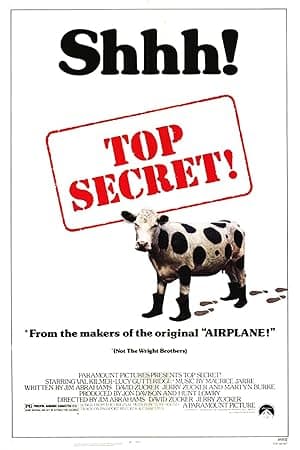
Top Secret!
A rock star, a resistance, and a barrage of nonsense — Top Secret! still loves to make sense of nothing.
The setup
Top Secret! is the Zucker‑Abrahams‑Zucker team’s cheeky experiment in letting jokes collide with genre. It hands a stage to Val Kilmer’s American rock star and then uses his celebrity as a tool in a spy‑parody that never stops interrupting itself for a gag. If you remember it as gloriously daft, this is the piece that explains why.
THE MOVIE
Nick Rivers is still the reason this movie works
This is not a gentle parody. Top Secret! throws a rock‑and‑roll lead into a Cold War cartoon and then leans into the collision until sparks fly. At the centre is Nick Rivers, an American star who saunters into a fictional East Germany to play a cultural festival and promptly becomes tangled with a local resistance.
That celebrity persona matters. Nick’s stagecraft isn’t just window dressing: it’s the thing the plot borrows to pull off its stunts and musical set‑pieces. The movie builds many of its jokes around what it means to be famous onstage — and what a famous performer can get away with when the cameras (and the gags) are rolling.
This is a ZAZ picture through and through: broad, fast, and joyful in its disrespect for genre rules. They riff on Elvis‑style musicals, wartime resistance dramas and Cold War spy tropes, and they do it in the blunt, gag‑first style that made the trio’s name.
THE SETUP
The idea that sets Top Secret! in motion
Keep it simple: a last‑minute invite sends an American rock star to a cultural festival in a fictionalised East Germany. That’s the story’s launch pad — compact, obvious and brilliantly useful for comedy.
Once there, Nick meets Hillary Flammond and the plot shifts from pop‑star performance to rescue mission. Her father, Dr Paul Flammond, is being forced to work on a devastating naval weapon called the Polaris Mine, and rescuing him gives the film a loose espionage spine.
The film deliberately trades careful plotting for structural chaos: musical pastiche and sight‑gag non sequiturs are its main engines. Songs and visual one‑liners keep interrupting the spy beats, which is precisely the point — the watchword is momentum, not plausibility.
It’s worth remembering the movie you see in cinemas was trimmed down from a much longer screenplay shown first to college audiences. The resulting ninety‑minute version is a faster, punchier edit that foregrounds the gags over narrative patience.
THE CHARACTER
Why Nick Rivers matters
Nick Rivers is more than a vehicle for gags; he’s the movie’s playful lever. The concept of a self‑assured American rock star dropped into an authoritarian setting creates a steady stream of comic opportunities — stagecraft meets subterfuge.
Because the film leans on musical set‑pieces, Nick’s celebrity is practical as well as comic. His performer’s tools — the microphone, the crowd, the spectacle — get repurposed into resistance tactics and sight gags, which keeps the tone buoyant even when the plot pretends to be serious.
Val Kilmer plays the role in his first feature outing, which makes the casting feel like a discovery rather than a throwaway. The movie leans on the idea of persona: Nick behaves like someone used to being looked at, and the comedy often comes from what that attention can and cannot solve.
He’s also the movie’s easy point of identification. When the script wants to do something absurd, it often lets Nick be the straight line through the joke — the confident centre that the chaos spins around.
THE PERFORMANCE
Why Val Kilmer's performance matters
Kilmer’s musical numbers were singled out by contemporary reviewers, and for good reason: the songs are performed on screen and form a spine of the film’s comic identity.
Because those numbers are diegetic — they’re part of Nick’s job — they never feel like padding. They’re opportunities for the plotting to pivot and for the humour to re‑calibrate.
In short: how the film lands depends in part on the buy‑in to those musical moments. They’re not throwaway; they’re the engine that lets parody cohere into set pieces.
As the lead in his first feature role, Kilmer is the film’s musical linchpin: if the numbers work, the joke structure stays moving.
UNDER THE SURFACE
Top Secret! has more on its mind than the plot suggests
Beneath the pratfalls there’s a clear agenda: the movie is a study in parody. It doesn’t just make jokes about spies — it plays with the grammar of genre itself, treating familiar beats like toys to be rearranged for comic effect.
A second idea is celebrity and performance. By placing a performer at the story’s heart, the film asks, without solemnity, what celebrity can do in a serious world — whether spectacle is distraction, tool, or unexpected salvation.
There’s also a resistance vs. authoritarianism thread. The rescue plot and the depiction of a compelled inventor give the parody a political outline: authority to be mocked, resistance to be cheered, all rendered in outré, often absurdist style.
Finally, absurdist visual comedy and non sequitur gags are not random. They’re a method: by breaking expectation repeatedly, the movie reminds us how formulaic genre films can be, and has a good laugh while doing it.
PURE 80S
Top Secret! could not belong to any other decade
Top Secret! was made and released at a moment when Cold War stories were everywhere — which made the era itself prime material for satire. Using an East Germany setting as a comic foil taps directly into what audiences then recognised as geopolitical shorthand.
Released in 1984, the movie is part of a brief surge when parody films enjoyed broad mainstream attention and filmmakers felt free to skewer serious subjects with frivolity.
Production started in 1983 at Pinewood and ran for about three months, which left room for the kind of dense, rapid‑fire joke writing the ZAZ team favoured. The timing of its release and production places it squarely in that early‑80s comedy moment.
So the film’s approach to both politics and pop culture feels of its time: cheeky, impatient and determined to turn recognisable Cold War templates into punchlines.
THE LEGACY
Why Top Secret! still matters
The film remains part of how we talk about 1980s parody cinema because it’s one of the ZAZ team’s experiments in scale and shape. It’s not their only success, but it’s clearly of the same comedic family as Airplane! and The Naked Gun.
It didn’t smash expectations at the box office, but that’s not the whole story: the picture found a steady life afterwards and developed a cult following. That’s the kind of afterlife films like this tend to earn — loved for the jokes people keep quoting or the odd beats that stick.
Characters like Nick Rivers and Hillary Flammond, plus supporting oddities such as Nigel “The Torch” and Martin, give the movie recognisable anchors that fans like to return to.
So its continued presence in discussions about 80s parody is less about industry dominance and more about how its particular brand of nonsense keeps turning up in people’s memories.
THE VERDICT
Does Top Secret! still hold up?
Yes — if you like your comedy loud, elastic and occasionally anarchic. The movie’s premise is pure structure: a rock star goes to a cultural festival in a fictional East Germany, meets Hillary Flammond and becomes involved in rescuing her father from a plot about a Polaris Mine. That setup is only ever a pretext for musical set‑pieces and sight‑gag non sequiturs, and the film commits to that choice.
Val Kilmer’s presence matters because the songs are performed on screen and were remarked upon at the time; those numbers are integral rather than decorative. If you enjoy a parody that foregrounds performance, this one delivers.
Be aware it’s a ninety‑minute, joke‑dense edit trimmed from a much longer screenplay; the result is a film that favours momentum over subtlety. For some viewers that’s exactly the point — a nonstop barrage of invention — and for others it’ll feel thin on narrative satisfaction.
If you’re curious about 80s parody or the ZAZ lineage, Top Secret! is worth a watch. It still makes a strong argument for silliness: a film content to use celebrity and song to dismantle genre mechanics, and to do so at speed.
Share this movie