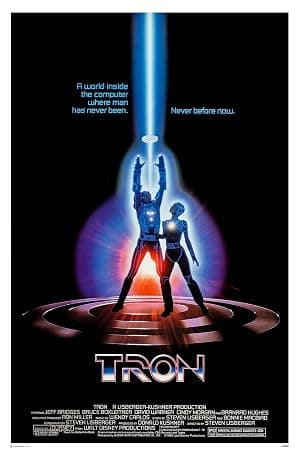
Tron
A film about authorship, arcade‑style justice and a man who literally has to fight for his credit.
The setup
Tron still hooks you not because of its novelty but because its central problem is a recognisable human one: a creator who’s been robbed of credit and will go inside the machine to prove it. It’s an 80s sci‑fi that insists on staking its emotional claim through one man’s grievance as much as through its gadgets. That stubborn human motive keeps the film from turning into pure spectacle.
THE MOVIE
Kevin Flynn / Clu is still the reason this movie works
You can admire Tron for its bright, early experiments with computer imagery — and you should. But what keeps the picture emotionally intact is much simpler: Kevin Flynn, a programmer and arcade owner who gets digitised into ENCOM’s mainframe and has to fight his way out. That basic human jeopardy — a person trapped inside a hostile system — gives the film a heartbeat amid the dazzle.
It starts with Flynn’s real-world fight. He’s trying to recover proof that an ENCOM executive stole credit for his arcade programs; that grievance pushes him into the building, into confrontation, and then, by the film’s conceit, into the Grid itself. It’s authorship vs corporate appropriation in muscle and microchip form.
Steven Lisberger directed the film and Jeff Bridges plays the man at the centre. In a neat bit of genre shorthand, Tron mixes that very human motive with action, fantasy and science fiction, all packed into a brisk 96 minutes.
THE SETUP
The idea that sets Tron in motion
Tron rests on a tidy piece of storytelling mechanics: the one-to-one relationship between people and their program avatars. When something happens in the real world at ENCOM, it has a mirrored consequence in the computer world. That link keeps the stakes readable — and it’s how a dispute over who wrote a game becomes a literal fight inside a machine.
The film doesn’t pretend the Grid is an allegory that needs unpacking. It uses the Users↔Programs match to move quickly between offices and arenas, and to make the personal feel systemic. That economy of idea helps the premise land — it’s easy to follow and it gives the film a consistent logic.
At the root of the plot is Flynn’s attempt to retrieve evidence that Ed Dillinger claimed credit for Flynn’s arcade work. That is the motive that sends him into action both in the real world and later inside the Grid.
Steven Lisberger is credited as the writer‑director, and the whole conceit — creativity flattened by corporate bureaucracy, then chased into a technological battleground — stays visible throughout the setup.
THE CHARACTER
Why Kevin Flynn / Clu matters
Kevin Flynn matters because his problem is straightforward and personal. He’s not chasing abstract ideals; he wants his work recognised. That grievance gives the action a clear spine: this isn’t just about saving the world, it’s about righting a wrong.
His connection to Alan Bradley is important. Alan is presented as Flynn’s technical ally in the real world and, inside the Grid, as the creator of the security program Tron. That linkage lets the film fold the human relationships into its digital conflicts, so Flynn’s fight has friends inside and outside the machine.
Because the story keeps returning to authorship and credit, Flynn never becomes merely a vessel for spectacle. The movie repeatedly ties what happens in-game back to a real human cost — an unpaid creator trying to reclaim the record.
And there’s a theatrical neatness to the casting: Jeff Bridges plays the part, and the character’s arc is tied into the film’s wider idea that individuals can push back against systems that try to rewrite their work.
THE PERFORMANCE
Why Jeff Bridges's performance matters
Contemporary response to the film flagged a tension: some critics felt the story and dramatic depth were stretched thin under the weight of the technical show. That criticism extended to aspects of Jeff Bridges’s performance, which a number of reviewers judged strained by the film’s heavy emphasis on its visual effects.
Put plainly: the movie was doing a lot of new technical work, and some viewers thought the human side didn’t always hold up under that pressure. The performance discussions at the time are best read through that particular friction — performer versus spectacle — rather than as assessments divorced from the film’s ambitions.
UNDER THE SURFACE
Tron has more on its mind than the plot suggests
One obvious idea is authorship versus corporate control. The engine that starts the picture is a stolen credit: a company advances because it takes a creator’s work. Turning that grievance into a literal journey inside a computer sharpens the question — who owns creative labour when it’s swallowed by an organisation?
Another running concern is human agency against system or AI control. The Grid is governed by a central intelligence and by imposed games; the characters’ choices play out inside that architecture, which keeps the film honest about how agency can be constrained by technological power.
Finally, the movie treats video games and virtual reality as a cultural form, not just a set of flashy tricks. The in‑system contests and arcade‑style mechanics aren’t window dressing; they’re the film’s grammar for describing conflict, reward and punishment.
Those three ideas combine to make Tron more than a tech demo. It frames a specific 80s worry — what happens to creators when their work is subsumed by bigger machines — and folds that worry into the action.
PRACTICAL EFFECTS
The effects work that gives Tron its physical personality
Tron’s look was achieved through hands-on, physical processes as much as computer rendering. The film used a 'backlit animation' technique: actors were photographed in high‑contrast black and white, then those images were turned into Kodalith positives and hand-processed cels and mattes to create the characters’ glowing circuit-line appearance.
On the digital side, several specialist computer‑graphics companies produced raster-rendered sequences, and some of that work required high‑performance computing hardware of the era. So the finished film is a hybrid — handcrafted optical work sitting alongside early computer imagery — which gives it a distinct, tactile personality.
PURE 80S
Tron could not belong to any other decade
Tron was made during the early‑1980s arcade and home‑video‑game boom, and it borrows directly from the visuals and mechanics of contemporary games. The film frames its battles and contests in the language of arcade play — wins, losses, high stakes — which makes it feel of a piece with the era’s gaming culture.
Crucially, its extensive use of computer imagery placed it at a turning point in effects practice. Tron was one of the first mainstream studio features to integrate multiple substantial computer‑generated segments, meaning its ambition was as much technical as it was narrative.
Put together: the subject matter (games and virtual environments) and the film’s experimental visual strategy are specific to the early 80s moment when games were moving from arcades into everyday consciousness.
And yes — it was released in 1982, so it arrived right as those conversations about games and computers were gaining real cultural traction.
THE LEGACY
Why Tron still matters
Tron’s afterlife is unmistakably multimedia: it grew into a franchise that includes a film sequel released decades later, an animated series, multiple video‑game tie‑ins and licensed works. It’s a property that kept getting picked up and expanded rather than quietly disappearing.
The film also received Academy Award nominations — for Best Costume Design and Best Sound — which underlines how the industry recognised its technical and design ambitions at the time.
Beyond awards and tie‑ins, Tron is regularly cited in histories of computer graphics and visual effects as an early landmark for incorporating computer‑generated imagery into a major studio feature. That citation keeps it in conversations about how effects practice evolved.
So its legacy is twofold: a concrete presence across media and a place in the technical story of cinema’s digital turn.
THE VERDICT
Does Tron still hold up?
Yes — but with a clear rider. If you go to Tron expecting a modern, tightly plotted blockbuster, you’ll be frustrated: contemporary critics noted the film’s narrative and dramatic limits, and the movie often prioritises spectacle. However, if you come for the blend of a simple human grievance with a machine‑world built as a series of contests — Games, light‑cycle duels and arena matches — the film rewards you.
At its centre is Kevin Flynn: he’s digitised into ENCOM’s mainframe after confronting executives about stolen game credit, and his motive — reclaiming authorship — keeps the movie anchored. The Grid’s structure, where each user has a program avatar and choices are staged as in‑system contests, makes the stakes easy to follow and oddly satisfying in the arcade sense.
The supporting setup matters too: Alan Bradley is presented as Flynn’s ally and the creator of the program Tron, while Ed Dillinger functions as the corporate antagonist who benefits from claiming Flynn’s work and uses the Master Control Program to hold power. Yori and Tron are the in‑system allies whose aims line up with Flynn’s, so the human relationships give the digital fighting a reason.
Finally, there’s a small but useful contemporary note: reviewers like Roger Ebert described the actors as engaging within the film’s technological showcase. In short, watch Tron if you’re interested in an early, imaginative attempt to dramatise authorship, agency and games — and if you don’t need every dramatic beat to be modernly polished.
Share this movie
Keep watching
More movies from the 80s
1982
Star Trek II: The Wrath of Khan
Star Trek II: The Wrath of Khan: parents protecting their children and fear, and why this 1982 movie still matters.
Read our take →
1982
Swamp Thing
Swamp Thing: freedom and fear, and why this 1982 movie still matters.
Read our take →
1981
Galaxy of Terror
Galaxy of Terror: fear and parents protecting their children, and why this 1981 movie still matters.
Read our take →