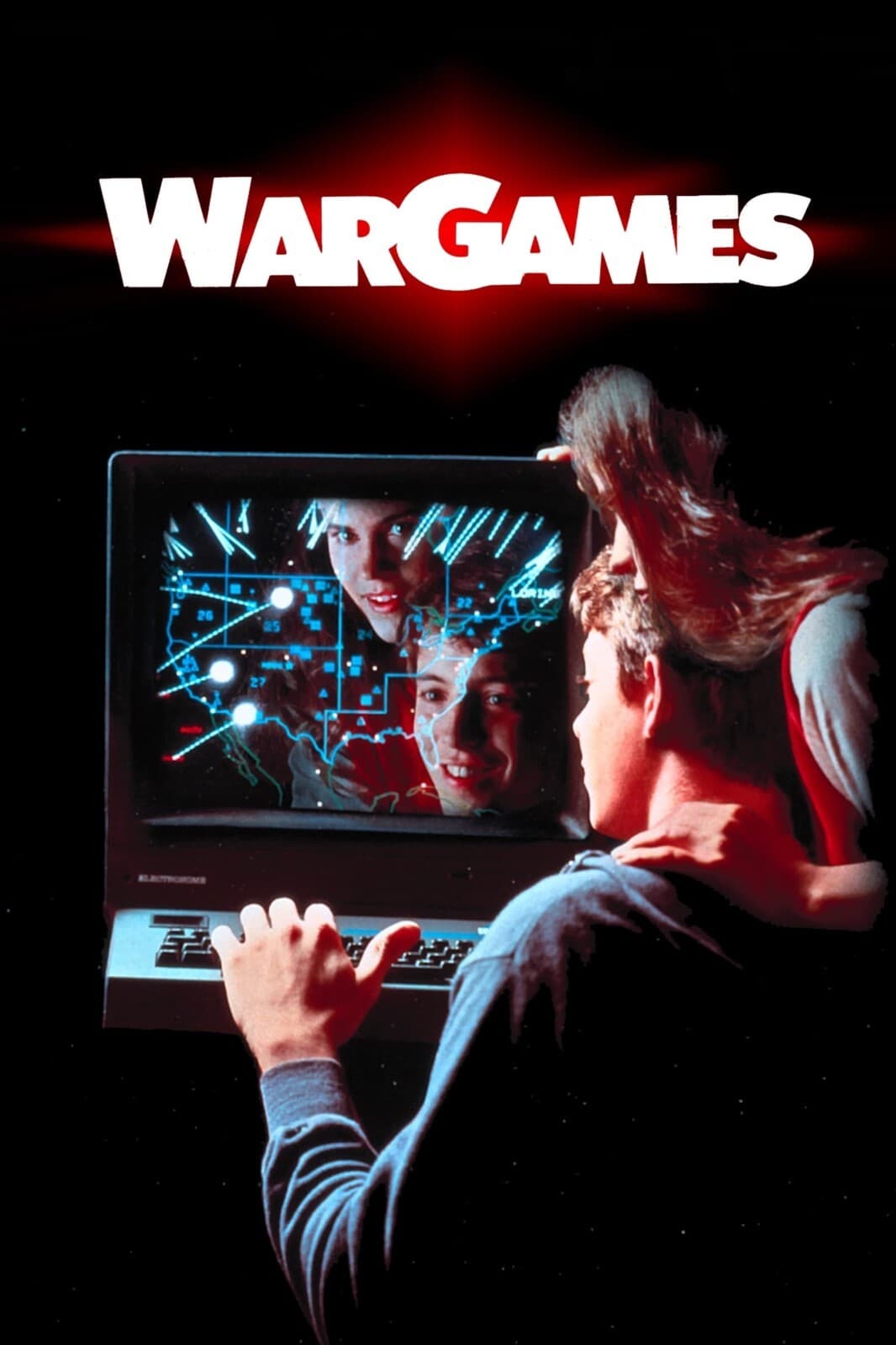
WarGames
A teenage prank that becomes national panic — and a neat little film about humans still being better at meaning than machines.
The setup
WarGames hooks you not with spectacle but with a single, banal idea: a curious kid searching for unreleased games. From that small act the movie builds a thriller about accidental escalation, actors who matter, and a mechanical brain that doesn’t quite understand play. It’s the sort of 1983 movie that still feels sharp because its central gamble — what happens when play is mistaken for reality — is as uncomfortable today as it was then.
THE MOVIE
David Lightman is still the reason this movie works
Talk about WarGames and people almost always land on one image: a kid at a terminal who thinks he’s phoning a game company and instead wakes up a military supercomputer. That moment is the movie in miniature — small, mischievous, and then suddenly far bigger than anyone expected.
Matthew Broderick’s David Lightman isn’t a spy or a soldier. He’s a curious teenager, technically savvy and eager to impress his mates, who uses dialing tricks to hunt for unreleased games and, by accident, reaches WOPR at NORAD. Believing he’s found a game, he launches a simulation called 'Global Thermonuclear War' and sets an escalating chain of events into motion.
John Badham directs a lean, 114-minute thriller that prefers human reactions to rhetoric. Cold War nuclear anxiety sits under the surface — the threat is enormous — but the movie keeps returning to the smaller, human moment that actually starts the crisis.
THE SETUP
The idea that sets WarGames in motion
At its simplest, WarGames runs on a clean, terrifying premise: a teenager connects to a top-secret military computer and, thinking he’s playing, starts a simulation titled 'Global Thermonuclear War'. The mistake is plausible and that plausibility is the engine of the film.
Once NORAD treats the simulation as real, the movie neatly pivots from prank to crisis. The stakes grow not because the plot invents bigger dangers but because the authorities must take an apparently automated threat extremely seriously.
A key strand of the story becomes finding Dr. Stephen Falken, the computer’s original designer, and convincing him to intervene. That hunt pulls the film away from its teenage-centred mischief and into a confrontation about machines, responsibility and human oversight.
Behind the screenplay are Lawrence Lasker and Walter F. Parkes, with John Badham stepping in as director during pre-production. The result is a taut setup that keeps the premise visible without turning the picture into a sequence of escalating set-pieces.
THE CHARACTER
Why David Lightman matters
David is not a plot device wearing a hoodie. He’s the believable centre through which the movie asks its questions. He’s curious, technically adept and yes, eager to impress — a combination that makes his mistake feel human rather than contrived.
Because David’s motives are ordinary — curiosity and peer approval — the consequences feel stranger. The film asks us to watch what happens when an everyday person’s mischief encounters a system designed for ultimate decisions.
Jennifer acts as his counterpoint: friend, moral check, and the one who drags the plot from solo hacking into real teamwork. Her presence stops the story from becoming a solo boy-genius drama and reminds the audience that collaboration, not lone heroics, is the healthier route.
Matthew Broderick is the actor cast in the part, and the film depends on David being someone you can root for even as he stumbles into catastrophe.
THE PERFORMANCE
Why Matthew Broderick's performance matters
One clean piece of contemporary evidence sums up why casting matters here: Roger Ebert singled out the film’s casting and acting as strengths, praising Broderick’s central turn and the way the movie flesh(es) out its characters.
That matters because the plot asks the audience to accept David’s error as believable. If the central figure had felt flat or merely schematic, the film’s moral and emotional tensions would have been much harder to sell.
Broderick’s presence keeps the movie anchored to a recognisable teenager rather than elevating him into a myth. The casting choice helps the film balance humour, panic and responsibility.
So when the story moves from bedroom terminals to war rooms, the emotional continuity remains — partly because the audience has a plausible person to follow.
UNDER THE SURFACE
WarGames has more on its mind than the plot suggests
On the surface it’s a thriller about a runaway simulation. Below that surface the film is quietly meditating on Cold War nuclear risk — how easily systems built to prevent catastrophe could, by mistake, accelerate it.
Closely related is the tension between automation and human control. WOPR is a machine built to run war plans; the human systems around it must still decide what to believe and what to do. That friction is the movie’s moral machinery.
There’s also a recurring idea about gameplay versus reality: the film asks what happens when rules designed for play are taken as orders. That gulf between simulation and consequence is the conceptual pivot of the whole piece.
And because the protagonist comes from early hacker culture — a kid poking at systems out of curiosity and subcultural interest — the film raises ethical questions about access, responsibility and the unforeseen reach of technical competence.
THE FILMMAKING
How WarGames was put together
WarGames looks the way it does because its team made practical choices that kept actors in the moment. William A. Fraker served as director of photography and earned an Academy Award nomination for his work; Angelo P. Graham handled production design.
The movie’s technical nominations — writing, cinematography and sound — show how much craft went into making a techno-thriller that still reads as human-focused drama.
One clever production trick deserves mention: the large NORAD display sequences were produced by photographing high-resolution vector/monitor outputs live on set. That meant actors could genuinely react to moving tactical graphics rather than pretending to stare at blank screens.
Those choices help the film feel immediate. The images on the room-sized displays are part of the actors’ reality, which matters when you’re staging a story about belief, mistake and systemic response.
PRACTICAL EFFECTS
The effects work that gives WarGames its physical personality
WarGames leans on old-school, on-set techniques to make its technological world feel tangible. Large-screen NORAD sequences were built by filming high-resolution vector/monitor outputs so the visuals were actually visible to actors during shooting.
The production also used traditional miniature photography for select missile-silo and effects shots, integrating those elements with the live on-set displays so everything read as part of the same, physical environment.
Those methods keep the movie grounded. The effects aren’t there to show off; they’re there to make the human reactions credible.
It’s a practical approach that suits a film whose drama hinges on people responding to information, not on flashy spectacle for its own sake.
PURE 80S
WarGames could not belong to any other decade
WarGames was produced and released right at the height of early-1980s Cold War tensions and at the exact moment when personal and home computers were beginning to appear in American households. That conjunction gives the film its specific urgency.
Released in 1983 and premiering at Cannes that May, the movie arrived when the public was newly aware that small machines could reach far bigger systems — a cultural anxiety the film exploits without melodrama.
Principal photography took place between August and November 1982, with locations including Los Angeles, Seattle and Culver City. The filmmaking sits comfortably in that moment: technically attentive but narratively focused.
Put simply: WarGames works as an 80s movie because it translates contemporary technological fear into a human story rather than an abstract alarm.
THE LEGACY
Why WarGames still matters
WarGames earned three Academy Award nominations — for its screenplay, cinematography and sound — which is a tidy, industry-side reminder that the film was taken seriously beyond its genre trappings.
There’s also a real-world footnote: the film’s release, and the attention it received in the White House after President Reagan screened it, is credited in retrospective accounts as having prompted government concern about computer-security risks and later policy work on telecommunications and automated information systems.
Finally, the existence of a 2008 follow-up that borrows the original’s WOPR/Joshua material shows the story’s conceptual hooks kept writers and producers interested decades later.
Taken together, those elements explain why WarGames still turns up in conversations about technology, policy and the thriller form.
THE VERDICT
Does WarGames still hold up?
Yes — on its own modest terms. The film’s central engine is simple and stubbornly effective: a teenager (Matthew Broderick) using dialing techniques to find unreleased games accidentally connects to NORAD and launches a simulation called 'Global Thermonuclear War', which the system treats as real. The basic premise still rings true as a narrative device.
What keeps the movie from feeling like a period curio is that its problem isn’t novelty but logic: WOPR repeatedly runs war simulations to learn outcomes, and the story’s tension depends on the gap between simulation and operational command. That conceptual hinge feels sharp and, crucially, still worrying.
The plot’s insistence on finding and convincing Dr. Stephen Falken to intervene matters because it hands the story back to people: the solution is not a clever hack but human judgment, persuasion and responsibility. Jennifer’s role as David’s moral counterpoint underlines that cooperative note.
So watch it for the premise, for the way the screenplay keeps its moral questions tidy, and for a central performance that contemporary critics singled out as a reason the characters hold together. It’s a movie about what happens when play is taken as reality — and we still need reminding of that.
Share this movie
Keep watching
More movies from the 80s

1983
Christine
Obsession, adolescence and a car that won't let go.
Read our take →

1983
Cujo
A mother, a boy and a locked car — Donna Trenton holds the line.
Read our take →

1983
Jaws 3-D
Jaws 3-D: freedom and authority, and why this 1983 movie still matters.
Read our take →