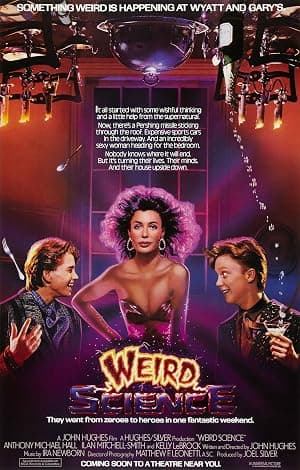
The setup
Weird Science is the sort of movie that announces itself through voice more than premise: fast-talking boys, an absurd experiment and a green-lit permission to behave badly. Revisit it and you find a John Hughes teen comedy that still smells of mischief — anchored, oddly, by the one kid who wants to be someone else. Yes, Gary Wallace is the reason this one keeps being worth talking about.
THE MOVIE
Gary Wallace is still the reason this movie works
There’s a weirdly simple truth at the heart of Weird Science: it gives a nervous, fast-talking teenager a starring role in his own fantasy — and then refuses to let him treat that fantasy like a cheat code. Gary Wallace is precisely that kind of nervous, status-obsessed adolescent who would try anything to escape humiliation; the film spins everything around how he responds when his wish actually comes true.
You don’t have to squint to see the setup: two outcast schoolboys use a homemade computer program and an electrical surge to create a living woman called Lisa. That conceit buys the film a full midday’s worth of comic trouble: wind-ups, overconfidence, one very unreliable Cadillac and a handful of lessons that hit harder than the jokes.
And yes, John Hughes is steering the whole thing. Released in 1985 and running at a brisk 94 minutes, Weird Science sits in Hughes’s teen-film run as the rowdier, odder cousin to his more solemn schoolroom pieces — a comedy that wants to be outrageous and, for a moment, also insists on doing right by its awkward lead.
THE SETUP
The idea that sets Weird Science in motion
Keep it simple: the plot kicks off when two nerdy teenagers conjure a woman through a mix of computing bravado and a power surge. That miracle — or mistake, depending on your moral mood — is less about how it happens than about what it does to their lives.
The movie’s engine is social: Lisa’s arrival forces the boys to handle the attention she brings, and to face the dominoes their new confidence knocks over. The film leans into Frankenstein imagery explicitly, borrowing brief clips and the idea of creation as a thematic motif, while also using a government/computer hookup as the unlikely power source for their experiment.
Weird Science keeps the stakes recognisably adolescent. Lisa’s interventions range from practical — providing a Cadillac and fake IDs so the boys can pass as grown-ups — to decisive, by changing how Chet, Wyatt’s bullying older brother, figures in the story. Ultimately the film reels the household back to a form of normal after her departure, but not before the boys have been forced to grow.
There’s also a slant of adaptation here: the story is loosely rooted in an EC Comics tale from the early 1950s, which helps explain the film’s mix of madcap invention and moral second thoughts.
THE CHARACTER
Why Gary Wallace matters
Gary isn’t memorable because he’s charming — he’s memorable because he’s trying to be. Anthony Michael Hall’s Gary is the boy who talks quicker than he thinks, terrified of humiliation and constantly shopping for status. That makes him a perfect fit for a story about a fantasy that promises to fix everything at once.
What the movie cleverly does is keep the focus on Gary’s motives. He isn’t only after romance; he’s after escape: from ridicule, from being overlooked, from the small arithmetic of schoolyard power. The comedy comes from how big and awkward his wish is, and the drama from the fact he must learn, in short order, how to live with what he asked for.
Put bluntly: Weird Science works because Gary’s desperation is recognisable. It’s not heroism at first — it’s a tantrum dressed up as ambition — and watching the film is watching him discover the price of that shortcut.
That’s why Gary matters more than the gimmick. The machine creates Lisa. The story is about what Gary does with her arrival.
THE PERFORMANCE
Why Kelly LeBrock's performance matters
Contemporary critics singled out Kelly LeBrock for giving Lisa something the premise desperately needed: real presence. Roger Ebert, for one, called her "wonderful" and credited her with bringing warmth and intelligence to a role that could easily have been a flat fantasy figure.
That matters because Lisa is, on paper, a cartoon: an engineered adult who exists to unstick two teenagers from their lives. LeBrock’s contribution is the thing that convinces the audience Lisa is not just a prop, and lets the film slide between gag and genuine human intervention without collapsing.
In short, the performance makes the conceit survivable. Without that tonal ballast, the movie would be more transparently problematic.
UNDER THE SURFACE
Weird Science has more on its mind than the plot suggests
Beneath the pratfalls and the special-access antics, Weird Science is about adolescent wish-fulfilment and the fact that making a fantasy real doesn’t erase the work of becoming an adult. That’s where the film’s coming-of-age beats live: the boys don’t just get what they want; they’re made to reckon with what wanting can do.
There’s also a clear play with creation and playing God. The Frankenstein references are not decorative; they signal that conjuring life carries moral consequences. In this case the moral bookkeeping focuses on responsibility — the new circumstances teach Gary and Wyatt about the social costs of their choices.
And we can’t ignore the awkward mechanics of male fantasy and objectification. Lisa exists as a wish-figure, and the film frequently treats her as the solution to the boys’ problems. That sits uneasily alongside the film’s attempts at decent humour, and the tension between the two is part of why Weird Science still sparks conversation.
Finally, peer humiliation and social status are the freight the whole movie carries. The central conflict is resolutely adolescent: it’s about learning how to live with attention, and how to disentangle self-worth from what other people think.
PRACTICAL EFFECTS
The effects work that gives Weird Science its physical personality
Weird Science leans on practical make-up and effects for its stranger moments — the transformations and the more grotesque set-pieces are achieved with physical make-up work rather than being finessed away. Production credits and later home-video extras make clear a practical-effects crew handled those sequences.
That hands-on approach gives the film a tactile oddness: the weird bits feel like things in a room with the actors, not glossed-over illusions. For a film that trades in sudden physical comedy and body-morphing jokes, that matters; the filmmaking choice keeps the shocks immediate and, at times, nastily funny.
Credits also list named special-effects and make-up personnel, which is why the film’s more sensational visuals are still the kind of things people mention when they talk about Weird Science’s personality.
Practical effects aren’t a virtue on principle, but here they help the movie sell the sillier half of its bargain.
PURE 80S
Weird Science could not belong to any other decade
Weird Science arrived in the summer of 1985, in the middle of John Hughes’s run of teen-focused features. After films like Sixteen Candles and The Breakfast Club, Hughes was working the terrain of teenage life from multiple angles — nostalgia, pathos and, in this case, broad fantasy.
It also fits a mid-80s pattern: comedies aimed at young people that grafted genre ideas on top of schoolyard concerns. Put simply, the decade liked clever premises: high-concept hooks that let juvenile anxieties play out on a larger-than-life stage. Weird Science is that idea turned sideways — a teen comedy built on a science-fantasy conceit.
Finally, the film’s production sits neatly in the era: shot across late 1984 and into the end of the year, with locations around Chicago and studio work in Los Angeles, it’s a product of an American studio system that knew how to make relatively cheap, loud youth films for broad audiences.
All of this makes Weird Science feel like an 80s project in both spirit and method.
WATCHING IT NOW
What has aged — and what hasn't
Modern viewers tend to split Weird Science into two parts: the bits that survive on sheer comic momentum and the bits that sit uncomfortably when watched with contemporary eyes. Critics over the years have repeatedly flagged Kelly LeBrock’s contribution and the film’s effective comic moments even while pointing out problems with how female characters are treated or how the film leans on spectacle.
As a teen comedy, it still works when you accept its premise as cartoonish shorthand for anxieties about status and humiliation. The buddy-movie energy and the scenes that centre on the boys’ attempts to navigate their new social footing still deliver laughs and a recognisable coming-of-age arc.
But the film’s premise — male wish-fulfilment manifesting as an engineered adult woman — doesn’t sit easily now, and that tension is part of what makes Weird Science a film you watch differently than you might have in 1985.
So: parts of it still play, especially the comic beats and certain performances; other parts stick in the throat, and that mixture is what modern viewing feels like.
THE LEGACY
Why Weird Science still matters
Weird Science has kept a foothold in pop-culture conversation for a few tidy reasons. It spawned a TV adaptation that ran on the USA Network through much of the 1990s, which helped keep the title alive for a new generation of viewers.
There have also been periodic attempts at talking remakes; producers and studios revisited the property on and off in later decades, which is one reason the film’s name continues to surface in industry chatter.
Finally, the movie keeps turning up in retrospectives about John Hughes’s output and is frequently labelled a cult favourite in coverage of 80s genre films. That combination of a high-concept hook, memorable oddball moments and its place in Hughes’s teen-film run explains why people still bring it up.
None of this makes it untouchable — but it does explain why Weird Science endures as a conversation piece rather than a forgotten curio.
THE VERDICT
Does Weird Science still hold up?
Yes — with a fairly long asterisk. Weird Science remains worth watching because it’s a compact, weird little machine: two awkward boys summon a woman, the consequences force them to confront their cowardice and the film mixes raunch with genuine growth. That central arc — from wish-fulfilment to a painful lesson in responsibility — still reads as a classical teen comedy move.
Part of the film’s staying power is performance and tone: critics singled out Kelly LeBrock as bringing warmth and intelligence to Lisa, which softens the premise’s rawer edges, while the film keeps the story moving in 94 efficient minutes. Anthony Michael Hall’s Gary, the fast-talking, insecure pivot of the story, remains the emotional anchor for everything that follows.
But it’s also fair to say Weird Science is of its time. The fantasy at the story’s centre is explicitly male wish-fulfilment, and watching it now requires you to hold that discomfort in one hand and the film’s comic ambition in the other. If you can do that, you’ll find a movie that still delivers memorable set-pieces, a handful of pointed jokes and a surprisingly earnest coming-of-age undercurrent.
So, should you watch it? Yes — if you’re prepared to enjoy the funny, sometimes silly inventiveness while acknowledging the film’s more troubling ideas. It’s not a flawless time capsule, but it’s an interesting one: a teenage Frankenstein story that still manages to make you care about the boy who wished it into being.
Share this movie
Keep watching
More movies from the 80s
1984
Supergirl
Supergirl: love and power, and why this 1984 movie still matters.
Read our take →
1983
Christine
Obsession, adolescence and a car that won't let go.
Read our take →
1985
Real Genius
Real Genius: the safety of home and family, and why this 1985 movie still matters.
Read our take →