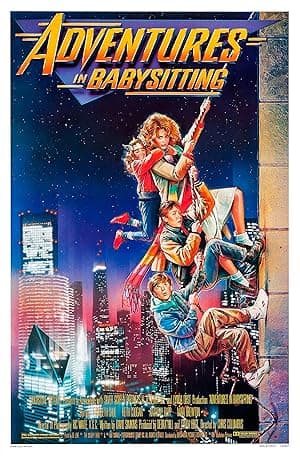
Adventures in Babysitting
A one-night odyssey that turns babysitting into a crash course in grown-up choices.
The setup
Adventures in Babysitting is the sort of 80s movie that makes a simple premise — a teenager stuck looking after some kids for a night — feel like an expedition. Directed by Chris Columbus and centered on Elisabeth Shue's Chris Parker, it’s a tight, 99-minute sprint that sees suburban responsibility collide head-on with urban unpredictability.
THE MOVIE
Christina "Chris" Parker is still the reason this movie works
People keep coming back to Adventures in Babysitting because it gives us a clearly drawn centre to hang the chaos on: Chris Parker, a 17-year-old who is nudged into babysitting and ends up shepherding three children into downtown Chicago for a very bad night to go wrong.
Everything that follows — a cancelled anniversary date, a flat tyre, a tow-truck pick-up and a series of escalating urban run-ins — exists to test whether Chris can be responsible when adult supervision evaporates. It’s a single-night trial by fire that turns a simple babysitting gig into a coming-of-age sprint.
All of that is bound together by Chris Columbus’s steady hand behind the camera and Elisabeth Shue occupying the middle of the mess; the film’s tight running time keeps the story lean and keeps you asking not what will happen next, but whether Chris can pull it off.
THE SETUP
The idea that sets Adventures in Babysitting in motion
Don’t let the babysitting label fool you — the film’s premise is deliberately simple so it can deliver a series of escalating complications. Chris agrees to look after her neighbours’ child, then winds up responsible for three kids when her friend bolts for the city.
From that point the plot works as a chain of pressurised improvisations: adults are absent, the children make impulsive choices and Chris is repeatedly forced to think on her feet. The set pieces — a puncture and tow-truck misadventure, accidental entanglement with a car-theft ring, a blues-club appearance, and a daring office-building rescue — are less about plot twists and more about testing Chris’s resourcefulness.
The film’s engine is its single-night, city-spanning structure. Each episodic encounter increases the stakes and narrows the time window for sensible decisions, so the comedy and adventure sit naturally next to real responsibility.
That design keeps the stakes readable: it’s not a mystery to solve, it’s a problem to handle — again and again — with the clock ticking.
THE CHARACTER
Why Christina "Chris" Parker matters
Chris matters because she’s practical without being dull; she’s a teenager forced into grown-up decisions and the film continually asks her to choose the sensible thing under ridiculous pressure. That positioning makes her the believable fulcrum the whole film pivots on.
Her choices are rooted in loyalty — protecting the kids and running after friends — which keeps her sympathetic and gives the comedy an emotional spine. The movie isn’t just piling on pratfalls; it’s watching a young person stretch into responsibility.
There’s also a physical bravery written into the role. The production creates moments that look dangerous — like the sequence in which a child dangles from a building — using harness-and-pulley techniques and careful set work to sell the peril without putting anyone at real risk.
And because this was Chris Columbus’s first feature as a director, putting a steady, likeable character at the centre helped the film find its feet and kept the audience rooted even when the city starts behaving wildly.
THE PERFORMANCE
Why Elisabeth Shue's performance matters
Contemporary coverage singled out Elisabeth Shue as a real asset to the film — her presence made the whole premise plausible and gave audiences someone to root for when things started to go sideways.
That doesn’t mean the movie is a one-woman show, but having an appealing, credible lead is crucial for a story that hinges on one teenager carrying the night. Reviews at the time repeatedly linked Shue’s likability to the film’s ability to balance humour with genuine stakes.
So when the script leans into chaos, the audience trusts that the central figure is capable of steering everyone through it — which is exactly what the film needs from its lead.
UNDER THE SURFACE
Adventures in Babysitting has more on its mind than the plot suggests
On the surface it’s an adventure-comedy. Underneath it’s a film about adolescence being forced to make adult calls in a hurry. The single-night format is not just a narrative trick — it compresses growth and responsibility into a sharp, watchable arc.
There’s also a suburban-versus-urban strand running through it: suburban kids and a suburban sitter shoved into a city ecosystem they don’t control. That contrast creates both comedy and tension, and it makes every encounter feel like a lesson in real-world unpredictability.
Friendship and loyalty are the emotional currency — Chris is not a reluctant hero who wants glory; she steps into chaos because of who she cares about. That loyalty turns small choices into meaningful acts.
Finally, much of the movie is about improvisation: thrown into one impossible situation after another, Chris has to invent solutions on the spot. It’s leadership under pressure, but stripped of ceremony — messy, urgent and human.
THE FILMMAKING
How Adventures in Babysitting was put together
A choice the production made early on was to shoot with lighting and camera techniques more commonly used in drama. That decision gives the film an unpredictability of tone — you feel the comedy, but you also feel the possibility of danger, which keeps the stakes genuine.
Production design did a lot of heavy lifting. Parts of a Chicago skyscraper were reconstructed on a Toronto stage and a large Translight backdrop was used to suggest the city skyline; the point was to sell a vertical rescue convincingly without pretending the crew were working on-location in Chicago for every shot.
Those practical constructions allowed the filmmakers to stage the more nerve-jangling moments — physically believable danger without throwing anyone off a real building.
Put together with Columbus’s clear, economical direction, these choices help the film move quickly from one set piece to the next while keeping the audience engaged with what feels like genuine consequence.
PRACTICAL EFFECTS
The effects work that gives Adventures in Babysitting its physical personality
When a moment needs to feel perilous, the film generally relies on solid, old-fashioned trickery rather than green-screen theatrics. A harness-and-pulley rig was used to create the illusion of a child dangling many stories up while the performer remained close to the ground.
Production also rebuilt two storeys of the Associates Center and used a 20x40 Translight backdrop to suggest the Chicago skyline. Those practical measures kept the action tactile and grounded, which matters when the movie asks the audience to care about a rescue.
The effects aren’t showy for their own sake; they exist to make the action readable and convincing in a way that supports the performances and the urgency of the night.
PURE 80S
Adventures in Babysitting could not belong to any other decade
The film sits neatly inside the mid-80s moment when Disney’s Touchstone label was expanding into teen and adult fare; Adventures in Babysitting was produced for that imprint and financed through the era’s common structures like Silver Screen Partners III.
Released in the summer of 1987 — opening in Los Angeles and New York on 1 July before a wider U.S. roll-out — it feels like that era’s blend of family-friendly storytelling trying a slightly edgier urban spin.
It was shot in multiple cities (principal photography began in Toronto with additional shooting in Chicago and effects work in Los Angeles), which helps explain the mix of studio-crafted sequences and real-city encounters.
Commercially it did respectable business for the time, pulling in a mid‑$30 million domestic gross — enough to keep it in the public eye without pretending it rewired Hollywood.
WATCHING IT NOW
What has aged — and what hasn't
There are parts that still click: the film’s brisk pacing keeps the night moving, the blues-club sequence remains an entertaining detour, and many viewers still point to Elisabeth Shue’s central presence as a steadying force.
At the same time some elements feel very much of their time. The teen dynamics and social shorthand sit in a pre-smartphone world, and the logistics of the story rely on the fact that characters can’t immediately call for help or check everything online.
The physical tricks — the harness work and stage reconstructions — still read well because they keep the action tangible rather than digital. That tactile quality helps the film avoid feeling entirely retro in its action beats.
Finally, contemporary and archival commentary has always been mixed; while direction and the lead performance tend to receive praise, there are criticisms in the record about parts of the script and how certain urban characters are portrayed — which is worth keeping in mind when watching today.
THE LEGACY
Why Adventures in Babysitting still matters
It matters partly because it launched Chris Columbus’s feature directing career and pointed him towards the family- and teen-focused films he would later be known for. This film is very much the first footnote in that trajectory.
The property’s later reimagining and the fact that remake efforts circulated for years show the premise has a long tail — people still see value in the idea of a single-night urban odyssey led by a reluctant teenager.
It wasn’t a blockbuster that rewired the industry, but its modest mid‑$30 million box-office and continued presence in 80s teen-comedy conversations give it a steady, recognisable place in retrospectives: familiar, fondly remembered and still discussed.
THE VERDICT
Does Adventures in Babysitting still hold up?
Yes — with caveats. If you want a lean, entertaining one-night movie that balances comic set pieces with a believable test of responsibility, this still does the job. The premise is simple: Chris reluctantly takes a babysitting job and ends up improvising through a city-spanning night of escalating trouble. That structure keeps everything propulsive.
Elisabeth Shue’s Chris is the axis the film needs; contemporary coverage singled her out as a reason the film works, and the narrative depends on her being someone who can be relied on when adults vanish from the frame. The plucky child characters and a flustered teenage peer add emotional texture and occasional romantic awkwardness that keep the stakes human.
There are things that will feel dated — a story built around the absence of immediate communications, and some script choices that have not aged neatly — but the pacing, the blues-club sequence and the film’s practical staging of danger still make it a satisfying watch.
So watch it for the ride and for Chris — a teen pushed into grown-up decisions who makes the mess matter. It’s not flawless, but it’s still clever enough to make babysitting feel like an adventure.
Share this movie
Keep watching
More movies from the 80s
1987
The Principal
The Principal: authority and courage, and why this 1987 movie still matters.
Read our take →
1985
Weird Science
Fast talk, bad luck and a very literal wish come true — with consequences.
Read our take →
1986
The Karate Kid Part II
A seaside sequel about duty, dancing and learning when not to fight.
Read our take →