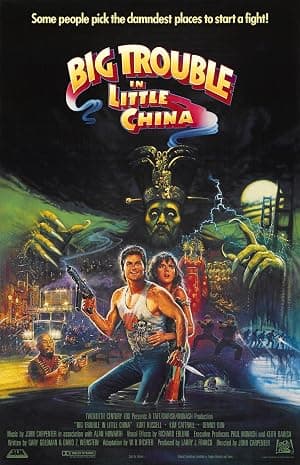
Big Trouble in Little China
A swaggering trucker, ancient sorcery and a Chinatown that hides a very odd basement — this is John Carpenter being playful and dangerous at the same time.
The setup
Big Trouble in Little China is the sort of movie that refuses to be tidy. It straps a brash truck driver to a pulp-fantasy rollercoaster — equal parts martial-arts underground lair and comic riff on the action hero — and then lets John Carpenter enjoy the chaos. If you're wondering why people still bring this one up at parties, start with Jack Burton.
THE MOVIE
Jack Burton is still the reason this movie works
If you remember one thing about Big Trouble in Little China, it will probably be Jack Burton — a loud, swaggering truck driver who turns up to help his mate and then talks like he's already won the film. That's intentional: the film follows him after he helps Wang Chi try to rescue Wang's green-eyed fiancée, and the whole setup gives Burton plenty of room to grandstand.
But there's another, stranger engine under the chatter: the villain, David Lo Pan, is not a typical crime boss but an ancient sorcerer who needs a woman with green eyes to lift his curse. That collision — modern street-level rescue mission meets mythic sorcery — is what lets the film swing between action, fantasy and comedy.
Directed by John Carpenter and clocking in at a brisk 99 minutes, the movie makes a virtue of being both pulpy and nimble. It knows which buttons to press: humour, spectacle and a lead who sells himself as the star even when the story quietly hands the real heavy lifting to other characters.
THE SETUP
The idea that sets Big Trouble in Little China in motion
At its simplest, the film is a rescue picture: Jack Burton helps his friend Wang Chi when Wang’s fiancée is snatched on arrival in San Francisco’s Chinatown. That barebones premise keeps the action moving and gives the movie a clear throughline without forcing it into ordinary summer-movie shapes.
What starts as street-level skulduggery quickly peels back into something weird and subterranean. The story takes the characters from Chinatown’s streets into a hidden, supernatural lair where martial-arts combat and outright magical duels become the rules of engagement.
Crucially, the movie plays with who we expect to be the hero. Jack behaves like the classic, self-assured lead — all bluster and one-liners — while Wang Chi is often the one doing the decisive fighting. That inversion creates a steady, enjoyable tension: who gets to be the legend, and who actually gets things done?
All of this gives the film room to mix genres. It keeps the plot simple enough to follow, while letting the set-pieces and oddball ideas — a sorcerer needing green eyes, hidden lairs — deliver the fun.
THE CHARACTER
Why Jack Burton matters
Jack Burton matters because he’s the personality the film is built around. He arrives as a cocky truck driver who speaks in grand gestures and tall tales; the story uses that bluster as a running joke and a mirror for other characters’ quieter competence.
That brashness is not decorative. It creates comic tension: Jack thinks and talks like the star, even when he often isn’t the one solving problems. The contradiction between his self-image and what the film asks him to actually do is where a lot of the pleasure comes from.
He’s also tied into the movie’s emotional wiring. The rescue plot is fuelled by friendship and loyalty — Jack turns up because Wang Chi is his friend — and Burton’s swagger amplifies the bond rather than replacing it. The film lets that friendship be the gravity while letting Jack orbit around it.
Put another way: the film could have handed the lead role to someone quieter, but it chose a loudmouth. That decision keeps the tone tilted toward comedy and makes the moments when the crew pull together feel earned rather than obligatory.
THE PERFORMANCE
Why Kurt Russell's performance matters
Contemporary notices tended to single Kurt Russell out for how he carried Jack Burton. Critics flagged his delivery and comic swagger as a deliberate take on the macho movie star — a bravado-infused, sometimes almost John Wayne-like riff on the action hero.
That cast choice shapes the movie’s tone. Casting a performer who could sell that sort of bluster lets the film get away with playing its lead as a lovable blowhard rather than an actual infallible saviour.
So Russell’s presence isn’t just casting by convenience; it’s part of the joke and the mechanism. The film is happier because the lead is loud enough to be funny and confident enough to believe his own mythology.
UNDER THE SURFACE
Big Trouble in Little China has more on its mind than the plot suggests
On the surface it’s an adventure-comedy with kung-fu and sorcery. Underneath, the film is playing with the action-hero idea — it deliberately subverts that archetype by making the ostensible hero more talk than triumph.
It’s also a movie about myth meeting modernity. You have a contemporary American setting colliding with ancient Chinese sorcery, and the thrills come from how those worlds don’t fit neatly together but rather fall into comic and sometimes dangerous miscommunication.
Friendship and loyalty thread through the noise. The rescue mission is fuelled by personal ties rather than duty or destiny, which keeps the stakes human even when dragons and curses appear.
And because the story stages cross-cultural encounters so squarely at its centre, the film constantly balances pulp-adventure spectacle with the consequences of that cultural collision — sometimes for laughs, sometimes for tension.
THE FILMMAKING
How Big Trouble in Little China was put together
Behind the film’s jaunty tone there’s a technical backbone. Dean Cundey was the director of photography, and the camera and lighting choices were shaped with the film’s optical work in mind — the look had to accommodate a lot of in-camera and compositing trickery.
Production design played its part too. John J. Lloyd’s sets allowed the action to move from streets into the film's invented subterranean spaces without losing momentum, so the flights between urban exterior and hidden lair felt coherent.
And the production wasn’t shy about hands-on techniques: the movie deliberately used practical make-up, prosthetics and puppetry alongside optical compositing. That combination gives the weird moments a physicality you can almost feel.
In short, Carpenter’s direction sits on top of a crew that planned for spectacle. The filmmaking choices are practical and unflashy in service of the movie’s strange hybrid of humour and fantasy.
PRACTICAL EFFECTS
The effects work that gives Big Trouble in Little China its physical personality
A lot of the film’s oddball charm comes from tangible, practical work. Effects artists led by Steve Johnson handled special make-up and creature work, while Boss Film and Richard Edlund contributed optical finishing — a mix that kept the supernatural feeling anchored to real surfaces.
Some of the movie’s standout moments are the kinds of set-pieces you only get when teams build things and make them move: Lo Pan’s on-camera makeup transformation, a fishlike creature in the sewers, and the rather memorable inflating/exploding effect used for the character Thunder.
The sequences featuring the Three Storms are a good example of layered craftsmanship. Stunt work, prosthetics and puppetry combined with optical enhancement to suggest weather-based powers without depending on entirely digital shorthand.
Those choices give the film a tactile personality. When the weirdness happens, you can sense something physical at the core, which helps sell both the scares and the laughs.
PURE 80S
Big Trouble in Little China could not belong to any other decade
Released in 1986, the film arrived at a moment when American studios were quite comfortable packaging East-versus-West mysticism into broadly entertaining summer pictures. That context helps explain why a pulp premise about sorcerers and green-eyed brides felt like a viable blockbuster idea.
Its genre-mix — action, adventure, comedy, martial arts and fantasy — reflects an 80s appetite for pulpy serial-style entertainment where tone shifts were part of the bargain. The movie wears its mismatched moods proudly; it’s not trying to be elegant, it’s trying to be entertaining.
The production timeline underlines that mainstream ambition. Principal photography began in late 1985 with San Francisco exteriors and most interiors and effects work staged on Fox soundstages, signalling a film built for wide release rather than niche arthouse circulation.
Contemporary reaction was mixed-to-negative and the initial box-office return disappointed, but those early setbacks didn’t kill its afterlife: over time the film found an audience through home-video and retrospectives that appreciated its oddball mix.
THE LEGACY
Why Big Trouble in Little China still matters
The movie flopped financially at first — it didn’t recoup what was spent during its theatrical run — but that’s not the end of the story. Through home video, fan screenings and retrospectives it developed a strong cult following that kept it alive in public conversation.
It has also grown in importance when people trace John Carpenter’s relationship with Hollywood. The film is often pointed to as a moment after which Carpenter pursued a less conventional path with studio work, making it a useful touchstone in career retrospectives.
There’s been ancillary activity too: 1980s-era licensed video games and later comic-book adaptations extended the film’s life beyond cinemas, and talk of remakes or sequels has surfaced periodically, keeping the title in the cultural orbit.
Taken together, these strands explain why the film is still discussed: it may not have landed as intended on first release, but its personality and oddness ensured it wouldn’t be forgotten.
THE VERDICT
Does Big Trouble in Little China still hold up?
Short answer: yes — if you’re inclined toward movies that are messy on purpose and have personality to spare. The setup is modest (a rescue mission in Chinatown that plunges into a subterranean sorcerer’s lair), but the movie’s energy comes from how it twists the expected hero story and delights in the mismatch between talk and action.
Kurt Russell’s Jack Burton is the engine: written and cast as a swaggering, self-mythologiser, he gives the film a loud centre that the quieter competence of characters like Wang Chi balances. Contemporary notices noticed Russell’s bravado and the film leans into that choice rather than apologising for it.
If you care about hands-on craft, there’s plenty to enjoy — the production committed to practical make-up, puppetry and optical compositing to sell the supernatural elements, and that workmanship still rewards attention. And if you’re curious about Carpenter’s career, the film marks a distinct, offbeat detour in his studio-era work.
So watch it for the oddness, the friendship at its core, and the way the film quietly lets others do the heavy lifting while Jack gets to take the bows. In short: it’s not polite cinema, but it’s rarely boring — and sometimes that’s the point.
Featured in
Explore more about Big Trouble in Little China
Share this movie
Keep watching
More movies from the 80s
1985
Police Story
Police Story: freedom and authority, and why this 1985 movie still matters.
Read our take →
1985
The Protector
The Protector: family and parents protecting their children, and why this 1985 movie still matters.
Read our take →
1980
The Young Master
The Young Master: heroism and courage, and why this 1980 movie still matters.
Read our take →