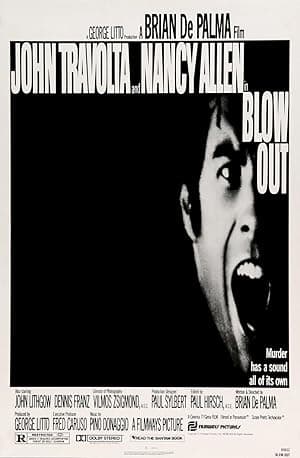
The setup
Blow Out is the kind of thriller that makes you think you missed something the first time. Brian De Palma built a mystery around a soundman who accidentally records a crash that isn’t what it seems — and then refuses to stop listening until the world is forced to hear the same truth.
THE MOVIE
Jack Terry is still the reason this movie works
You remember the set-up because it feels like an idea you should’ve thought of yourself: a freelance sound-effects man happens to catch more than ambience while recording effects for a low-budget horror film. That accidental capture becomes the hook and the hammer of the whole story.
Jack Terry’s curiosity — and a nagging sense of failure he won’t shake — turns what could be a neat technical puzzle into something messier and human. He isn’t just proving a point; he’s trying to fix a wrong he thinks he caused, and that gives his hunt for answers real teeth.
All of this wears Brian De Palma’s fingerprints. The director frames the uneasy argument between what you hear and what you see, and hands the film to John Travolta’s Jack and Nancy Allen’s Sally so the theoretical becomes urgent, personal and — yes — a little dangerous.
THE SETUP
The idea that sets Blow Out in motion
At its simplest: Jack Terry records a car crash and becomes convinced it wasn’t an accident. That discovery drives everything that follows without ever turning the film into a procedural checklist.
What gives the premise shape is the way Jack treats evidence. He doesn’t rely on gut instincts alone; he reconstructs events by matching recorded sound to stills and film, editing and synchronising to test competing versions of the same moment.
The movie keeps the stakes tight by pinning the future of the case to a few fragile things — witness testimony, physical reels and what someone else might want buried. That fragility makes the organised push to conceal the truth feel immediate.
Nancy Allen’s Sally is more than a witness on a notepad: her testimony and security are practical plot engines. Her presence forces Jack’s investigation out of the workshop and into the messy business of keeping people alive while hunting for facts.
THE CHARACTER
Why Jack Terry matters
Jack Terry could easily have been a neat cinematic conceit — a technician with ears and some kit. Instead, the script ties his professional habits to a personal itch: curiosity mixed with guilt. That blend turns a clever hobby into a compulsion.
He’s the sort of protagonist who treats audio like evidence and obsession like homework. The job isn’t just a skill set; it’s the lens through which he understands the world, which makes his refusal to accept surface appearances believable.
Because Jack is motivated by past failures, his investigation feels less like a crusade for justice and more like an attempt at personal repair. That shifts the movie from ‘find the perpetrator’ to ‘what does this man need to hear to sleep again?’
Finally, Jack is memorable because the film keeps him busy in ways most thrillers don’t: he dissects noises, edits reels, synchronises fragments. Those practical actions give his obsession kinetic form — you hear his thinking happening.
THE PERFORMANCE
Why John Travolta's performance matters
Contemporary and later critics noticed that Travolta wasn’t playing the same economic charm machine many audiences associated with him. They flagged the turn as a departure — a deliberate step into darker, more focused material.
That critical pickup matters because Blow Out needs a lead who can carry both the mechanical side of the work and the private weight of failure. The attention the role received suggests Travolta managed that double job in ways that made the film feel different from his recent parts.
Put simply: the casting reads as a deliberate risk. When reviews singled out the performance it was because the part asks for more than star wattage — it asks for believable obsession and the slow narrowing of a man’s world to a single truth.
Whether you come for the plot or the puzzle, the performance keeps you committed to Jack’s point of view. The critical response helped point that out at the time, and it still helps a modern viewer understand why the film leans on him so heavily.
UNDER THE SURFACE
Blow Out has more on its mind than the plot suggests
On the surface it’s a conspiracy thriller. Below that surface, the movie stages a constant argument between sound and image: which of them do you trust, and what happens when they disagree?
That argument is political as well as aesthetic. De Palma set the story against a background of institutional suspicion, so the investigation reads as a small, stubborn attempt to pierce a larger culture of cover-up and plausible deniability.
Obsession and guilt are the emotional engines. Jack’s forensic work isn’t detached science; it’s haunted by his need to make amends. The more he listens, the less he can pretend he isn’t implicated in what he finds.
There’s also a monitoring, surveillance quality to the whole enterprise. The film makes you feel watched and listening at once — a neat trick for a movie about how recorded media shapes, and sometimes distorts, perceived truth.
THE FILMMAKING
How Blow Out was put together
Part of Blow Out’s personality comes from the crew De Palma assembled. Vilmos Zsigmond handled the cinematography (with László Kovács involved in a reshoot), while Paul Hirsch edited and Pino Donaggio supplied the music — a compact team with clear technical pedigree.
The film uses widescreen framing and carefully considered lighting to give its thriller logic a cinematic scale. The technical choices make the city feel both specific and theatrical, which suits a story that is always performing truth for an audience.
That scale ramps up in a sequence the production treated like a mini-spectacle: the Liberty Day Parade. De Palma mounted a major shooting operation for the set piece that involved hundreds of extras and multiple camera platforms — it’s filmmaking that wants to feel lived-in.
Small technical details — the way sound is edited into a scene, the cross-references between visual fragments and audio — are where the craft meets the concept. The movie’s construction is plainly in service of its central disagreement between what you hear and what you see.
PRACTICAL EFFECTS
The effects work that gives Blow Out its physical personality
De Palma’s appetite for doing things properly shows in the production choices. The Liberty Day Parade isn’t implied — it was staged, with more than a thousand extras and around twenty-five stunt drivers on hand.
To capture that scale the crew used multiple camera rigs, including a customised helicopter mount. It’s the kind of old-school decision that makes the sequence register as chaotic and real in a way digital extras often struggle to replicate.
The titular crash demanded similar commitment. The production team actually built a temporary dam across a creek for the sequence that centres on the blow out, then restored the site once it was no longer needed.
There were hiccups — a large block of parade footage was stolen in transit and had to be insured and reshot — but the result on screen is plainly the product of practical logistics and a willingness to stage big, physical moments rather than shortcut them.
PURE 80S
Blow Out could not belong to any other decade
Blow Out sits at a particular cultural moment. De Palma drew on public preoccupations with political scandals and famous assassinations from the previous two decades, which feeds the film’s late-1970s/early-1980s atmosphere of institutional mistrust.
That placement isn’t nostalgia for its own sake; it links the story’s paranoia to a real historical seam of public anxiety about cover-ups and the reliability of official accounts.
Stylistically the film blends noir conventions with conspiracy-thriller ingredients and reflexive cinematic moves — that mixture was a pattern in early-1980s American cinema, when filmmakers were testing how institutions and media shape public reality.
Released in 1981 and squarely part of De Palma’s early-80s body of work, Blow Out reads like a product of its era precisely because it treats distrust of institutions and interrogation of media as central, not incidental, concerns.
THE LEGACY
Why Blow Out still matters
The film’s afterlife isn’t idle fan chatter; it’s practical. Quentin Tarantino has repeatedly named Blow Out among his favourites and has said it influenced his decision to cast John Travolta in Pulp Fiction — a concrete line from De Palma’s casting choices to much later mainstream work.
Musically the film left traces too: Pino Donaggio’s theme for the central pair was later repurposed by Tarantino in Death Proof, which is a neat example of how Blow Out’s textures migrated into subsequent genre cinema.
There’s also been a steady preservation of the film’s reputation: director-approved restorations and high-profile home-video editions, including a Criterion release and a 4K restoration, show that the movie continues to be treated as worth conserving.
Taken together — the endorsements, the musical afterlife, the restorations — Blow Out hasn’t just been remembered; it’s been curated, which speaks to the way later filmmakers and archivists have found reasons to keep talking about it.
THE VERDICT
Does Blow Out still hold up?
Yes. Blow Out is very much worth watching if you care about movies that make craft mean something — about how careful listening and practical ingenuity can be woven into a thriller’s engine. The central conceit (a man who records a crash that wasn’t an accident) still gives the film a tight, propulsive spine.
It helps that the story doesn’t rely on plot gymnastics alone. Jack’s forensic reconstructions — the way sound is synchronised with images to test rival versions of events — keep the film intellectually engaging and emotionally invested at the same time.
The moral pressure cooker matters too. Jack enlists Sally and the search exposes an organised effort to smother evidence; that combination of personal guilt and institutional concealment gives the narrative its urgency and keeps you rooting for small acts of truth.
Lastly, the combination of Travolta in the lead, the clear thematic clash between sound and image, and the film’s careful construction all add up. Blow Out is 108 minutes of a specific cinematic argument, and for anyone who likes a thriller that asks you to listen as well as watch, it still lands.
Share this movie
Keep watching
More movies from the 80s
1981
Ms. 45
Ms. 45: family and the safety of home, and why this 1981 movie still matters.
Read our take →
1988
Frantic
Frantic: our relationship with technology and mortality and lifespan, and why this 1988 movie still matters.
Read our take →
1981
Body Heat
Heat, greed and a lawyer who forgot to say no.
Read our take →