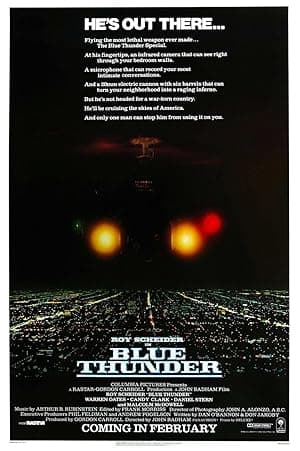
The setup
Blue Thunder is the sort of 1980s thriller that pairs big mechanical spectacle with a grumpy human at its centre. Put simply: the film gives you a believable pilot and then hands him a very dangerous toy. It’s John Badham steering the spectacle, but Frank Murphy is the reason you stay in the cockpit.
THE MOVIE
Frank Murphy is still the reason this movie works
Blue Thunder begins with a neat, readable promise: hand a seasoned Metropolitan Police helicopter pilot a prototype attack‑surveillance chopper and see what happens. That promise isn’t just aerial stunts — it’s a moral crank being asked to sign off on something he instinctively doesn’t trust.
Murphy and his co‑pilot use the helicopter’s onboard sensors and videotape capability to dig into the machine’s intended use — and that investigation turns the aircraft into both evidence-gathering tool and detonator for a larger conspiracy about domestic surveillance and crowd control.
John Badham directs with an eye for drama and momentum, but the film survives because Frank Murphy is written and staged as a maverick: an experienced pilot whose suspicion of militarised policing gives the story its backbone and its nerve.
THE SETUP
The idea that sets Blue Thunder in motion
The engine that runs Blue Thunder is tidy and easy to explain: Frank Murphy is put in charge of testing a prototype attack‑surveillance helicopter called Blue Thunder. That arrangement gives the film a clean dramatic fulcrum — man versus machine, and man deciding what that machine ought to be used for.
The conflict sharpens because Murphy’s past rubs up against the present. A former Vietnam comrade has a hand in the programme, and that personal enmity escalates the stakes from professional misgivings to a private, bitter clash rooted in shared history.
Practically, the helicopter is written to do two jobs at once: it’s an investigative platform, with mounted cameras and sensors feeding videotape evidence, and it’s also an armed system — so every discovery can be followed almost immediately by a physical, aerial response.
That duality gives the plot its rhythm. The movie alternates evidence-gathering, the chase to secure and circulate videotape, and increasingly large aerial confrontations over Los Angeles — the videotape’s release being the story’s key public lever without us needing to relay every final beat.
THE CHARACTER
Why Frank Murphy matters
Roy Scheider plays Frank Murphy, and the script gives him a very specific spine: he is an experienced, maverick helicopter pilot who doesn’t take orders at face value. That scepticism is what turns a high-tech thriller into something you can care about.
Murphy’s objection to militarised policing isn’t just a talking point; it’s the engine of his choices. The film makes him investigate Blue Thunder because he believes the machine is being repurposed for crowd control and domestic surveillance — and because he can’t live with that possibility on his conscience.
Those instincts also humanise the film’s larger themes. Murphy’s dynamic with Kate — his civilian contact and ex‑partner — pulls the private investigation into the public realm: she becomes actively involved in set pieces (including a high‑speed ground chase) that push the videotape evidence toward exposure.
So the aircraft is important, but only because Murphy makes it matter. Without him, Blue Thunder is a gadget movie; with him, it’s an argument you can follow and a fight you want to see won.
THE PERFORMANCE
Why Roy Scheider's performance matters
Contemporary observers pointed to the film’s aerial and action work as its headline attraction — and within that framework Roy Scheider’s presence was noted as a stabiliser. He provides a believable centre that the kinetic sequences can orbit around.
That credibility matters because the movie asks you to accept both the technical spectacle and Murphy’s moral outrage. Scheider’s role is to bridge spectacle and motive: to make you believe the pilot who’s terrified of what the helicopter might become is the same man who can fly it.
Put another way: the film depends on a lead you trust enough to follow into danger, and contemporary commentary treated Scheider as supplying that trust within the action context.
So the performance’s value is practical rather than performative grandstanding — it’s about anchoring the film’s momentum and giving the viewer someone sensible to worry about.
UNDER THE SURFACE
Blue Thunder has more on its mind than the plot suggests
On the surface it’s a helicopter thriller; underneath it’s a compact set of anxieties: who watches citizens, who militarises police tools, and what happens when veterans and the military-industrial world collide in peacetime.
Surveillance versus privacy is the obvious tension — the helicopter is built to see and record, and the film spends time showing how footage can become both proof and a weapon. That videotape mechanic turns the plot into a debate about visibility and control.
The militarisation of policing threads through the story as well: an armed aircraft designed in the name of public safety quickly looks like an instrument with different loyalties. The film stages that danger in moral terms, using its machines to test civic boundaries.
Finally, the post‑Vietnam angle is baked into the characters: veteran alienation and old loyalties make the conflict personal, not merely institutional, so technology becomes a puppet of human grudges and power plays.
THE FILMMAKING
How Blue Thunder was put together
Blue Thunder’s construction is partly practical and partly collaborative: the production teams responsible for the helicopter’s cockpit and instruments worked closely with visual effects and electronics specialists to make the aircraft feel plausible on screen.
That attention to realistic detail feeds directly into the storytelling. If the cockpit looked like a toy, the film’s argument about surveillance would be undermined; building credible onboard equipment kept the stakes grounded.
Editing is another key ingredient. Frank Morriss and Edward M. Abroms earned an Academy Award nomination for their work, and that recognition reflects how much the film relies on cutting — from surveillance footage to aerial sequences — to maintain suspense and clarity.
In short: the movie’s identity comes from the way its technical choices serve the narrative, keeping big action readable and the surveillance mechanics intelligible to the audience.
PRACTICAL EFFECTS
The effects work that gives Blue Thunder its physical personality
The production bought and heavily modified two Aérospatiale SA‑341G Gazelle helicopters: one to fly the stunt work, one as a backup. That decision kept many sequences genuinely airborne rather than entirely composited.
For actor close-ups the crew used a detailed mock‑up cockpit and leaned on rear projection and mirrored reflections to suggest real flight. Those tricks are old-school, but they keep the actors connected to the machine without pretending the cockpit was a functioning modern avionics suite.
When the script demanded aerobatics that a real Gazelle couldn’t safely perform, the film turned to miniatures and motion‑control photography — including a radio‑controlled model for a 360° loop — handled by specialist miniature crews.
Even the instruments and onboard monitors were largely practical on set: the displays shown to actors were fed by external equipment via cables rather than being self-contained avionics, which is a small but telling example of how the team married practicality and illusion.
PURE 80S
Blue Thunder could not belong to any other decade
Blue Thunder arrived in 1983 at a moment when anxieties about surveillance, military influence and civil unrest felt immediate. The screenplay and production tapped into those early‑1980s concerns rather than inventing them.
That timing also places the film alongside other Cold War‑adjacent thrillers. John Badham released WarGames the same year, and contemporary coverage naturally discussed both films when considering his interest in technology and national security themes.
The movie’s premise — an advanced aircraft watching and intervening in the city — translated easily into television, too: the film’s helicopter concept was adapted for a weekly ABC series in 1984, a sign the idea had legs for serial storytelling.
So Blue Thunder is very much a child of its moment: it dresses its paranoia in technical detail and then lets that paranoia play out across the action beats of a mainstream 1980s thriller.
THE LEGACY
Why Blue Thunder still matters
A straightforward reason the film hasn’t been forgotten is its television spin‑off: the helicopter idea proved robust enough to be repurposed for a weekly series in 1984, which kept the concept in public view beyond the film’s run.
Technically and craftwise, the picture earned an Academy Award nomination for Frank Morriss and Edward M. Abroms in Best Film Editing — a reminder that the movie’s construction, not just its premise, commanded professional respect.
There’s also a quieter note: Blue Thunder was among the last films released during Warren Oates’ lifetime, and the production’s release was followed by a dedication to him — a small but human legacy tied to the film’s making.
Taken together, those facts show why the film persists in conversation: it spawned further media, received industry recognition for its craft, and carries personal production history that anchors it to its moment.
THE VERDICT
Does Blue Thunder still hold up?
Yes — with a rider. Blue Thunder’s central bargain still pays off: it hands a believable, sceptical pilot a very persuasive machine and then uses both to stage tidy moral collisions about surveillance and the militarisation of policing.
If you come for the aerial action, the film still delivers. The production used modified Gazelle helicopters alongside mock‑ups, miniatures and motion‑control work to sell its stunts, and contemporary reviews flagged those sequences as the film’s technical highlight — not least because the editing (an Academy Award‑nominated job) keeps them punchy and readable.
If you come for the ideas, the film’s worries about who watches whom and what happens when veterans’ loyalties cross with institutional power feel uncomfortably modern. The plot turns on Murphy and his partner using onboard sensors and videotape to document a conspiracy, and that simple mechanic turns spectacle into civic argument.
So watch Blue Thunder for Roy Scheider’s grounded lead, for the craft of the aerial work and for a story that raises a question still worth asking: when a machine can both observe and strike, who gets to control it?
Share this movie
Keep watching
More movies from the 80s
1982
Blade Runner
Four engineered years, a handful of memories and a detective who isn’t sure he wants to do his job.
Read our take →
1987
The Hidden
The Hidden: mortality and lifespan and mortality, and why this 1987 movie still matters.
Read our take →
1983
Christine
Obsession, adolescence and a car that won't let go.
Read our take →