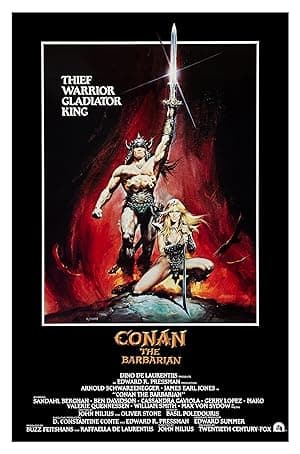
Conan the Barbarian
A musclebound quest that talks about steel, fate and how to be remade by violence.
The setup
Conan the Barbarian still feels like a film that knows exactly what it wants to be: a gruelling origin story, a revenge march and an old-fashioned myth all rolled into one. John Milius gave it a single-minded centre — Conan — and the rest of the movie arranges itself around that engine: the theft of a sword, the taking of a boy, and a life rebuilt around one purpose.
THE MOVIE
Conan is still the reason this movie works
If you remember one image from Conan the Barbarian it’s not the sets or the chanting or even the fights. It’s the shape of a life that begins in a single, brutal moment: a Cimmerian village is razed, Conan’s parents are killed, the family sword is taken and the boy is dragged into slavery. That opening is not window-dressing; it’s the engine the whole film runs on.
John Milius put that engine centre-stage. He co-wrote and directed the film with a clarity of purpose that keeps the story simple and muscular: a young man shaped by trauma searching for strength, identity and the promise of revenge. The film’s appetite for myth — and for the moral puzzle called the 'Riddle of Steel' — gives the revenge plot a philosophical crank.
It’s also a big‑budget, unashamedly operatic piece of entertainment. Arnold Schwarzenegger plays Conan; James Earl Jones plays the antagonist around whom that revenge orbit spins; Sandahl Bergman appears as Valeria, whose short but sharp presence matters. And Basil Poledouris’s score does more than fill space — it helps make the film feel like a lived myth.
THE SETUP
The idea that sets Conan the Barbarian in motion
At its most economical, the film sets Conan up as a man with one mission: find Thulsa Doom and answer what was taken from him. That pursuit — and the unraveling of Doom’s snake‑worshipping cult — is the story’s main dramatic thread.
Mako’s narration, credited as the Wizard, keeps the tale feeling framed and mythic; his voicebookends parts of the picture and gives the film a fable‑like cadence, including the epilogue.
Rather than long stretches of explanation, the movie leans on music and montage to carry us through years of Conan’s life. Poledouris’s score was recorded with a large orchestra and choir, and it’s stacked into those sequences to do heavy narrative lifting.
So the setup works because it’s focused: a clear enemy, a simple quest, and a storytelling mechanism that favours showy tableaux and music over talky exposition.
THE CHARACTER
Why Conan matters
Conan matters because he’s built as a consequence. He isn’t a blank‑slate adventurer who decides to be a hero — he’s a boy refashioned by violence into a machine for a purpose. The theft of his family sword and the killing of his parents aren’t just backstory; they are the kiln in which his identity is fired.
Arnold Schwarzenegger plays that remade man. The film keeps the character’s aim straightforward: revenge and the search for strength and meaning after enslavement. That single-mindedness helps the audience slot into Conan’s head and follow his path without a lot of mental detours.
Conan also functions in relation to others. Subotai is the companion who widens Conan’s world from solitary avenger to travelling partner; Valeria is the short-lived foil whose camaraderie, freedom and loss throw Conan’s choices into relief. These relationships make the hero less of a walking idea and more of someone who moves through human ties — brief, crucial and often costly.
Finally, the 'Riddle of Steel' — taught to him by his father — hangs over the character like a question he must answer in blood and choices. It’s the organising motif that follows Conan from childhood through to his final confrontation.
UNDER THE SURFACE
Conan the Barbarian has more on its mind than the plot suggests
On the surface it’s a revenge quest. Underneath, the film is wrestling with questions about sources of power. The Riddle of Steel — whether strength comes from the object or the man who wields it — threads through Conan’s choices and the way other characters structure authority.
That feeds into a second, larger tension: charismatic authority versus individual strength. Thulsa Doom leads by seduction and cultish command; Conan’s idea of power is personal, forged by hardship and muscle rather than sermon or spectacle.
Identity and transformation are built into the very structure: a boy becomes a slave, becomes a fighter, becomes an avenger. The film stages those shifts as a sequence of trials and losses, which is why violence and its costs aren’t merely spectacle but subject matter the movie keeps returning to.
Put together, the themes give the story weight. Revenge propels the action; the Riddle of Steel gives it a question to chew on; and the contrast between different kinds of authority turns a sword movie into something that tries, at times successfully, to be a modern myth.
THE FILMMAKING
How Conan the Barbarian was put together
John Milius steered the ship as writer-director, and the production gathered a team that left a clear fingerprint: Ron Cobb led production design, Duke Callaghan is credited as director of photography, and the movie favours large, sweeping moments over quiet interior beats.
One of the film’s most distinctive choices is how it compresses decades into montage. Long stretches of Conan’s life are condensed into epic sequences that pair images with music rather than explanations, so you feel time passing rather than read about it.
Those montages are dependent on Basil Poledouris’s score; the music wasn’t an afterthought. Poledouris worked from storyboards and footage, and the result is an operatic soundtrack that often carries the emotional project when the script steps back.
The film also wasn’t fixed in a single shape: preview screenings and studio input produced multiple theatrical cuts. The need to trim or tone down violence for wide release is part of why different running-time variants exist and why some scenes survived only to reappear later in home‑video editions.
PRACTICAL EFFECTS
The effects work that gives Conan the Barbarian its physical personality
The film relied on a mix of optical work, miniatures and matte artistry handled by specialist teams; Visual Concept Engineering under Peter Kuran is one of the named companies involved, and the credits list miniatures and matte artists among the effects crew.
That practical approach gives many sequences a tangible, physical personality. When the camera cuts to distant battlements or ruins, those elements are often built or composited rather than conjured digitally — which is part of why the movie reads as a constructed world rather than an altogether imaginary one.
The sword fights and stunts are similarly on-set commitments: choreography and real stunt work play a large part in the action, and contemporary production reports record at least one accident during a swordfight in which Sandahl Bergman nearly lost a finger.
Taken together, the hands‑on effects and stunts make the film feel like a production that preferred mechanical solutions to theatrical problems — a practical attitude that matches its mythic ambitions.
PURE 80S
Conan the Barbarian could not belong to any other decade
Conan arrived during the early‑1980s sword‑and‑sorcery revival, a moment when studios were willing to bankroll larger‑scale fantasy and action pictures built around muscular heroes and operatic scores. It’s very much of that moment in its scale and ambitions.
The production itself reflects early‑80s international practice: financed by the Dino De Laurentiis Corporation, shot largely on location in Spain with constructed sets, and distributed in North America by Universal — a multinational approach typical of big pictures of the time.
Studio scheduling also shows the era’s commercial instincts. The release was moved forward to May 14, 1982, reflecting the sort of strategic timing decisions studios made when they wanted a film to sit in a particular marketplace window.
Finally, the movie’s afterlife — a direct sequel in 1984 and a long home‑video history with multiple different cuts — is the kind of franchise flicking the decade often produced: one expensive adventure that, if it worked even a bit, quickly led to more.
WATCHING IT NOW
What has aged — and what hasn't
The film’s central setup still reads plainly: the childhood trauma that sends Conan into slavery and shapes his life is straightforward and still motivates the story. That clarity helps modern viewers understand exactly what the hero wants and why.
Mako’s voiceover keeps functioning as a framing device, though it also reminds you that the film is written as a fable. For some viewers that narration adds grandeur; for others it underlines the film’s artifice — either reaction is valid because the device is so overt.
There’s also a technical caveat: Conan exists in several running-time variants. Different cuts circulate on home video, so what you watch today — whether the shorter theatrical edit or one of the extended versions — changes the film’s texture and how much it lingers on particular scenes.
And the soundtrack still plays a role in how the film is experienced: Poledouris’s main thematic material — the Riddle of Steel and Anvil of Crom motifs — has been reissued and continues to anchor how many people remember the movie.
THE LEGACY
Why Conan the Barbarian still matters
One concrete reason Conan still matters is star-making momentum: the film established Arnold Schwarzenegger as an international leading man and directly led to a 1984 sequel, which cemented the character’s place on screen.
Another is the music. Basil Poledouris’s score — especially the Riddle of Steel and Anvil of Crom material — keeps being mentioned in retrospective conversations and has been reissued on special‑edition releases. The sound of the film lives beyond its image.
Finally, the movie’s home‑video life is long and complicated. Multiple different cuts and special editions have been released on VHS, DVD and Blu‑ray, which means generations of viewers have encountered slightly different versions of the same story.
Put together, those threads — star status, a distinctive score and a varied home‑video history — explain why Conan keeps surfacing in film conversations without needing to claim grander influence than the evidence supports.
THE VERDICT
Does Conan the Barbarian still hold up?
Yes — with reservations. If you want a clean, purposeful myth about revenge and the forging of a man, this still hits. The inciting attack on Conan’s village, the theft of the sword and his subsequent enslavement remain a powerful, unambiguous motor for the story; the revenge quest that follows is easy to follow and emotionally direct.
The film’s montage structure — condensing decades into a few score‑backed sequences — is a strength rather than a weakness. Those sequences, backed by Poledouris’s orchestral work recorded with choir and orchestra, deliver the sense of a life passing and a man being remade without excessive exposition.
There are caveats. The principal conflict — Conan versus Thulsa Doom and his cult — is compelling because Doom represents an alternative, seductive kind of power. But studio changes that produced multiple running‑time variants mean different viewers will have slightly different experiences depending on the cut they find, and some of the violence was trimmed for wide release.
Still: if you’re curious about a film that dares to make a philosophical motif (the Riddle of Steel) central to a sword‑and‑sorcery adventure, and you want to see the picture that helped turn its lead into a star, then yes — watch it. It’s a film that wears its convictions loudly, and for better or worse, that stubbornness is exactly what gives it life.
Share this movie
Keep watching
More movies from the 80s
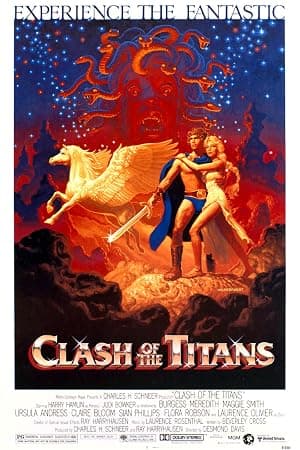
1981
Clash of the Titans
A labour of gods, monsters and one man who won't be pushed around.
Read our take →
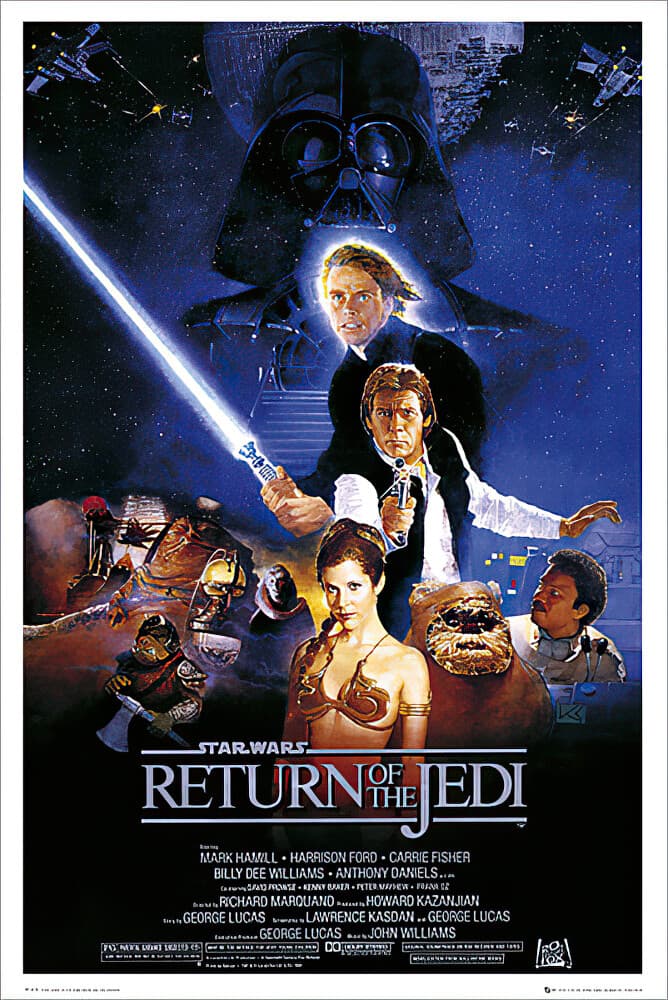
1983
Star Wars: Episode VI – Return of the Jedi
Star Wars: Episode VI – Return of the Jedi: mortality and lifespan and mortality, and why this 1983 movie still matters.
Read our take →
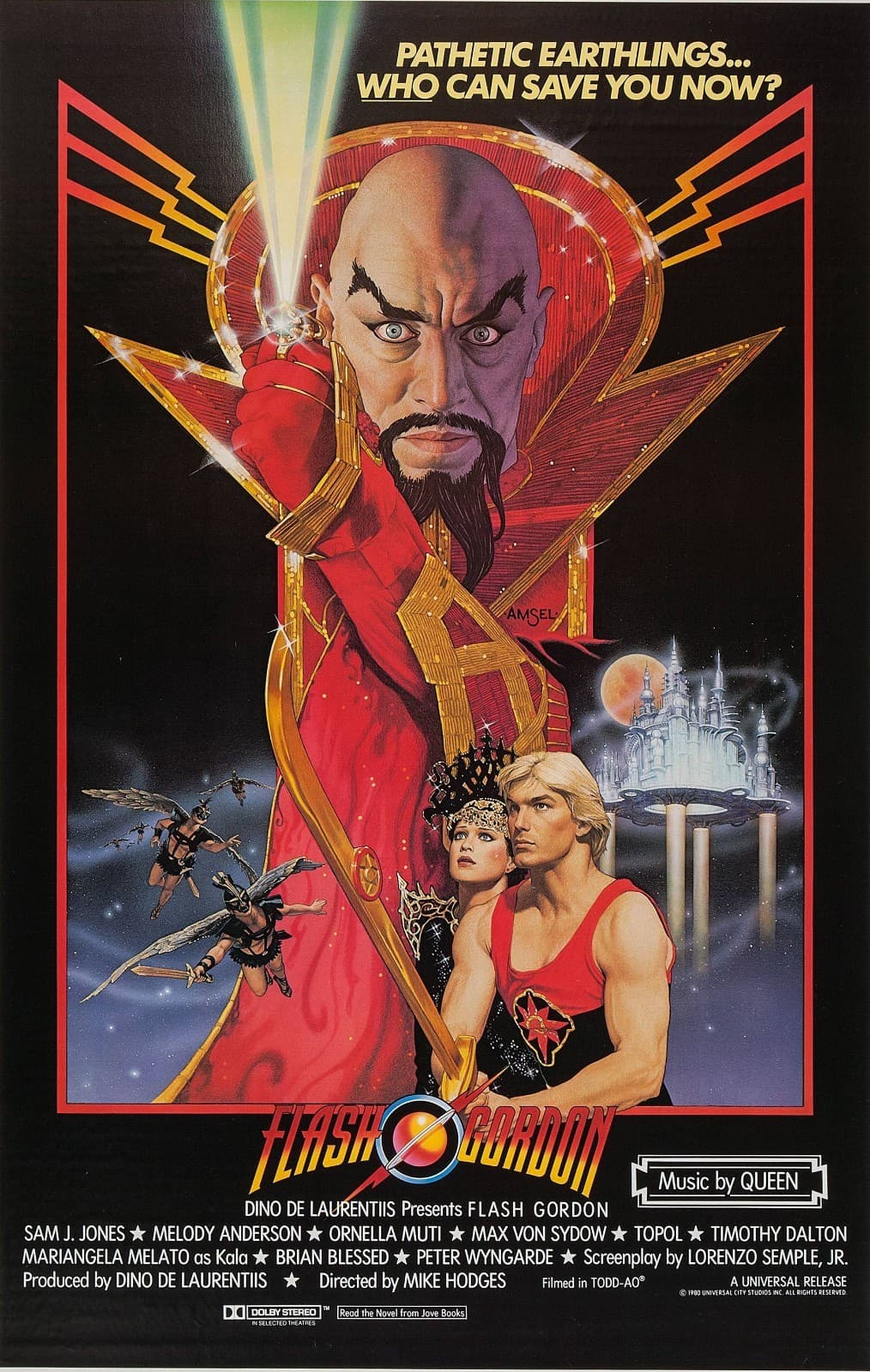
1980
Flash Gordon
Brash heroics, operatic spectacle and a Queen soundtrack — Flash Gordon wears its pulp heart on its sleeve.
Read our take →