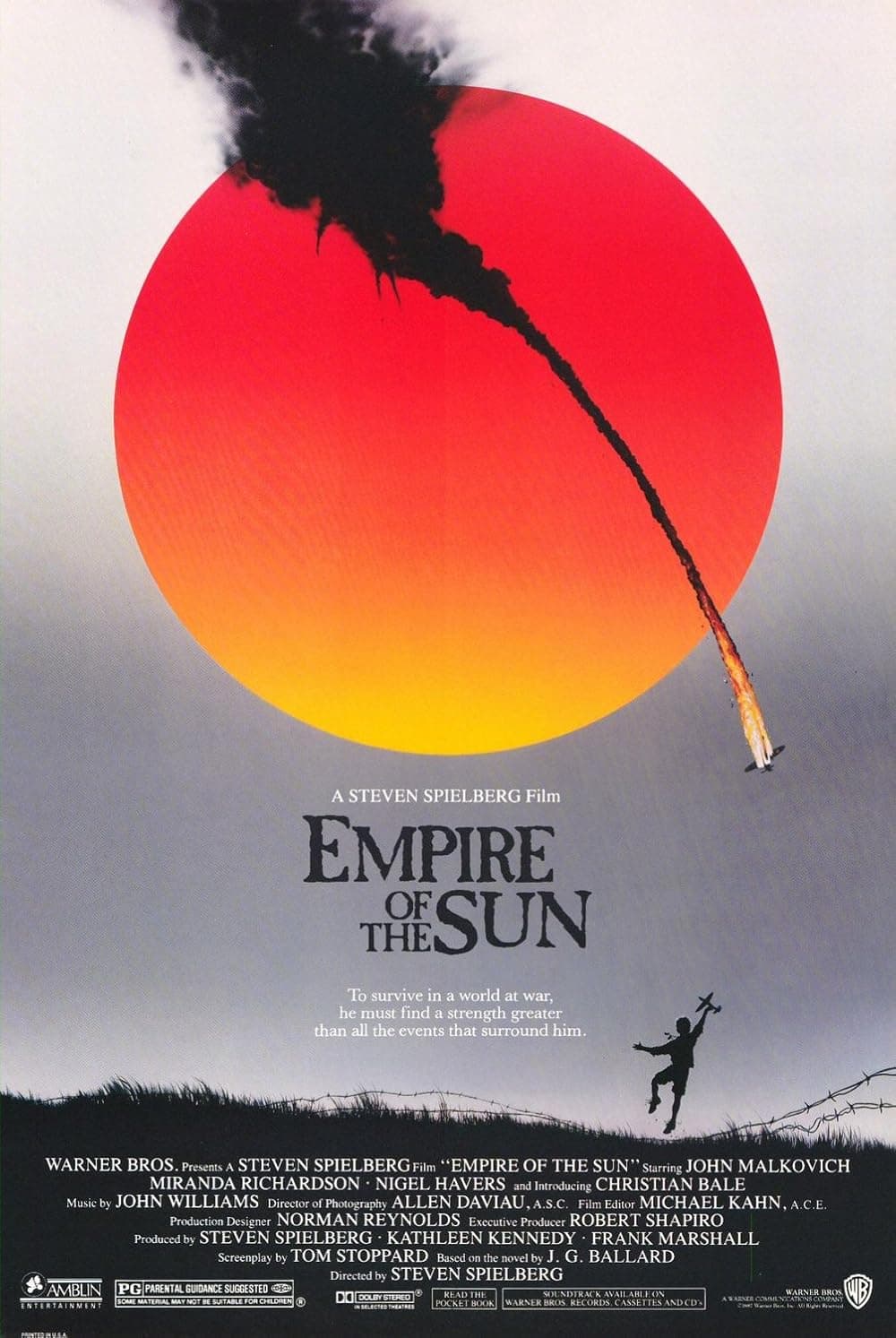
Empire of the Sun
A child's obsession with flight becomes the lens for war, survival and a very awkward apprenticeship in adulthood.
The setup
Empire of the Sun keeps turning up in conversations because it refuses to be neatly sentimental or merely spectacular. Spielberg gives us a boy — Jamie “Jim” Graham — and then hands him the whole of wartime Shanghai to make sense of. Watch it now and you’re still watching a film shaped around one terrific, difficult child's journey.
THE MOVIE
Jamie "Jim" Graham is still the reason this movie works
If you remember one image from Empire of the Sun it will probably involve a boy staring at the sky. That’s not nostalgia so much as the movie doing exactly what it promised: giving Jamie "Jim" Graham an almost religious appetite for aeroplanes and then using that hunger as the engine of everything that follows.
Spielberg stages the film around Jim's separation from his parents during the chaos after Pearl Harbor, then watches him adapt — first to the strange company of American grifters, then to life inside the Soochow Creek internment camp placed beside a Japanese airfield. It's a long film, and it trusts the audience to live inside Jim's head for most of its 150-minute running time.
Part of why people still talk about Empire of the Sun is that it's a coming-of-age picture told in wartime scale: loss of innocence, obsession with flight and a pragmatic will to survive keep tumbling into one another until the boy is very obviously not the same child who began the story.
THE SETUP
The idea that sets Empire of the Sun in motion
At its core the film asks a plain, practical question: what does a well-off schoolboy do when the world he knows disappears? Jim starts as a privileged child in Shanghai, and the Japanese attack collapses that certainty. Separated from his parents, he is picked up by two American grifters and eventually relocated to an internment camp beside an airfield.
That neighbouring airfield is not background scenery; Jim's obsession with aircraft structures key sequences and his emotional life. The film uses aeroplanes as both literal threat and impossible longing — a running motif that punctuates the darker business of survival.
Inside the camp the plot becomes less about rescue and more about adaptation. Jim evolves from sheltered child to resourceful adolescent: smuggling, trading favours, learning how to be useful. Those practical changes are the film's steady engine.
Important beats — the street chaos after Pearl Harbor, Jim’s capture and transfer, the relationship he forms with the grifter Basie, and the U.S. bombing raids on the airfield — keep returning the story to the same idea: survival is messy, and growing up in a war won't give you tidy lessons.
THE CHARACTER
Why Jamie "Jim" Graham matters
Jim isn't memorable because he's heroic. He's memorable because he's hungry — not just for his parents, but for the machines in the sky and for a place to belong. That longing shapes most of his choices, even when the choices are survival trades and small, morally dubious bargains.
His arc is quietly structural: the film is less interested in a tidy adult verdict than in recording how a child learns to live by practical rules. He becomes useful to others — a smuggler, an apprentice of sorts — and that usefulness is what keeps him alive.
The Jim–Basie relationship deserves emphasising. Basie is a crooked adult who alternates between exploiting and protecting Jim; that corrosive surrogate-parent bond is the school where Jim receives some of his hardest lessons about the adult world.
All of this matters because the film keeps returning to Jim’s perspective. He’s a lens for displacement and identity — a boy whose name, loyalties and needs shift as imperial Shanghai dissolves around him.
THE PERFORMANCE
Why Christian Bale's performance matters
Christian Bale's casting was the result of an international search, and his turn as Jim was widely singled out at the time as a breakthrough juvenile performance. That recognition is not just trivia; the film rests on the audience accepting Jim as both naive and cunning, and Bale’s casting supplied a credible centre for that tricky balance.
Contemporary awards attention — including a special National Board of Review citation for Outstanding Juvenile Performance — confirms how central his presence was to the film's reception.
Put bluntly: Empire of the Sun needed a child who could carry a three-hour film without vanishing into the scenery. The contemporary response suggests Bale delivered on that demand.
Which matters when the movie asks you to live inside a boy who is being taught adulthood by opportunists, doctors and corrupt hierarchies. If you don't buy Jim, the film loses its hinge.
UNDER THE SURFACE
Empire of the Sun has more on its mind than the plot suggests
On the surface it's a wartime odyssey. Beneath that surface the film argues with several difficult ideas at once: growing up too fast, what technology means to desire, and how survival often asks you to compromise your private ethics.
Loss of innocence is the obvious through-line — but it's not sentimental. Jim's coming-of-age happens in the ugly economy of a camp where adults are teachers and predators in the same afternoon.
The obsession with flight and technology keeps returning because those machines represent two contradictory things: freedom and destruction. For Jim they are beauty, escape and the object of a nearly religious fascination; for the film, they are also instruments that make the camp and its violence possible.
Finally, there's displacement and identity. Jim's shifting names, allegiances and practical roles underline how belonging is a moving target when an empire collapses and a child is left to fend for himself.
THE FILMMAKING
How Empire of the Sun was put together
Empire of the Sun spends a lot of its running time moving between spectacle and small human moments, and the technical credits explain why that feels possible. The film’s cinematography, editing and production design were singled out by contemporary reviewers — all the ingredients you need when a movie wants to feel both vast and lived-in.
Allen Daviau’s camerawork and Norman Reynolds’ production design are repeatedly mentioned in the same breath, with Michael Kahn’s editing pulling the sequences together. Those elements helped the film swing between the grand (air raids, city chaos) and the intimate (a boy bargaining for survival).
If the film sometimes feels episodic, that was part of what reviewers noted: it moves from one discrete survival lesson to the next, and the technical team had to make each segment readable and emotionally immediate.
John Williams' score is another constant presence: reviewers singled it out along with the production design and cinematography, which is why the film’s sound and music are often foregrounded in accounts of its craft.
PURE 80S
Empire of the Sun could not belong to any other decade
This is late-80s Spielberg in a very specific mood: alternating between blockbuster spectacle and more adult dramas. That tension is part of what made the film feel like a grown-up project from a director who also directed summer hits.
The film's creative team — producers, composer, cinematographer and editor — reads like a who's-who of Spielberg's 1980s circle. That continuity matters because it means the movie carries the same technical polish as his lighter, more commercial work while attempting a different, harder tone.
In 1987 contemporary reviews often paired Empire of the Sun with other child's-eye wartime films — critics were comparing approaches as much as subject matter, and that conversation is very much of its moment.
Finally, the production choices — shooting in Shanghai as well as English stages and constructed sets in Spain — reflect the late-80s ambition to make historical drama feel immediate and global rather than studio-bound.
THE LEGACY
Why Empire of the Sun still matters
The film’s craft has kept it in circulation: it picked up multiple Academy Award nominations in the technical categories and won recognition at the BAFTAs, including awards in costume and production areas and praise for John Williams' score.
It also occupies a particular place in career narratives. For Christian Bale, this is widely acknowledged as the screen role that introduced him on an international level — the performance that launched a long career arc discussed in retrospectives.
Archival screenings and festival programs keep returning to the film as part of reassessing Spielberg's 1980s output; it’s the sort of movie programmers pull out when they want to show a director trying something more sober and complicated.
So Empire of the Sun still matters because it combines technical ambition with a story that foregrounds a difficult, early performance and an unflinching look at what childhood can become under violence and displacement.
THE VERDICT
Does Empire of the Sun still hold up?
Yes — with a sensible caveat. If you come for a traditional Spielberg crowd-pleaser you may find the film's tone and episodic rhythm uneven; several contemporary reviewers noticed that at the time. But if you want a serious, uneasy coming-of-age played out against wartime survival, this is precisely the film to watch.
It works because Jim’s arc is coherent: a privileged boy separated from his parents becomes a resourceful adolescent, driven by longing for family and an obsessive fascination with aircraft that repeatedly returns the story to both wonder and danger. The practical mechanics of survival — smuggling, alliances with figures like Basie, and the presence of stabilising adults such as Dr. Rawlins — give the emotional changes real weight.
Add the technical strengths — cinematography, production design and John Williams' score — and you have a film that knows how to stage its bigger moments while keeping the focus on one boy's interior life. That combination is why the film remains on programmers' and critics' radars.
So, should you watch Empire of the Sun today? Absolutely, if you’re prepared for a long, often unsettling journey that treats childhood as something complicated rather than cute. It's a film that asks you to look up at the sky and remember why the view was worth wanting in the first place.
Share this movie
Keep watching
More movies from the 80s
1987
Au revoir les enfants
Au revoir les enfants: family and friendship, and why this 1987 movie still matters.
Read our take →
1987
Full Metal Jacket
Two halves, one soldier: Joker carries Kubrick’s Vietnam from drill yard to Huế.
Read our take →
1987
Good Morning, Vietnam
A loud, furious hello from a man who thinks radio can fight censorship and loneliness at once.
Read our take →