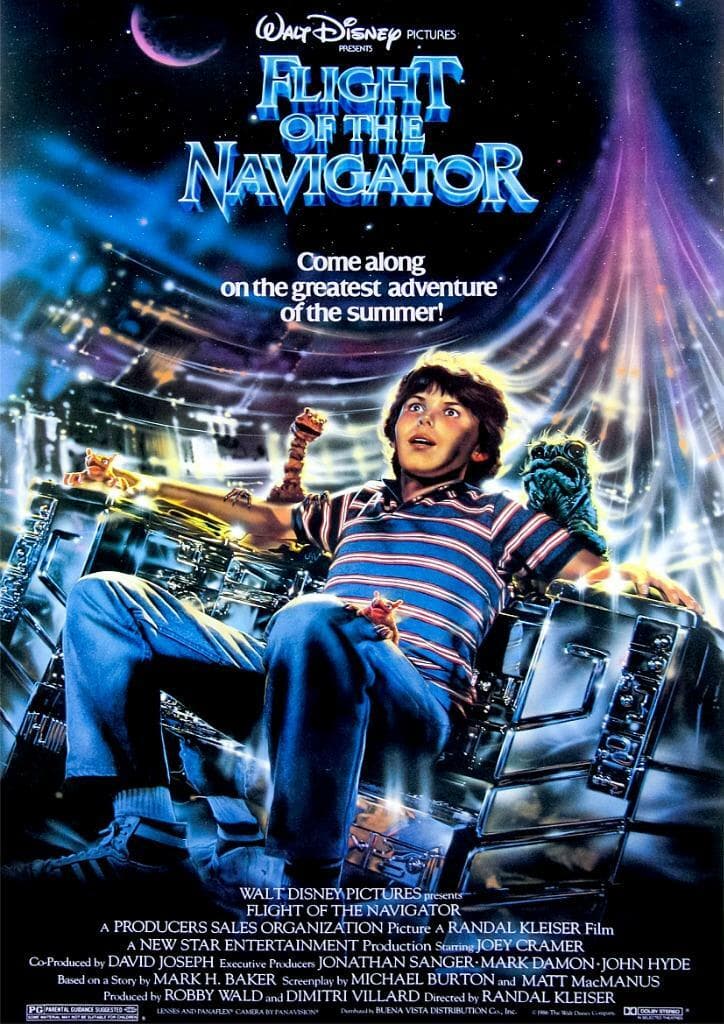
Flight of the Navigator
A boy, eight missing years and a chrome spaceship that needs him as much as he needs home.
The setup
Flight of the Navigator is that rare '80s kids' film that keeps its centre small: a twelve‑year‑old who vanishes from one summer and turns up eight years later, unchanged and bewildered. Randal Kleiser stages a lean, 89‑minute adventure where the emotional engine is simply David trying to get back to a life that moved on without him. If you remember the ship at all, you probably remember why — because David is the reason the whole thing matters.
THE MOVIE
David Scott Freeman is still the reason this movie works
If there’s a single image that defines Flight of the Navigator it isn’t the spaceship, it’s the idea of a twelve‑year‑old who vanishes on July 4, 1978 and reappears eight years later without having aged. That jolt — a boy out of time — is what gives the film its heartbeat.
From there the trouble is practical: NASA finds images and star charts inside David’s mind and takes him into scientific custody. The movie’s stakes live in the small, human problem trapped inside the big, genre set‑piece.
Randal Kleiser keeps the runtime tight (89 minutes) and the focus narrower than you might expect: this is a family sci‑fi about a child whose displacement in time creates all the emotional and logistical friction the story needs.
THE SETUP
The idea that sets Flight of the Navigator in motion
The film’s engine is simple and effective: David disappears in 1978 and later reappears years ahead, which forces a collision between his private need to go home and the institutional logic of scientific study.
NASA’s involvement isn’t window dressing; it’s the primary obstacle. Scientists find imagery and star charts in David’s brain that match a crashed alien craft, so he becomes a subject under observation rather than a regular kid reunited with his family.
On the other side of that containment sits the ship itself. Through telepathic contact David connects with the Trimaxion Drone Ship — nicknamed ‘Max’ — and that relationship becomes plot‑critical, because the ship’s databanks were damaged and it needs David’s memories to navigate.
That triangle — boy, bureaucracy, and a damaged intelligent ship — keeps the story moving without ever confusing its priorities. The personal comes before the spectacular.
THE CHARACTER
Why David Scott Freeman matters
David isn’t a cipher or a generic kid hero. He’s the lens through which every decision in the film — scientific, ethical, emotional — is filtered. Put simply: without him the ship’s need and the NASA drama wouldn’t mean much.
Joey Cramer plays David Scott Freeman, and the film trusts that the audience will care about a boy who’s been ripped out of time and wants to get back to the family he remembers.
That personal angle is what makes the human–alien friendship feel lived‑in rather than gimmicky. David’s mind contains the crucial navigational data the ship needs, so the rapport with the Trimaxion Drone Ship is both emotional and plot‑necessary.
Because Flight of the Navigator is a family film, those childhood emotions — confusion, longing, stubbornness — are allowed to drive a science‑fiction premise without the plot getting needlessly clever.
THE PERFORMANCE
Why Joey Cramer's performance matters
Contemporary responses singled out Joey Cramer as the winning centre that keeps the film’s family‑friendly tone grounded. That’s important because the story asks viewers to accept an extraordinary situation and care about one small person inside it.
Because the film keeps David at its emotional centre, the casting choice matters: the audience must be willing to follow his bewilderment and determination through the NASA sequences and his interactions with the ship.
The performance provides the film with a readable human rhythm: when David wants to go home, you feel it. When the ship needs him, his confusion carries weight.
In short: Cramer is the film’s human hinge — the reason the emotional beats land amid the sci‑fi mechanics.
UNDER THE SURFACE
Flight of the Navigator has more on its mind than the plot suggests
On the surface it’s an adventure: lost boy, shiny ship, scientific containment. Underneath, the film is interested in what happens when childhood collides with adult systems — the theme labelled here as childhood versus authority.
Time displacement does the heavy lifting emotionally. David hasn’t aged but the world has moved on; that mismatch turns a sci‑fi conceit into a frank story about loss, memory and the awkwardness of returning to life after being left behind.
The human–alien friendship anchors those ideas. The ship needs David’s memories, so their rapport mixes the practical and the personal: he’s not just a key, he’s company.
And because the film is built as a family picture, it leans into nostalgia for household life in the mid‑1980s rather than turning inward into grim darker territory. That choice keeps the film warm without making it sentimental.
THE FILMMAKING
How Flight of the Navigator was put together
One of the reasons the ship still feels specific is the way the production blended new digital techniques with traditional methods. The film’s early CGI was handled by Omnibus Computer Graphics under Jeff Kleiser’s supervision, and it used reflection‑mapping — an image‑based lighting technique — to give the ship that chrome look.
That choice matters because the visual personality of the Trimaxion Drone Ship is literally reflective: how it looks affects how believable it reads on screen, especially when the digital elements sit beside physical ones.
Kleiser’s direction keeps the camera and story focused on David, letting the technical work serve the characters rather than call attention to itself.
So the film’s identity comes from a pragmatic mix of emerging CGI approaches and straightforward direction that prioritises story clarity over spectacle.
PRACTICAL EFFECTS
The effects work that gives Flight of the Navigator its physical personality
The Trimaxion Drone Ship wasn’t just a CGI model. The production realised it with a combination of early computer imagery, miniatures and life‑size props — a hybrid approach that lets the film move between scales believably.
Many miniature shots used motion‑control systems to keep camera moves repeatable, and larger interiors were built as practical stage sets where actors could interact directly with their surroundings.
At the same time Omnibus Computer Graphics supplied the computer animation and used reflection‑mapping/image‑based lighting to match the ship’s chrome surface to its environment.
That practical/digital mix gives the movie a tactile presence: the chrome ship reads as an object in the story world because it was handled in multiple ways rather than invented entirely in post.
PURE 80S
Flight of the Navigator could not belong to any other decade
Put simply: this movie sits in a particular moment of effects history. It arrived after Tron had shown what computer graphics might do, but before photoreal digital effects became common — a mid‑1980s transition point.
As a 1986 family sci‑fi adventure it fits a period trend of youth‑centred speculative stories that mix household drama with genre elements. Those films made room for children’s emotions inside big‑idea plots.
The production itself felt that mix: principal photography began in December 1985 and used South Florida locations alongside interior work in Norway, a pairing that underlines the film’s hybrid practical/digital ambitions.
So the movie is of its time not because of a fashion choice but because its methods and storytelling reflect the possibilities — and the limits — of mid‑80s family sci‑fi.
WATCHING IT NOW
What has aged — and what hasn't
Modern viewers who return to Flight of the Navigator tend to find the same anchors that helped it land in the first place: its family‑oriented tone and Joey Cramer’s central turn continue to be cited as strengths.
The film’s emotional premise — a boy out of time wanting to return to his family — still reads clearly, because the story keeps that personal problem at the centre rather than letting the sci‑fi trimmings take over.
Visually, the effects remain an interesting historical mix: contemporary praise singled out the visual‑effects work, and the decision to blend miniatures, props and early CGI still gives the ship a specific presence.
Where the film shows its age is mostly in what it chooses not to complicate: it’s a family picture that prefers clarity and warmth over the thornier possibilities the premise could have explored. That’s a choice; whether you see it as a flaw depends on what you want from the movie.
THE LEGACY
Why Flight of the Navigator still matters
Part of the film’s afterlife is technical: its visual‑effects work gets referenced in histories of early CGI and in retrospectives about 1980s digital effects.
That technical interest keeps the movie in conversations about how filmmakers moved from practical and miniature work toward computer imagery.
The property has also attracted repeated attempts to revisit it: in September 2021 Disney announced a female‑led reboot for Disney+ with Bryce Dallas Howard attached to direct and produce, evidence that the basic idea still appeals to studios.
So the film matters both as a piece of family storytelling and as a marker in the history of effects — a small movie that sits at an intersection of emotional clarity and technical curiosity.
THE VERDICT
Does Flight of the Navigator still hold up?
Yes — if your standard is a lean, family‑friendly sci‑fi that keeps its focus on a single human problem. The film is eighty‑nine minutes that know what they are: a story about a boy who disappeared in 1978, reappeared years later, and finds himself in the custody of scientists while longing for his family.
David’s link to the Trimaxion Drone Ship — the telepathic rapport and the ship’s need for his memories — gives the plot both heart and urgency. That dependency turns an abstract concept into a relationship worth caring about.
The castings matter: Joey Cramer is the narrative centre, Sarah Jessica Parker’s Carolyn McAdams is the human ally inside the research facility, and Howard Hesseman’s Dr Louis Faraday provides the professional pressure that keeps the containment conflict sharp.
If you go in expecting a deep, modern deconstruction you’ll be disappointed. But if you want a compact, warm adventure where a misplaced boy and a damaged ship make a believable pact, Flight of the Navigator still delivers — part time capsule, part small miracle of focus.
Share this movie
Keep watching
More movies from the 80s

1986
Aliens
Motherhood, marines and monsters: why Ripley still makes Aliens sing.
Read our take →

1986
Critters
Critters: freedom and family, and why this 1986 movie still matters.
Read our take →
1986
Star Trek IV: The Voyage Home
Humpback whales, a stranded starship crew and Admiral Kirk’s habit of ignoring the rulebook — in other words, proper Star Trek business.
Read our take →