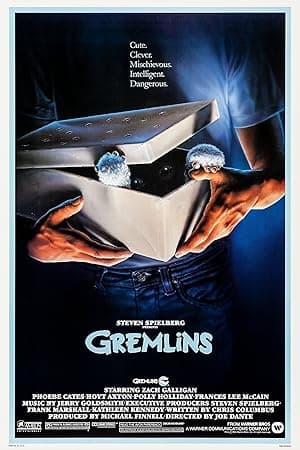
Gremlins
A cuddly Christmas present, three simple rules — and a small town that learns what consequences look like.
The setup
Gremlins isn’t just a monster movie that happens to be festive; it’s a film built around one very particular domestic problem: a lost set of rules and the person who has to enforce them. Follow Billy Peltzer as the film turns a cute mogwai into a test of responsibility, community and what happens when childhood gets corrupted on a mass scale.
THE MOVIE
Billy Peltzer is still the reason this movie works
Gremlins hangs on a simple domestic problem: an earnest father buys a small furry creature in Chinatown and hands it to his son as a present. That transaction feels like an invitation — and the film never stops testing who’s going to clean up the mess.
The creature arrives with three blunt rules: no bright light, don’t get it wet and absolutely no feeding after midnight. Those rules are not a list you skim — they are a ticking structure the whole film uses to build trouble.
Billy Peltzer is the one who has to live by them. His attempts to keep Gizmo contained, and to reverse the consequences when rules are broken, are what drive the story forward and give the comedy-horror mix a human anchor.
THE SETUP
The idea that sets Gremlins in motion
The movie’s engine is delightfully mechanical. A mogwai arrives with three explicit prohibitions and that tidy rulebook becomes the film’s toolbox for surprises.
Break the rules and the consequences are immediate and literal: contact with water produces more mogwai; feeding after midnight triggers a transformation into something vicious and destructive.
Those three rules are not background detail. The story uses them as repeating set pieces — water scenes produce multiplication, bright light becomes a weapon, and the midnight feeding is the fuse that detonates chaos.
Because the mechanics are clear, the film can play with stakes without losing you. You always know what might go wrong next and why it will be worse than the last time.
THE CHARACTER
Why Billy Peltzer matters
Billy is not an abstract kid; he’s the person who inherits responsibility. The film’s central problem is never just about monsters — it’s about who looks after them when a present becomes a problem.
That makes his choices crucial. Billy’s attempts to contain Gizmo and to clean up after the rules are broken are the actions the plot is built around. The chaos doesn’t happen to him so much as through him.
His family situation matters to that reading. Rand Peltzer’s purchase — a gesture born of goodwill mixed with financial worry — is the small domestic spark that sets off much larger town-wide trouble. Parent-child responsibility, then, isn’t window-dressing; it’s the engine.
There’s also the practical note that Zach Galligan plays Billy and later returned to the role for the sequel, which underlines how central the character is to the story’s ongoing life.
THE PERFORMANCE
Why Zach Galligan's performance matters
Contemporary coverage singled out the leads when Gremlins arrived. Reviews at the time praised Zach Galligan alongside his co-star, marking them as part of what kept the film watchable through tonal shifts.
That’s an important point. When a movie hops between family-friendly gags and sharper, sometimes violent set pieces, the human actors are the stabilisers. The fact critics noticed Galligan says he did the job the script needed.
Put simply: the movie asks the audience to care about the human response to nonsense. Contemporary praise suggests Galligan supplied enough of that to carry the film’s riskier turns.
Which matters because Gremlins only stays interesting when you believe someone is actually trying to sort the mess out — and critics at the time believed the leads provided that steadiness.
UNDER THE SURFACE
Gremlins has more on its mind than the plot suggests
On the surface Gremlins is a creature romp. Underneath, the mogwai-to-gremlin metamorphosis does something sharper: it literalises the loss of innocence. Cute becomes dangerous; mischief becomes malevolence.
Responsibility and consequences are stitched into that transformation. The rules are moral shorthand — small acts of negligence lead to communal catastrophe. It’s an old-fashioned cause-and-effect morality play dressed up in fur and fangs.
There’s also a consumerist angle. The film’s release was tied to merchandising and that commercial pressure sits oddly next to the corruption-of-innocence idea: the same culture that makes toys of cute creatures also profits from their monstrous transformations.
Finally, Gremlins stages all this in a tidy small-town setting, so the menace feels like an intrusion on communal normality rather than a distant threat. That contrast sharpens the stakes: it’s not just a monster movie, it’s a small-town panic about responsibility.
THE FILMMAKING
How Gremlins was put together
The credits underline that Gremlins was made by a professional crew: John Hora is listed on cinematography and Tina Hirsch as principal editor. Those are the people whose work shapes how the story moves and how the tonal shifts land.
Joe Dante’s direction ties those parts together. The names in the credits remind you this was built like a studio picture — crafted to balance charm and the occasional nastiness rather than to be deliberately arty or throwaway.
You don’t need technical jargon to read the point: a committed cinematographer and editor were in place to give the film coherence as it moved between moods.
That behind-the-scenes steadiness is why the premise can veer wildly and still feel like a single movie rather than a string of sketches.
PRACTICAL EFFECTS
The effects work that gives Gremlins its physical personality
Gremlins owes a lot of its memorable personality to hands-on creature-making. Chris Walas supervised the design and construction of the gremlins and Gizmo puppets, mixing manual and mechanical controls on set.
Production records note extensive puppet-building: many Gizmo puppets were made and a large number of puppets were created for the lead gremlin Stripe. Foam-latex and similar materials were used in their construction.
Vocal effects were a team effort too — the credits list numerous specialists who contributed the creature sounds. That combination of puppet craft and vocal work is what gives the creatures a physical life you can believe in.
Those practical choices mean the movie’s monsters feel tactile. They behave like objects in a scene, which makes the film’s chaotic set pieces feel immediate rather than composited.
PURE 80S
Gremlins could not belong to any other decade
Gremlins opened in 1984 at a moment when studios were testing how far family entertainment could be pushed toward darker territory. Its mix of toy-friendly imagery and quite graphic creature violence fed into a contemporary debate about where to draw the line for younger viewers.
Those debates were part of the same conversation that led to a rethinking of the MPAA ratings that year. Gremlins sits squarely in that argument: a family-market picture that sometimes behaves like a creature-horror.
It’s also a product of the Amblin era. Released under Spielberg’s banner, the film fits the 1980s pattern of high-concept studio films that aimed for broad family appeal while still taking energetic narrative risks.
All of that — a studio system willing to mix tones, and an audience negotiating new boundaries — ties Gremlins firmly to its decade.
WATCHING IT NOW
What has aged — and what hasn't
The element critics and viewers still argue about is the tonal gymnastics. Gremlins shifts from Disney-like comedy into black-humoured body-horror and that flip can feel jarring to modern tastes. That discussion hasn’t gone away.
At the same time the story’s skeleton — the simple rules, the chain of consequences, the parent-child responsibility — remains sharp. Those mechanics still provide clarity for contemporary viewers who don’t want to be baffled by plot logic.
The film’s willingness to unsettle a family audience is now part of its personality. Some will find that audacious; others will find it uneven. Both reactions are defensible given the picture’s design.
So what ages is the way the movie moves between moods. What survives is the plot’s clear cause-and-effect and the emotional through-line about who has to answer for a mistake.
THE LEGACY
Why Gremlins still matters
One clear reason Gremlins keeps turning up in discussions is that it spawned a sequel — the story had enough life (and enough audience appetite) to return to the screen again.
Beyond sequels, the film is often mentioned when people talk about 1980s genre-mixing: it’s a neat case study in how a studio picture can be both family-friendly and visibly violent without fitting cleanly into either box.
The creature work is another thread of continued interest. The film’s puppetry and designs are repeatedly noted in histories of practical effects — the physicality of the gremlins is part of why the movie remains memorable.
Put together, those pieces explain why Gremlins is still referenced: it sits at an intersection of tone, design and commercial ambitions that keeps the conversation alive.
THE VERDICT
Does Gremlins still hold up?
Yes. Gremlins is still worth watching because its premise is ruthlessly simple and reliably staged: a mogwai with three rules turns into multiplying, dangerous creatures when those rules are broken, and that mechanism keeps the stakes recognisable no matter how strange the set pieces get.
The central dramatic problem — stopping multiplied gremlins as they spread through Kingston Falls — gives the film a clean conflict that remains satisfying. Billy Peltzer is the protagonist who has to wrestle with responsibility, and Kate Beringer’s role in identifying the gremlins’ fear of bright light gives the human team a clear way to fight back.
The movie’s physical choices help too: the practical creature work and the scene where the gremlins watch Snow White in a cinema give the film a tactile energy that still reads on screen. Those moments justify rewatching even if you find the tonal jumps bracing.
If you go in expecting a perfectly even tone you’ll be irritated. If you accept that Gremlins was built to mix cosy and cruel and that it does so with a certain inventiveness, you’ll find it both entertaining and oddly humane — because at its centre is a small, stubborn question: who is responsible for a toy that goes wrong?
Featured in
Explore more about Gremlins
Share this movie
Keep watching
More movies from the 80s
1988
Scrooged
Scrooged: fear and belief in the supernatural, and why this 1988 movie still matters.
Read our take →
1984
Silent Night, Deadly Night
Silent Night, Deadly Night: family and the safety of home, and why this 1984 movie still matters.
Read our take →
1983
A Christmas Story
Nine years old, a single-minded wish, and a narrator who never lets you forget it.
Read our take →