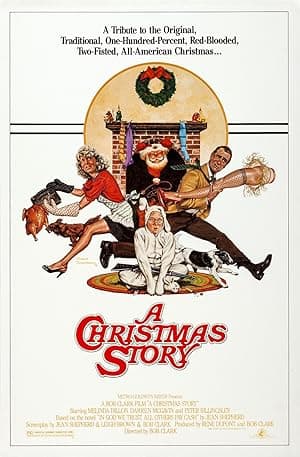
A Christmas Story
Nine years old, a single-minded wish, and a narrator who never lets you forget it.
The setup
A Christmas Story keeps cropping up on telly every December for a reason: it telescopes a child’s single obsession into a whole season’s worth of small catastrophes and strange triumphs. Told by the adult Ralphie and anchored to a single want — a Red Ryder BB gun — Bob Clark’s 1983 comedy still has the peculiar confidence of a film that knows nostalgia can be funny and uncomfortable at the same time.
THE MOVIE
Ralphie Parker is still the reason this movie works
Tell someone 'You’ll shoot your eye out' and, if they know the movie, you don’t need to say anything else. That line is shorthand for what A Christmas Story does: take one stubborn childhood desire and let it rearrange an entire household’s life.
The film is built around adult Ralphie’s voice — Jean Shepherd’s narration — which presents the events as memory. That framing lets the movie slip between fondness and humiliation without turning into a lecture: one minute there’s a glow of sentiment, the next you’re cringing with him.
Everything collapses back to the want. Peter Billingsley’s Ralphie drives the action: his pursuit of a Red Ryder BB gun shapes the small tests and moral choices that make the film feel like a private, very specific kind of coming-of-age.
THE SETUP
The idea that sets A Christmas Story in motion
At its simplest, the plot is crystal clear: nine-year-old Ralphie wants a Red Ryder 200-shot carbine air rifle and every adult reply is the same warning. That single, repeated refusal becomes the throughline — the thing that sends Ralphie into all the film’s little dramas.
But call it a throughline and you’d miss how the movie is actually arranged. It’s episodic: a string of set pieces and domestic misfortunes that orbit Ralphie’s desire rather than a single, propulsive plot.
That structure only works because the story is being told as a memory. The retrospective narration lets scenes breathe as individual moments — sometimes affectionate, sometimes mortifying — while the BB gun request quietly tethers them together.
Compact and tidy, the whole thing runs to just over an hour and a half, which is exactly the right length for a string of vivid childhood snapshots.
THE CHARACTER
Why Ralphie Parker matters
Ralphie isn’t a broad cartoon of childhood. He’s specific — nine years old, precise in his wants and vulnerable in the ways every child is when adults gatekeep the things they crave. That specificity is what keeps the film from feeling twee.
Peter Billingsley plays him, and the film gives us enough of Ralphie’s point of view that we live through the small humiliations as if they belong to us. The BB gun is less a toy than a measuring rod: wanting it reveals where he’s brave, where he’s foolish and where he’s still a kid.
The affection for the character has stuck. The house used for the family exterior was later bought and restored as a public museum — a neat, literal sign that people still want to visit Ralphie’s world.
Ralphie’s story has been returned to a few times since 1983, including a 1994 follow-up (largely recast) and a 2022 HBO Max reunion that brings Billingsley back into the family fold — a reminder that the character remains the engine of the franchise.
THE PERFORMANCE
Why Darren McGavin's performance matters
Contemporary reviewers highlighted Darren McGavin’s turn as the Old Man. He’s the household’s combustive centre: the sort of parent whose enthusiasms and frustrations become comic events for everyone else.
Critics singled him out — Roger Ebert, for example, described McGavin as an 'enthusiast' — and that label tells you what the performance gives the film: a kind of kinetic, slightly unpredictable energy that punctuates the quieter moments.
You can track a lot of the movie’s comic momentum back to the Old Man’s mood swings. When he’s animated, the family feels alive; when he’s sulky or proud, the stakes change for Ralphie and everyone around him.
So while Ralphie is the heart, the Old Man is the necessary obstreperousness that makes those heartbeats interesting.
UNDER THE SURFACE
A Christmas Story has more on its mind than the plot suggests
On the surface it’s a comedy about a boy and a dangerous present; underneath it’s a film about how adults shape a child’s world. The insistence on safety and propriety — 'you’ll shoot your eye out' — is one side of a tug-of-war between desire and authority.
Because the film is told as a memory, nostalgia arrives joined at the hip with embarrassment. That mix keeps the movie honest: childhood is not only treasured moments, it’s also small humiliations that linger.
Ralphie’s journey is modest — not a sweeping moral awakening — but it’s a coming-of-age in miniature. His single-minded wish pushes him into choices and social tests that feel meaningful precisely because they’re so small.
Finally, the film’s setting and tone are very much about small-town life: domestic rituals, family economies of pride and shame, and a community that both protects and polices its children.
PRACTICAL EFFECTS
The effects work that gives A Christmas Story its physical personality
The film’s snowbound look was often created without snow. Production notes record substitutions such as potato flakes, shredded vinyl and firefighter’s foam to sell winter when real flurries weren’t available.
That same pragmatic approach shows up in the film’s gags. The flagpole tongue-stuck sequence was achieved with a mechanical solution — a plastic sleeve and a small suction device — so the bit could play safely and reliably.
Those choices are the sort of low-key craftsmanship that gives the film a tactile feel: you’re watching objects and props doing real jobs, not digital effects smoothing everything out.
It’s a modest, practical-minded kind of movie-making that suits the story’s domestic appetite for detail.
PURE 80S
A Christmas Story could not belong to any other decade
Although the story itself looks back to the 1940s, the movie is very much an early-1980s creation — an adaptation of Jean Shepherd’s anecdotes filtered through Bob Clark’s sensibility and released in 1983.
Its afterlife was shaped by the era: modest theatrical returns gave way to repeated television airings, VHS and re-releases through the 1980s and 1990s, which is how the film became a seasonal fixture for a wider audience.
That trajectory fits a broader 1980s pattern: family comedies of the decade often embraced affectionate period nostalgia, adapting older, smaller-scale stories for modern viewers while allowing the past to be seen with a wink.
In short, A Christmas Story is a 1940s-set memory told by 1980s cinema — and the telling is what roots it in that moment.
WATCHING IT NOW
What has aged — and what hasn't
A Christmas Story’s public afterlife is part of how it reads now. It spawned follow-ups — most notably a 1994 continuation of the Parker-family stories that was largely recast — which shows how the original invited further returns even if those attempts never quite matched the first film’s voice.
Meanwhile, the family home used for exterior shots has been preserved and turned into a year-round museum in Cleveland. That physical preservation is a clear sign that people still want to step into Ralphie’s neighbourhood and relive the film’s world.
Those facts don’t answer whether every joke still lands — but they do show that the movie’s particular blend of memory and domestic detail remains a live proposition for audiences who want to revisit it.
If you’re watching today, expect a film whose fanbase has kept it in circulation; the continued interest is less about nostalgia as a comfort blanket and more about the film’s specific, repeatable pleasures.
THE LEGACY
Why A Christmas Story still matters
Part of the film’s afterlife is literal: sequels and follow-ups kept returning to the Parker family across decades, and the house itself became a museum — a neat, tangible sign that people keep wanting to step into this particular holiday story.
But the movie’s cultural hooks are smaller, sharper and more repeatable: the leg-lamp, the refrain 'you’ll shoot your eye out', and the flagpole tongue gag have all popped up again and again in seasonal programming and coverage.
Those recurring touchstones mean the film survives in pieces as well as a whole. Even if someone can’t name the director, they’ll recognise the gags — and that’s a kind of longevity.
So its legacy is mixed: part franchise history, part pilgrimage site, and part collection of jokes and images that slide easily into American holiday conversation.
THE VERDICT
Does A Christmas Story still hold up?
Yes — if you respond to small-scale storytelling and carefully observed memory. The film is built as a series of vignettes around Ralphie’s single wish for a Red Ryder BB gun, and that modest structure is its strength: you get a lot of character and atmosphere from very little plot.
The retrospective narration steers you through laughter and second-hand embarrassment, so the tonal shifts feel intentional rather than messy. That device keeps the movie feeling like someone telling you a story about being a child, not a film pretending to be a document.
The cast matter here: Peter Billingsley’s Ralphie is the emotional anchor, Mrs. Parker the pragmatic counterweight, and contemporary criticism singled out Darren McGavin as a spirited presence who supplies much of the comic life. Together they keep the episodic structure from floating off into whimsy.
If you’re wondering whether to watch it now, go for the warmth and the set pieces — the department-store Santa, the leg-lamp moment, the flagpole gag. If you still grin at 'you’ll shoot your eye out', the film is doing exactly what it set out to do: it’s reminding you how very complicated and hilarious being nine can feel.
Share this movie
Keep watching
More movies from the 80s
1983
Trading Places
A rigged bet, a culture-swap and Louis Winthorpe III — still very funny, still very sharp.
Read our take →
1984
Gremlins
A cuddly Christmas present, three simple rules — and a small town that learns what consequences look like.
Read our take →
1985
Brazil
A man who daydreams his way out of paperwork—and into trouble.
Read our take →