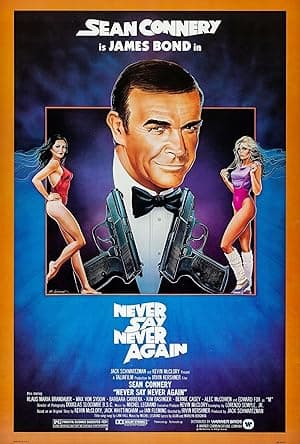
Never Say Never Again
Sean Connery comes back, the nukes go missing, and the old Bond gets a very 1980s second act.
The setup
Never Say Never Again sells itself on one obvious thing: Sean Connery returned to James Bond. That central casting move reframes a familiar spy story — stolen thermonuclear warheads, underwater salvage, a luxury-yacht setup — and asks whether the same old adventure can carry new anxieties. Directed by Irvin Kershner and clocking in at just over two hours, it is less a reboot than a retread with attitude — and that attitude is the whole point.
THE MOVIE
James Bond is still the reason this movie works
What keeps people coming back to Never Say Never Again isn’t legal neatness or studio pedigree; it’s the simple drama of a veteran spy being pulled back into a job that could end the world. The film’s engine is practical and urgent: SPECTRE agents have a way of making thermonuclear warheads vanish and use a counterfeit eyeprint to hijack missile test installations as part of a blackmail scheme.
That premise — stolen nuclear weapons, an extortion plan that plays on Cold War dread — is the movie’s heartbeat. It hands Bond a clear, consequential task: find the devices before they’re launched. And a clear task gives screen time to the thing audiences actually want to see: Bond doing Bond things.
All this arrives in 1983 under the steady direction of Irvin Kershner, with Sean Connery reprising the role after a twelve-year break. The film’s runtime lets it linger where some modern action movies hurry, and that roomy confidence, plus Connery’s return, is what makes this non-Eon effort worth revisiting.
THE SETUP
The idea that sets Never Say Never Again in motion
Never Say Never Again begins with a clean, old-fashioned spy problem: SPECTRE has stolen nuclear warheads and can impersonate a launch-authority by faking an eyeprint. That gives the antagonists a terrifying leverage — the threat here isn’t petty theft, it’s unauthorised control of thermonuclear weapons.
From that cliff-edge idea the movie rebuilds familiar territory: underwater sequences, a luxury yacht, and elaborate salvage and combat set pieces. It’s not trying to reinvent the Bond formula so much as to reapply it to the early-1980s world and its tensions.
Concrete set mechanics drive the action. The production staged underwater salvage and combat sequences — even putting an artificially aged ship offshore for certain scenes — and it all leads toward a big, staged assault on a fortress-like stronghold. Those sequences are the practical scaffolding that keep the premise moving.
Finally, the film makes its intentions obvious: this is a retelling in motion. The story structure openly reworks material from an earlier, related Bond story, shifting set pieces into a new production while keeping the same basic do-or-die stakes.
THE CHARACTER
Why James Bond matters
Bond matters here because the film treats him like an asset you bring back when the stakes are lethal. The picture literally returns an experienced operative to active service to recover stolen nuclear hardware, and that framing gives the character weight: he is the professional you call when the consolation prizes won’t do.
That return is a storytelling move as much as a casting one. Bringing Connery back after a long absence places the themes of legacy and repetition front and centre: this Bond carries history with him, and the plot keeps reminding us why experience still counts.
Bond also functions through the people around him. Domino Petachi is a central supporting figure whose relationships and fate matter to Bond’s choices across the film, while a roster of antagonists and helpers — from Maximilian Largo to a rebuilt Q and M — fill in the world he’s re-entered.
Put bluntly: this isn’t a fresh-faced rookie learning the job. It’s an older Bond asked to prove the old methods still work when nuclear blackmail is on the table.
THE PERFORMANCE
Why Sean Connery's performance matters
If you come looking for a catalogue of acting choices, note this section has a minor but interesting contemporary wrinkle: some reviewers at the time were surprised to find other performers making strong impressions. Roger Ebert’s review, for example, singled out the way Klaus Maria Brandauer added a human element to the antagonist role.
That note is worth flagging because it reframes Connery’s return. He is the headline and the reason many viewers will press play, but the film leaves room for other players to reshape familiar roles — which in turn changes how Connery’s Bond is perceived on the screen.
So what Connery brings isn’t just an old badge and a familiar silhouette; his return recalibrates the cast and the audience. The presence of a recognised Bond alters expectations, and the film deliberately trades on that to let supporting work land differently.
UNDER THE SURFACE
Never Say Never Again has more on its mind than the plot suggests
On the surface it’s a kidnapping-of-warheads thriller; underneath it’s a film that keeps bumping into bigger ideas of repetition and inheritance. The picture deliberately reworks earlier material, asking whether stories — and the people who tell them — can be reused without losing force.
Nuclear blackmail and Cold War anxieties supply a specific kind of pressure. The stolen thermonuclear warheads aren’t just a stunt; they evoke a decade where the idea of unauthorised nuclear use felt alarmingly plausible, and the plot makes that dread immediate and operational.
There’s also a story about an older hero coming back to a world that has moved on. The film foregrounds return and legacy: this Bond is not a novelty act but a man whose past methods must prove they still matter.
Finally, there’s a quiet argument about the lone agent versus clandestine organisations. Bond is presented as the operative who cuts through institutional threats — that tension between individual resourcefulness and sprawling conspiracies is what the movie keeps circling.
PRACTICAL EFFECTS
The effects work that gives Never Say Never Again its physical personality
The film stakes a great deal on physical production. Underwater set pieces were filmed on location in the Bahamas with a dedicated underwater unit, and the crew even placed an artificially aged cargo ship offshore for sequences that involved live tiger sharks.
Back on land and in studio, the production built large-scale environments — an underwater cavern and ancient-temple sets — at Elstree. Those constructed spaces are where the salvage and temple beats play out, giving the action a tactile gravity it wouldn’t have if it were all implied.
Not every practical choice passed without controversy. A horse-fall stunt filmed in Spain drew attention from animal-welfare organisations and led to a brief alteration in British prints, which is a reminder that practical filmmaking sometimes has real-world costs.
Taken together, the on-location underwater unit, the use of an aged hull and the Elstree builds supply the film with a physical personality: it feels like something assembled in the real world, with the risks and scale that go with that ambition.
PURE 80S
Never Say Never Again could not belong to any other decade
The movie’s very existence is an 80s story: it’s a non-Eon remake produced because Kevin McClory retained rights to certain Thunderball material. That legal and rights background is a distinctly 1980s breed of franchise business — part litigation, part entrepreneurial filmmaking.
1983 also produced a curious cinematic marketplace where two Bond films arrived in the same year; Never Say Never Again shared the calendar with Eon’s Octopussy, and contemporary coverage inevitably set the two against one another.
The British high court’s dismissal of attempts to block the film in 1983 is another period detail that matters: it allowed an independent production to proceed where studio law might otherwise have shut it down, and that legal green light is part of the film’s era-defining paperwork.
Commercially, the picture opened in North America on 7 October 1983 and set a then-opening-weekend record for a Bond film — a marker of how much attention Connery’s return and the production’s independence generated at the time.
WATCHING IT NOW
What has aged — and what hasn't
One simple truth remains: Connery’s return still functions as a hook. Seeing an established Bond back in action brings context to the film that newer entries can’t replicate — the weight of an older actor carrying older stories.
Some of the supporting cast details are reminders of era-specific casting and small arcs that may feel quaint today; for example, Prunella Gee appears in a smaller role as Patricia Fearing, a casting note that feels of its time when you spot it in the credits.
Narratively, the choice to retell an earlier adventure means the film trades on nostalgia and recognisability. That’s a decision viewers will either enjoy or find indulgent — your tolerance for repetition is the main variable in how well it plays now.
Overall, what ages better is the idea of a familiar spy story given room to breathe; what ages worse is the occasional sense that the film prefers revisiting old beats to rethinking them for a new moment.
THE LEGACY
Why Never Say Never Again still matters
Part of the film’s afterlife comes from its commercial footprint: when it opened in North America in October 1983 it set a then-opening-weekend record for a Bond film, which guaranteed attention and a place in Bond box-office trivia.
Equally important is what it represents in franchise terms: the picture remained independent of Eon Productions, and its production stems from Kevin McClory’s legal claim to Thunderball material. That makes it an outlier in franchise histories — a reminder that rights and authorship can produce alternative versions of familiar myths.
The movie’s distribution story continued to evolve; Metro-Goldwyn-Mayer later acquired distribution rights from the producer’s estate in 1997, which kept the film available within the wider Bond marketplace rather than letting it disappear into a legal footnote.
So the legacy is double: a commercially notable release at the time, and a standing example in Bond scholarship and histories of what can happen when legal rights and franchise mythology collide.
THE VERDICT
Does Never Say Never Again still hold up?
Short answer: yes — if what you want is an old-school Bond reinhabited with purpose. The film gives Bond a concrete, high-stakes mission (SPECTRE’s theft and misuse of thermonuclear warheads) and follows it through with the set pieces that the premise demands: underwater salvage, an aged sunken ship, and a final assault on a fortress-like stronghold.
Sean Connery’s return after twelve years is not just nostalgia; it changes the film’s tone. This is a Bond framed as an experienced operative brought back into service, and that focus on return and legacy gives the movie an emotional shorthand that still reads today.
The film also benefits from some sharp supporting work — contemporary critics noticed how certain performances added human texture to the villains — which makes the familiar Thunderball material feel less like a copy and more like a reworking with slightly different priorities.
So watch it for Connery, for the maritime set pieces and for a Bond movie that deliberately replays old beats while trying to give them new weight. If you’re after the definitive Eon Bond experience, this isn’t that film; but if you want a solid, character-driven re-take on a classic Bond adventure, Never Say Never Again still delivers.
Share this movie
Keep watching
More movies from the 80s
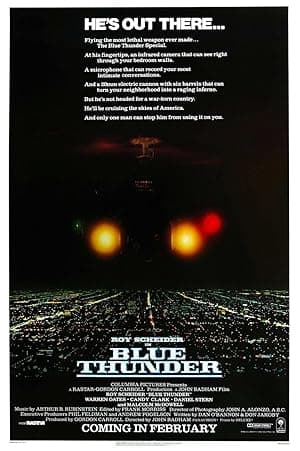
1983
Blue Thunder
A maverick pilot, a flying surveillance machine and a paranoid 1980s that still feels eerily familiar.
Read our take →

1983
Christine
Obsession, adolescence and a car that won't let go.
Read our take →

1983
Jaws 3-D
Jaws 3-D: freedom and authority, and why this 1983 movie still matters.
Read our take →