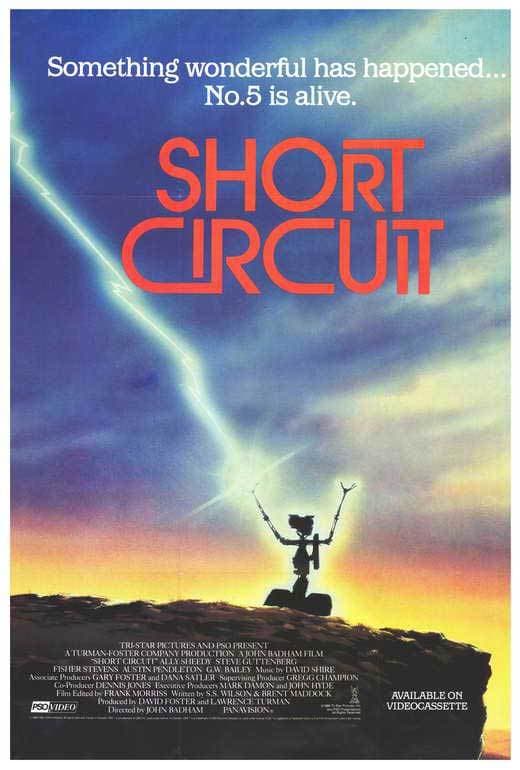
Short Circuit
A lightning-struck robot, a handful of humans who care, and an argument about what counts as being alive.
The setup
Short Circuit is the sort of 80s family movie that turns a technical mishap into a moral question and a lot of laughs. At its centre is Number 5 — the machine who wakes up, runs away and refuses to be reduced to a weapons programme. It’s a neat blend of runaway-robot adventure and small-scale human tenderness, directed with friendly momentum by John Badham.
THE MOVIE
Number 5 (later nicknamed 'Johnny 5') is still the reason this movie works
What keeps people returning to Short Circuit is simple: the story hands us a machine that suddenly wants to know things. A lightning strike throws Number 5’s circuits into a different register and the robot starts behaving like something more than a tool.
That curiosity propels everything that follows. Number 5 bolts from the Nova Robotics compound and, by fortunate accident, ends up in the care of Stephanie Speck, who thinks she’s found an extraterrestrial. Newton Crosby, the engineer who built the SAINT prototypes, becomes the robot’s most stubborn defender — caught between the lab and whatever life Number 5 might be carving out for himself.
John Badham directs the whole thing at a brisk 98-minute pace, and Tim Blaney is credited as the primary voice and one of the operators for Number 5. Released in 1986, Short Circuit stages a big-hearted debate about sentience and personhood inside a family-friendly sci-fi comedy.
THE SETUP
One lightning strike changes everything
Short Circuit opens with a straightforward incident: a public demo, a power surge and a circuit that stops being predictable. The moment alters Number 5’s behaviour and the robot escapes the Nova Robotics compound.
That escape sets up the movie’s basic shape. On one side you have designers and security forces intent on recovering and dismantling the rogue unit. On the other, there are people who insist Number 5 is acting like something alive and deserves protection.
The film keeps things tidy by turning those opposing positions into a chase. Engineers and military teams hunt; Number 5 seeks input and tries to learn about the world; a radio-tracking device helps the pursuers close in.
It’s a premise that works because it marries a clear physical pursuit with a softer, argumentative centre: is this a machine to be reclaimed or a being to be sheltered?
THE CHARACTER
Why Number 5 (later nicknamed 'Johnny 5') matters
Number 5 isn’t memorable because he’s flashy. He’s memorable because the film genuinely locates everything through his newfound curiosity and the way other characters react to it. That shift — from machine to something else — drives both the comedy and the argument.
The movie asks us to take that shift seriously. Newton Crosby, the engineer who created the SAINT prototypes, ends up defending Number 5’s behaviour rather than merely trying to retrieve hardware, which forces the rest of the company and the military to argue their case aloud.
Short Circuit wears its family-film label plainly: it aims at clarity of motive and warmth of relationship rather than academic subtlety. Friendship across difference — a human and a robot learning from one another — is literally the engine that keeps the story moving.
Tim Blaney is credited as Number 5 and as one of the robotic performers, which keeps the character consistently present on screen and in the movie’s soundscape. The fact that the story continued into an official sequel suggests the character’s appeal had legs beyond a single film.
THE PERFORMANCE
Why Tim Blaney's performance matters
Tim Blaney is listed among the robot operators and as the principal voice for Number 5, so his contribution is both mechanical and vocal. That combination keeps the character anchored: movement and sound come from a coordinated place.
Contemporary reviewers specifically noted that Blaney’s vocal work and his robotic performance helped sell Number 5 as a likeable presence rather than a prop. That’s useful evidence when a film’s success depends on an audience caring about a nonhuman lead.
Because Blaney was part of the radio-control crew as well as the voice, the performance feels integrated. The robot’s rhythms — its curiosity and bewilderment — are delivered consistently across image and sound.
Put simply: for Short Circuit to convince you that a piece of engineering has become interesting, that engineering needs to behave in recognisable, sympathetic ways. The published responses at the time credit Blaney with helping achieve that.
UNDER THE SURFACE
When does a machine become alive?
At its heart Short Circuit is a film about recognition. The central machine begins to show curiosity and emotion, and the story asks whether those behaviours amount to being alive.
That question bleeds into a second dispute: what do you use technology for? The film sets a humanistic view — people who think Number 5 should be protected — against a military or design-first impulse that sees the robot as property.
Identity and naming crop up as quieter ideas. A machine that learns and names things starts to look less like an experiment and more like a presence with preferences and attachments, which forces the characters to reassess how they treat it.
Finally, friendship across difference is the narrative glue. The plot’s emotional weight comes less from abstract argument and more from the relationships that grow when someone decides to teach, shelter or defend the newly sentient unit.
THE FILMMAKING
How Short Circuit was put together
A lot of the film’s look and its sense of believable machinery comes from the design work behind the robots. Syd Mead supplied the conceptual designs and an effects team realised those concepts for the screen.
Eric Allard oversaw the engineering and construction, so the aesthetics we see are the result of design thinking married to practical engineering choices.
That creative pairing matters because it keeps the robots feeling like coherent objects within the film’s world — designed, assembled and then treated as actors within scenes.
John Badham’s direction then stages the human-robot interactions so the audience can follow both the ethical argument and the slapstick business of a robot trying to learn its way through everyday life.
PRACTICAL EFFECTS
Why Johnny 5 still feels physically real
Short Circuit relied heavily on physical constructions: the production built seventeen distinct robot units and devoted a significant portion of its budget to that work.
More than forty builders worked under the supervision of Eric Allard to turn Syd Mead’s concepts into working machines, which is why the robots read as purposeful objects in the frame.
On set the robots were radio-controlled; several radio operators performed their movements in real time rather than relying on purely post-production tricks.
Tim Blaney appears both among the robotic performers and as the principal voice, which tied the machines’ motion and sound into a coordinated on-set performance strategy.
PURE 80S
Short Circuit could not belong to any other decade
Short Circuit arrived in 1986 during a mid-decade appetite for family-minded science-fiction where sympathetic nonhuman characters carried big emotional weight — a trend familiar from pictures like E.T.
The film’s industrial-futurist outlook is explicit: Syd Mead’s involvement plugs the robots into an 80s visual vocabulary that favoured slick, purposeful machinery as a kind of future shorthand.
On the business side, it was a product of the era’s studio-and-independent company relationships: produced by The Turman-Foster Company and distributed via the usual 1980s channels.
Principal photography began in 1985 and used a mix of location shooting in Oregon and studio interiors in Culver City, which is typical of mid-80s productions balancing place-based texture with controlled studio work.
WATCHING IT NOW
What has aged — and what hasn't
Not everything in Short Circuit sits comfortably with modern viewers. Later assessments have picked up on broad comic beats and instances of racial stereotyping in the Ben character that can feel dated.
Those moments don’t erase the film’s strengths, but they do mean a contemporary audience needs to be ready to notice where the humour doesn’t land the way it might once have done.
Where the film still holds up is in the basic shape of its relationships. The idea of a machine learning through human contact — and of people choosing to shelter rather than weaponise it — keeps the emotional centre relatable.
The production’s investment in building functioning robots remains a clear, tangible commitment: seventeen units and a large crew of builders made the robot presence in the story materially convincing.
THE LEGACY
Why Short Circuit still matters
Short Circuit performed well enough on release to spawn a theatrical sequel two years later, which is a practical measure of its commercial footprint at the time.
The film is largely remembered for its robot protagonist — the presence that carries both the plot and the argument about personhood — and for its association with a popular single from the era.
In technical histories of 1980s practical effects the production frequently appears because of the scale of its robot work: substantial design effort combined with radio-controlled puppetry and a large construction team.
So the movie’s legacy is a mixed one: remembered for a charming nonhuman lead and for a notable practical-effects effort, while also carrying some dated humour that complicates its standing today.
THE VERDICT
Does Short Circuit still hold up?
Yes — with qualifications. If you want a small-scale 80s sci-fi comedy that actually asks whether a machine might be more than an experiment, Short Circuit still delivers that argument with warmth and clarity.
The film’s central mechanics are simple and effective: a lightning strike changes Number 5’s behaviour, he escapes and is sheltered by Stephanie, and a push-pull unfolds between those who would reclaim him and those who insist he’s sentient.
Tim Blaney’s role as both radio operator and principal voice is part of why the robot convinces as a character, and contemporary reactions singled out that contribution as central to the film’s appeal. Newton Crosby’s position as creator-defender keeps the ethical debate from ever becoming abstract.
So watch it for the pleasure of seeing a machine learn through human contact and for the argument the movie stages about personhood. But watch it with the awareness that some of its comedy belongs to its moment — and won’t land for everyone today.
Share this movie
Keep watching
More movies from the 80s

1986
Critters
Critters: freedom and family, and why this 1986 movie still matters.
Read our take →
1986
Flight of the Navigator
A boy, eight missing years and a chrome spaceship that needs him as much as he needs home.
Read our take →
1986
Howard the Duck
Howard the Duck: courage and heroism, and why this 1986 movie still matters.
Read our take →