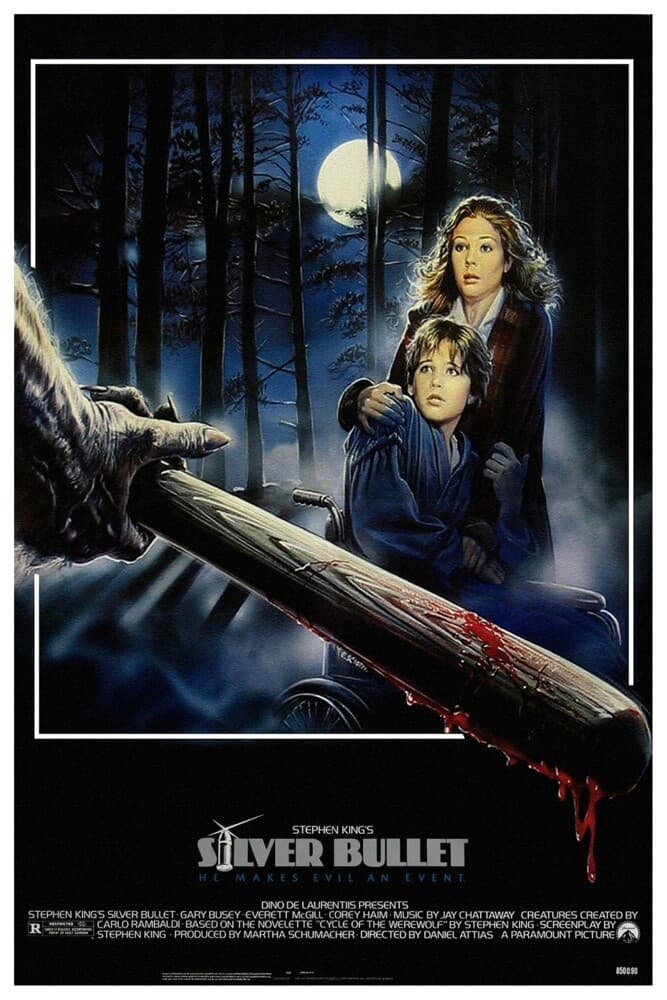
The setup
Silver Bullet arrived in 1985, directed by Dan Attias. The rocky relationship between Jane Coslaw and her paraplegic younger brother, Marty, changes after a series of murders begin in their small rural town of Tarker's Mills, Maine, in the spring of 1976. Decades later, it is worth looking at why the film still connects with audiences.
THE MOVIE
Uncle Red is still the reason this movie works
Silver Bullet was released in 1985 and directed by Dan Attias. Rather than simply retelling the plot, the film is worth revisiting for the characters, conflicts and ideas that give its story its identity.
Loss, Family and Home and safety emerge through what the characters face and the choices they make, giving the story more to explore beyond its immediate plot.
Uncle Red, Reverend Lester Lowe and Marty Coslaw do not begin the film seeing one another clearly, and watching those first impressions break down is a big part of why Silver Bullet still works.
THE SETUP
The idea that sets Silver Bullet in motion
The rocky relationship between Jane Coslaw and her paraplegic younger brother, Marty, changes after a series of murders begin in their small rural town of Tarker's Mills, Maine, in the spring of 1976.
Railroad worker Arnie Westrum is decapitated by an unseen attacker. That detail matters because it shapes the way the characters initially see one another.
Pregnant Stella Randolph, preparing to kill herself, is brutally murdered in her bedroom along with her unborn baby. From there, the film can concentrate less on explaining the setup and more on what happens between the people inside it.
An abusive father, Milt Sturmfuller, is killed in his greenhouse, and Marty's best friend, Brady Kincaid, is also slain.
Following Brady's death, the townspeople form a vigilante group.
Despite Sheriff Joe Haller's attempts to stop them, he relents after Brady's father, Herb, angrily confronts him.
Reverend Lester Lowe tries, but fails, to prevent the townsfolk from causing more bloodshed.
While the vigilantes hunt for the killer in the nearby woods, three of them are attacked and killed.
The survivors — particularly Andy Fairton — later deny seeing anything unusual.
Afterwards, Reverend Lowe dreams he is presiding over a mass funeral, only for the congregation — including the bodies in the caskets — to transform into werewolves and attack him.
He wakes up screaming and pleads with God to "let it end." As the unsolved murders continue to mount, curfews are put in place, canceling the town's Fourth of July celebration.
UNDER THE SURFACE
Silver Bullet has more on its mind than the plot suggests
Silver Bullet has more on its mind than the basic setup suggests. loss sits close to the centre of the film, but it is explored through the characters rather than treated like a lesson.
family matters just as much. The film keeps challenging the assumptions its characters make about one another, which is where much of its emotional weight comes from.
There is also plenty here about the safety of home and courage. Those ideas overlap rather than sitting in separate boxes, which helps the movie feel like a story about people rather than a checklist of themes.
PURE 80S
Silver Bullet could not belong to any other decade
Silver Bullet could hardly be separated from the decade that produced it. Released in 1985, it carries the attitudes, style and filmmaking rhythms of the 1980s without needing to announce them.
It also sits comfortably within the era's horror and monster filmmaking, even if the movie itself is more interesting than any single genre label suggests.
That is part of why it still appears in conversations about 1980s movies and 1980s horror movies. The film has become tied not only to its own story but to the wider memory of what 1980s movies felt like.
WATCHING IT NOW
What has aged — and what hasn't
Watching Silver Bullet now means seeing both what has lasted and what unmistakably belongs to 1985.
That kind of character-driven idea tends to survive changes in fashion far better than surface-level nostalgia.
Some moments inevitably land differently for a modern audience. Revisiting an older film properly means enjoying what still works without pretending every choice has aged equally well.
THE LEGACY
Why Silver Bullet still matters
A large part of that staying power comes from the characters. Uncle Red, Reverend Lester Lowe and Marty Coslaw are still useful shorthand for the personalities and pressures the film explores.
Silver Bullet has lasted because people continue to recognise something in it. Nostalgia helps, but nostalgia alone does not keep a movie in the conversation for decades.
THE VERDICT
Does Silver Bullet still hold up?
So, does Silver Bullet still hold up? Yes — although watching a film from 1985 honestly means accepting that not every moment will land exactly as it once did.
The film still has something recognisable to say about loss, family and home and safety, and its characters stop those ideas from feeling abstract.
Silver Bullet remains worth revisiting because characters such as Uncle Red, Reverend Lester Lowe, Marty Coslaw, Jane Coslaw and Sheriff Joe Haller still feel like people rather than labels once the film gets underneath the stereotypes.
Share this movie
Keep watching
More movies from the 80s
1985
A Nightmare on Elm Street 2: Freddy's Revenge
A Nightmare on Elm Street 2: Freddy's Revenge: the safety of home and family, and why this 1985 movie still matters.
Read our take →
1985
Cat's Eye
Cat's Eye: family and fear, and why this 1985 movie still matters.
Read our take →
1985
Day of the Dead
A bunker drama with zombies, a scientist who won a festival, and a soldier who won't listen.
Read our take →