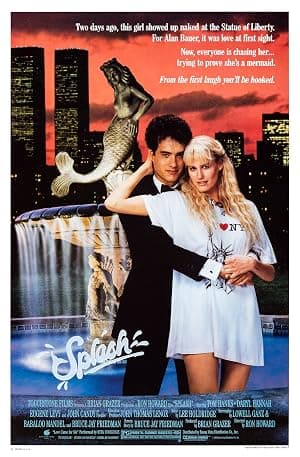
The setup
Splash feels, at first, like a very simple party trick: a mermaid turns up in the city and promptly causes trouble. But what keeps it afloat is a story about a grown man finally letting himself be rescued, and a very odd culture-clash romance that keeps finding funny, humane ways to complicate that idea.
THE MOVIE
Allen Bauer is still the reason this movie works
Splash begins with a neat, irresistible image: the boy who was pulled from the water by a mysterious girl eventually meets her again as an adult. That setup — a childhood rescue that turns into an improbable adult reunion — gives the film a fairy-tale spine without getting bogged down in fairy-tale rhetoric.
What makes the idea land is how it hooks into Allen Bauer’s particular loneliness. He’s a man wrapped in work and quiet ache, the sort of fellow whose life makes him open to being rescued a second time. Played on the page as a basic emotional need, that openness turns the mermaid’s reappearance into something tender rather than merely whimsical.
And Ron Howard steers the whole thing with a light touch. Splash is a romantic comedy that knows it’s also a fantasy: it settles into a rhythm where the fish-out-of-water jokes and the love story keep nudging against each other for surprise and heart.
THE SETUP
The idea that sets Splash in motion
At its simplest: a boy survives a near-drowning thanks to a girl who isn’t what she seems, and years later the grown Allen Bauer encounters her again. That reunion starts the romance, and the unusual nature of Madison’s origins turns the relationship into a constant negotiation between secrecy and exposure.
The story leans on two reliable engines. One is comedy born from Madison learning to live in the city — a classic fish-out-of-water thread that keeps throwing up small, delightful misunderstandings. The other is an escalating threat: a scientist, Walter Kornbluth, becomes obsessed with proving Madison is not human and tries to unmask and study her.
Those elements combine neatly. The romantic plot gives the film emotional stakes; the fish-out-of-water moments give it warmth and laughs; and the scientist’s pursuit supplies a concrete, watchable danger that forces choices about privacy and autonomy.
The screenplay shapes these pieces into a family-friendly romance with real stakes — family, loneliness, curiosity and the risk of being turned into a spectacle.
THE CHARACTER
Why Allen Bauer matters
Allen Bauer is written as a work-first man with a stubborn private hurt. That backstory — the boy who was saved from drowning — isn’t window-dressing. It’s the emotional hook that explains why he answers a mermaid’s return with openness instead of ridicule.
He’s memorable because the movie insists on his ordinariness. Allen isn’t a movie hero in the grand sense; he’s a decent, lonely bloke who stumbles into wonder and gradually learns to let it change him. That makes his romantic choices feel earned rather than sudden.
The family angle helps. Freddie, Allen’s brother, provides comic relief but also keeps Allen tethered to a recognisably human life. Those scenes of family chatter and teasing stop the premise from going off into pure fantasy and remind us what Allen stands to lose or gain.
And because Tom Hanks plays Allen, the character has a steady centre on the page: the romance needs someone who can believe in Madison without collapsing into caricature, and the screenplay supplies exactly that sort of ordinary, persuasive fellow.
UNDER THE SURFACE
Splash has more on its mind than the plot suggests
On the surface it’s a rom-com with a tail. Below that, the film is quietly concerned with how someone who’s literally from another world learns to belong. Madison’s adaptation to city life works as both comedy and a small study in cultural acclimation: the film delights in the tiny, often awkward ways she learns to be human.
The romance is, frankly, a statement about risk. Falling for someone who is different demands a leap: it’s a love across difference framed as both literal fantasy and a metaphor for leaving safety. Allen’s willingness to accept that risk is the movie’s emotional core.
There’s also a political impulse in the plotline about authority. The scientist who pursues Madison turns the story into a contest about privacy and consent: is it right to expose someone to advance knowledge? The film sets up a pretty clear tension between the private life of two people and the public appetite for discovery.
Put together, those themes stop Splash being mere novelty. It’s a romance that keeps asking what it costs to be seen, and who gets to decide that.
THE FILMMAKING
How Splash was put together
Splash isn’t a special-effects showpiece in the late-80s blockbuster sense; it’s a mid-budget studio picture built around character and a handful of technical commitments. The credits tell that story: Don Peterman handled cinematography, Daniel P. Hanley and Mike Hill edited the film, and Jack T. Collis created production design.
Those names matter because the movie’s identity depends on a professional crew willing to move between intimate comedy and the occasional fantasy set-piece. The production design anchors Madison’s fish-out-of-water moments in recognisable urban rooms and public spaces, which keeps the fantasy grounded.
The editing choices and lensing are the sorts of reliable studio craft that let the film trade smoothly between laugh lines and more tender emotional beats. It’s the kind of filmmaking that doesn’t call attention to itself but makes everything feel seamless.
In short: Splash is a well-put-together studio picture — competent, unobtrusive and focused on letting the oddball premise breathe without being overwhelmed by it.
PRACTICAL EFFECTS
The effects work that gives Splash its physical personality
Splash’s physicality is anchored in a handful of practical choices. Daryl Hannah performed her own underwater scenes, which gives those moments a believable continuity between performer and effect.
The mermaid tail itself was a serious piece of kit — constructed from plexiglass and latex and weighing roughly thirty-five pounds — and its presence shaped how scenes were staged and shot around water.
Underwater photography was handled on-location in the Bahamas with a specialised crew, so those sequences weren’t faked on a soundstage: they were planned and executed with the logistical constraints of real water in mind.
Those practical commitments keep the movie tactile. When Madison slips into water, the film sells the physical truth of that world, which helps the fantasy feel like something you could touch.
PURE 80S
Splash could not belong to any other decade
Splash arrived in 1984 as the first theatrical title from Walt Disney’s new Touchstone label — a deliberate move by a studio known for family entertainment to distribute pictures aimed at adult audiences. That corporate moment explains a lot about the film’s tone: it’s a studio romance that isn’t afraid to flirt with mild adult themes while keeping a broadly accessible heart.
It’s also very much of its era in another way: the movie mixes mainstream comedy with modest special-effects-driven fantasy sequences, the sort of mid-budget studio blend that the early 80s specialised in. The result is approachable fantasy that serves the romance rather than overwhelming it.
Splash also happens to be the film that gave Tom Hanks his first leading film role. That casting is part of its period significance — an early stop in the kind of star-making pathway the decade could still provide.
And the production itself leaned on location work, shooting in New York, Los Angeles and Nassau with a dedicated underwater unit — the logistical footprint of a studio picture that wanted both authenticity and fantasy.
THE LEGACY
Why Splash still matters
Part of Splash’s afterlife rests on its screenplay: the writers earned an Academy Award nomination and won the National Society of Film Critics prize for Best Screenplay. That recognition hints at a script whose structure and dialogue did more than fill in a novelty premise.
The movie also generated enough cultural chatter to spawn a television sequel a few years later — not proof of cultural domination, but an indication the story had legs beyond the original release.
There’s a stranger, more specific legacy too: some cultural-commentary and name-research work credit the film with pushing the given name 'Madison' into more common use in the United States. A small, odd imprint, but a tangible one.
Between awards attention, a follow-up and that curious name-effect, Splash left behind a mix of industry respect and popular footprint that helps explain why people still bring it up.
THE VERDICT
Does Splash still hold up?
Yes — but with a caveat. If you want a big, modern effects-driven fantasy, this isn’t it. If you want a warm, well-constructed romantic comedy that uses a fantastical premise to ask human questions, it still does the job. The film’s central hook — the boy saved by a mysterious girl who returns as a mermaid — remains an effective piece of narrative geometry that gives the romance purpose.
The movie keeps tension on the relationship by mixing the fish-out-of-water comedy of Madison learning to be human with an actual external threat: a scientist who aims to expose and study her. That argument between private life and public curiosity still reads as a clear, compelling conflict.
Beyond plot mechanics, the film rests on its characters: Allen is written as a sensible, work-focused man whose loneliness makes him receptive to being changed; Madison’s unfamiliarity with human customs supplies laughter and warmth; and the family moments stop the story feeling isolated from ordinary life. Those elements still work because the screenplay leans into them.
So should you watch it? Yes — for the romance, the oddball premise and the craft of a studio picture that knows how to balance comedy, tenderness and a little bit of wonder. It’s the sort of film that remembers to care about the people underneath the spectacle.
Share this movie
Keep watching
More movies from the 80s
1986
Peggy Sue Got Married
Peggy Sue Got Married: family and growing up, and why this 1986 movie still matters.
Read our take →
1988
Big
Big: our relationship with technology and friendship, and why this 1988 movie still matters.
Read our take →
1985
Teen Wolf
A teenage werewolf, a basketball court and a lesson about who you really want cheering for you.
Read our take →