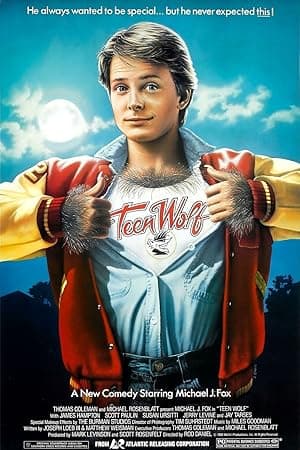
The setup
Teen Wolf is not just the movie about a boy who turns into a werewolf and suddenly becomes the school’s star player. It’s a compact coming-of-age comedy directed by Rod Daniel that turns high-school popularity into something oddly human: a choice about honesty, friendship and who deserves your loyalty. Spend ninety minutes with Scott Howard and you remember why the joke and the heart landed together.
THE MOVIE
Scott Howard is still the reason this movie works
If someone mentions Teen Wolf, most people picture a mop-haired teenager suddenly capable of out-jumping everyone on the basketball court. That is the surface, and it’s good surface: Scott Howard literally becomes more athletic and more noticed once the transformations begin.
But the film is less interested in monster-movie horror than in what that notice does to Scott’s head. He wants to be seen and accepted by his classmates, and those new, temporary advantages force him to decide what matters: popularity or the people who already care for him.
Rod Daniel keeps the picture breezy and short — at ninety minutes — and packs the centre of the story around Michael J. Fox’s Scott and his relationship with his father, Harold, who knows the family secret. That simple setup is why revisiting Teen Wolf still feels like catching up with an old friend who’s had a strange, funny week of growing up.
THE SETUP
The idea that sets Teen Wolf in motion
The basic engine is clean and very watchable: Scott Howard discovers he transforms into a werewolf, and with the change comes strength, speed and a confidence that his ordinary self never had.
Those gifts don’t come free. The film’s central tension asks whether Scott will keep using this advantage to climb the social ladder or choose his everyday friendships and relationships instead.
Because the new abilities feed directly into varsity basketball, the supernatural element neatly ties into an already familiar teen trope — sport as social currency — which makes the fantasy feel like an honest exaggeration of high-school pressures.
And crucially, Scott does not face the problem alone: his father, Harold, reveals the family secret and acts as a cautious mentor who has been through the same thing, which keeps the story grounded in a passing-on-of-wisdom rather than pure spectacle.
THE CHARACTER
Why Scott Howard matters
Scott Howard is the film’s heartbeat because his problem is recognisable: he wants to be noticed. That’s a small, human motive — not cosmic destiny — and it makes the gags and the choices land in a way they wouldn’t if the film treated him as a tragic figure.
Michael J. Fox plays Scott, and the movie is built around him being the kid who suddenly has a choice: use the transformations to chase popularity, or return to the quieter life he had with friends who know him.
The presence of Harold, Scott’s father, changes the dynamic from a solo self-discovery story into something more like coaching across generations. He isn’t just a revelation of family lore; he’s the practical voice who’s lived the consequences.
And because Scott already has people in his corner — Boof, the steady longtime friend, and Stiles, the comic-relief best mate — the character’s arc asks who will still matter when the applause starts. That’s what makes Scott memorable: the movie constantly brings him back to other people, not just the scoreboard.
THE PERFORMANCE
Why Michael J. Fox's performance matters
Contemporary notices and later reflections tend to point to Michael J. Fox as a major reason Teen Wolf still works for viewers.
The film leans on a central likeable presence to carry its lighter, sometimes daft premise, and that casting choice keeps the audience on Scott’s side even when the plot nudges him towards less sensible decisions.
Put simply: the movie needs a performer the audience trusts to play a teenager making childish mistakes. The evidence shows discussion often returns to Fox’s charm as the glue that holds the picture together.
That single piece of reliable critical shorthand explains why the film’s tone — amiable and family-friendly — manages to survive a few of the story’s broader comic gestures.
UNDER THE SURFACE
Teen Wolf has more on its mind than the plot suggests
On the surface it’s a teen comedy with a supernatural twist; underneath it’s a coming-of-age story about choosing who you want to be when everyone else is watching.
Identity and authenticity are threaded through the movie: Scott learns there’s a difference between being admired for something you can control and being accepted for who you actually are.
The father–son mentorship element adds weight. Harold’s role isn’t just exposition about genealogy — it’s a quiet lesson in how to pass on hard-won experience, which keeps the film from being only about shallow social wins.
Finally, the movie uses popularity and peer pressure as the stakes. The fantasy amplifies those pressures so the choices feel more dramatic than a normal school tale, but the emotions under the silliness are recognisable and immediate.
THE FILMMAKING
How Teen Wolf was put together
Teen Wolf doesn’t trade on flashy direction; its craft credits point to a straightforward, workmanlike production that serves the story rather than upstaging it.
The film’s look and rhythm come out of choices credited to a small team — Tim Suhrstedt behind the camera and Lois Freeman-Fox in the cutting room — which keeps things brisk at a ninety-minute running time.
Production design (credited to Chester Kaczenski) fills the world with the kinds of familiar high-school spaces that let the fantasy element read clearly: the ordinary frames the extraordinary.
In short, the filmmaking choices are economical and functional, allowing the premise and characters to be the loudest thing on screen.
PRACTICAL EFFECTS
The effects work that gives Teen Wolf its physical personality
Teen Wolf’s physical personality is rooted in old-school makeup and practical techniques rather than computer trickery.
The werewolf transformation and related makeups are credited to The Burman Studios and named makeup artists, which explains why the process required lengthy makeup calls during production.
There’s also a practical nod in the sports sequences: a stunt and basketball double handled on-court work for the lead, making the athletic moments read convincingly without overburdening the central performer.
Those grounded production choices keep the film tactile — you feel the physical work behind both the creature moments and the sports action.
PURE 80S
Teen Wolf could not belong to any other decade
Teen Wolf opened in August 1985, not long after Michael J. Fox’s profile had been boosted by a different, very successful film — a timing that the studio noticed and used in marketing.
The picture blends familiar mid-1980s teen-comedy trappings — high-school sports, popularity arcs and romantic triangles — with a light fantasy premise, which is exactly the era’s mix of the ordinary and the slightly offbeat.
That blend placed Teen Wolf alongside other studio and independent teen fare of the time: it felt of-the-moment without trying to be avant-garde.
Its immediate popularity spawned a sequel in 1987 and other tie-ins, showing the story’s concept fit snugly into the entertainment landscape of the mid-to-late 1980s.
WATCHING IT NOW
What has aged — and what hasn't
When people look back at Teen Wolf, a common note is that the film’s lasting warmth comes from its central charm and family-friendly tone rather than from any pretence of script complexity or effects mastery.
That means a modern viewer can still enjoy the movie as a pleasant, character-driven comedy — provided they are comfortable with a picture that wears its era in its soundtrack choices and teen-comedy conventions.
Those 1980s-specific touches — fashions, musical cues and familiar genre beats — do make parts of the film feel dated to some viewers.
Even so, the film’s key relationship — between Scott and the adults and friends around him — holds up because the emotional decisions are straightforward and still readable today.
THE LEGACY
Why Teen Wolf still matters
Teen Wolf’s afterlife is built on straightforward extensions of the original: a theatrical sequel in 1987 and an animated tie-in in the mid-1980s, both of which kept the premise in circulation.
Decades later the concept was repurposed again as a live-action MTV series in 2011, showing that the seed idea — a teenage monster as an adolescent metaphor — had room to breathe in very different tones.
For fans and collectors, the film has also been preserved in home-video packages and a collector’s Blu-ray release that includes a multi‑hour documentary on its making and reception.
Those continuations and reworkings don’t prove the original changed cinema, but they do explain why the title and the characters remain part of pop-culture conversation now and then.
THE VERDICT
Does Teen Wolf still hold up?
If you’re wondering whether to watch Teen Wolf now, the quick answer is yes — as a ninety-minute piece of weightless, amiable entertainment that still understands the core of its joke. Scott becomes a werewolf and the story uses that change to put a magnifier on popularity and choice.
The film’s central dilemma is honest and compact: Scott must decide whether to ride the temporary benefits of his transformation for social gain or to stick with the ordinary relationships that actually mean something.
Practically speaking, that choice plays out through basketball and school life, with Scott’s father Harold acting as the steady adult who’s been there before — a useful reminder that the film cares about passing wisdom as much as it enjoys the comic payoff.
So yes — watch it for the premise, for Michael J. Fox in the lead role, and for a neat little story about trading applause for authenticity. It’s not flawless, but it still offers the kind of decent, warm-hearted entertainment that made it worth talking about in the first place.
Share this movie
Keep watching
More movies from the 80s
1985
Weird Science
Fast talk, bad luck and a very literal wish come true — with consequences.
Read our take →
1985
Fright Night
A suburban boy, a suave neighbour and a late‑night horror show — Fright Night makes vampire panic feel uncomfortably domestic.
Read our take →
1985
Better Off Dead
Better Off Dead: family, and why this 1985 movie still matters.
Read our take →