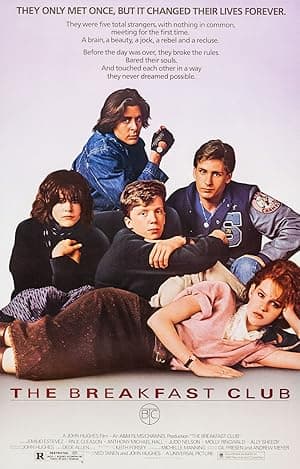
The Breakfast Club
Five teenagers. One Saturday. A surprisingly savage, oddly tender interrogation of who we're told to be.
The setup
There are easier ways to make a teen drama than locking five very different kids in a school library and letting them talk. The Breakfast Club does the hard thing: it trusts conversation. John Hughes wrote and directed a film about labels, family pressure and the little cruelties that bend a teenager into a role — and he put Claire Standish at the centre of why it still lands.
THE MOVIE
Claire Standish is still the reason this movie works
Five kids — each a neat high-school label — spend a Saturday in detention and, by the end of the day, have to account for who they actually are rather than who the school papers and lunch tables say they should be. That compressed premise is the film’s engine: conversation, not action, forces the change.
John Hughes opens and closes the picture with a first-person letter and uses the vice-principal’s all-day detention as the inciting device that pins the group together. It’s a simple mechanic, but it gives the film a bite-sized intensity: small, brutal exchanges that accumulate into genuine understanding.
At the heart of it is Claire Standish — played by Molly Ringwald — introduced as the popular ‘princess’ whose social position conceals insecurity and family privilege. She’s the character who proves the movie’s larger point: adolescent identity is fragile and complicated beneath the labels everyone uses.
THE CHARACTER
Why Claire Standish matters
Claire is the film’s mirror. On one hand she is the label everybody recognises — the ‘princess’ sitting at the right table. On the other, she is the demonstration that surface certainty often sits on quiet uncertainty.
Being the ‘princess’ in The Breakfast Club isn’t just a costume; it’s a social position that brings expectations, privileges and pressure. The film uses Claire to show how privilege can hide an anxious need to belong, and how being well-liked doesn’t erase private worries.
Because the story groups five archetypes together, Claire’s interactions do more than personalise a stereotype: they expose how family privilege and external expectation shape behaviour. That tension — the outward ease covering inward complication — is what makes her memorable.
Finally, Claire’s presence matters because she tests the honesty of the others. When she starts to peel off her label, the film reveals how brittle the whole system of high-school identity is — and how quickly people will reach for a kinder truth when a conversation gives them the chance.
UNDER THE SURFACE
The Breakfast Club has more on its mind than the plot suggests
On the surface it’s a tidy premise: five teenagers from different cliques in detention. Underneath, it’s a study of growing up — how identity forms, fractures and sometimes recomposes when people are forced into honest exchange.
Stereotypes are the obvious target. The movie hands each character a label — brain, athlete, princess, criminal, basket case — then spends its runtime unraveling how shallow those labels are. That unpicking is where the drama lives.
Family pressure is another quiet engine. The film repeatedly nods toward parental and social expectations as the reason the characters behave the way they do: it’s not just peer cruelty, it’s also the weight of what’s expected at home.
And the real work the picture asks of its audience is simple and humane: show two people from different worlds talking straight to one another, and watch the walls come down. Communication and empathy across divides is the idea that keeps the film honest.
PURE 80S
The Breakfast Club could not belong to any other decade
This is an 80s film in the sense that it comes from a mid-1980s cycle of American teen pictures — the movie’s young cast were folded into the contemporary ‘Brat Pack’ conversation and that media moment framed how audiences read them.
It was made on a modest budget and deliberately concentrated: Hughes took a low-cost, single-location approach and let conversation and character carry the weight rather than spectacle. That stripped-back production choice feels very of its moment — economical and audience-focused.
The soundtrack also roots the film in 1985 pop culture strategies. The prominence of a chart-minded song on the soundtrack album is typical of how youth-targeted films of the era used contemporary music to reach an audience.
And yes, it opened in 1985. Which matters because the film’s combination of teen talk, modest production and a radio-ready soundtrack was precisely the formula that worked for a lot of early-mid 80s coming-of-age films.
WATCHING IT NOW
What has aged — and what hasn't
A lot of the film’s longevity comes down to structure: it’s a concentrated, dialogue-driven picture that puts archetypes in a room and lets them be human. Film historians and critics repeatedly point to that set-up as a reason the film keeps getting talked about.
The themes — especially parental and social expectation — still register. When short scenes outside the library supply facts about family relationships, those moments remain sharp because the pressures they describe are recognisable across generations.
What feels more dated are the trappings you might expect from any mid-80s title, but the core remains intact: a director who wrote, produced and steered a movie about teens at a particular moment in American culture, and a story that privileges direct, face-to-face revelation.
So when you watch it now, what survives is the honesty of the exchange. The particulars of the era are background; the central conversation about who teenagers are when no one’s watching is still persuasive.
THE LEGACY
Why The Breakfast Club still matters
Part of the film’s afterlife is practical: the young cast were identified by mid-1985 media as part of the ‘Brat Pack’, and that label kept conversations about the movie alive in the culture that followed.
On an institutional level, the film’s preservation matters: it was selected for the U.S. National Film Registry in 2016, which is a clear marker that archivists and cultural custodians regard it as worth saving.
Restoration and curated releases have also fed its continuing presence. A restored edition issued by the Criterion Collection, with additional materials, shows there’s archival and scholarly interest in keeping the film available and examined.
Combined, media attention, formal preservation and archival care explain why the movie remains part of the conversation: it’s not just remembered by fans, it’s been actively preserved and presented for future viewers.
THE VERDICT
Does The Breakfast Club still hold up?
Yes — it does, and not for reasons of nostalgia. The film’s concentrated design — five students in a single day’s detention — makes its psychological and interpersonal stakes feel immediate. The story depends on talk and confession rather than action, and that focused approach still rewards patience.
Its central conflict is simple and human: kids arrive defined by labels — brain, athlete, basket case, princess, criminal — and have to confront what’s behind those names. Because the movie confines them to one principal location and one day, every small revelation counts.
Claire Standish matters here because she shows how social advantage and family expectation can be a trap as much as a protection; she’s the clearest example of the film’s broader claim about the fragility of adolescent identity. Brief scenes outside the library that point to family pressures keep those personal dramas grounded in real-world stakes.
If you’re deciding whether to watch it now: if you like character-driven dramas where conversation does the heavy lifting, this is still a strong, economical 97-minute example of the form. It proves that a Saturday in detention can change how people see one another — and that still matters.
Share this movie
Keep watching
More movies from the 80s
1986
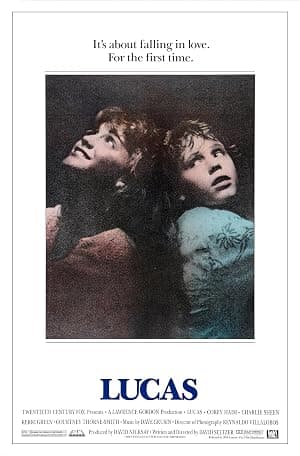
Lucas
Lucas: friendship and family, and why this 1986 movie still matters.
Read our take →

1987
Can't Buy Me Love
Can't Buy Me Love: friendship and peer pressure, and why this 1987 movie still matters.
Read our take →
1983
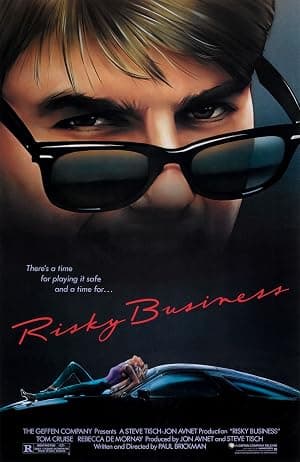
Risky Business
A suburban teenager, a one‑night business and the day ambition learned to look dangerous.
Read our take →