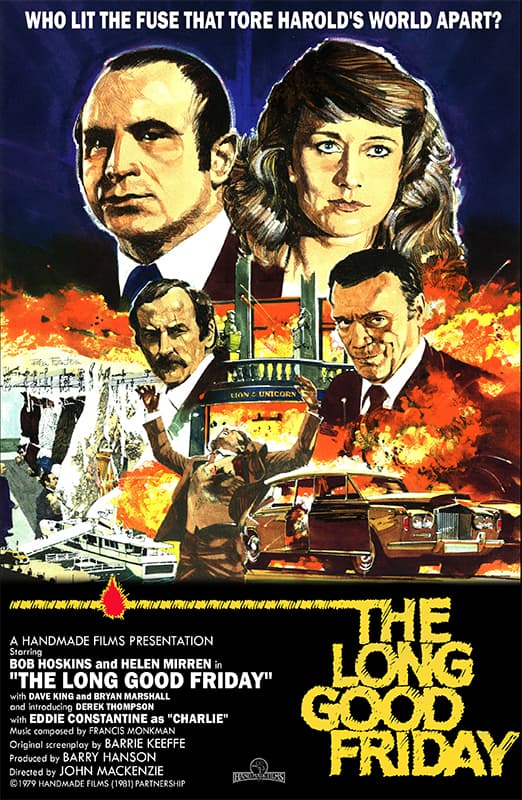
The Long Good Friday (1980)
Harold Shand thinks he owns London. One very bad weekend is about to prove otherwise.
The setup
Harold Shand is having a terrible day. His car has been blown up. One of his associates has been murdered. Another bomb has gone off in his casino. Nobody seems able to tell him who is responsible, and all of this is happening just as Harold is attempting to convince American Mafia investors that he's the perfect man to transform London's Docklands. Understandably, he's getting a little annoyed. The Long Good Friday arrived right at the beginning of the 1980s and gave British cinema a gangster who felt completely different from the romanticised mob bosses coming out of America. Bob Hoskins' Harold is ambitious, intelligent, frightening and occasionally very funny — but underneath the expensive suit is a man discovering that his reputation can't protect him from an enemy he doesn't understand. It's a gangster film about power. More specifically, it's about the moment a powerful man realises he hasn't got as much of it as he thought.
THE STORY
Somebody Is Dismantling Harold's Empire
Good Friday should have been Harold Shand's big moment.
He has ambitious plans for London's Docklands and American Mafia representatives arriving to discuss a lucrative partnership. Harold sees enormous potential in the neglected area and intends to be the man who controls what comes next.
Then his organisation starts being attacked.
Bombs. Murder. Chaos.
The timing couldn't be worse.
Harold initially assumes another criminal organisation must be making a move against him. That makes sense in his world. Find out who's responsible, make an example of them and restore order before the Americans lose confidence.
Except nobody knows who they're fighting.
The further Harold digs, the more uncomfortable the truth becomes.
Someone inside his organisation has created a problem that can't simply be solved by rounding up London's usual collection of villains and threatening them.
For possibly the first time in Harold's criminal career, intimidation isn't enough.
HAROLD SHAND
Bob Hoskins Is Absolutely Ferocious
It's difficult to imagine The Long Good Friday without Bob Hoskins.
Harold Shand is only about five-foot-six, but Hoskins somehow makes him appear capable of filling an entire room.
His temper helps.
Harold can go from smiling businessman to terrifying gangster in seconds, and Hoskins makes both versions believable. He doesn't play Harold as a mindless thug. This is an intelligent criminal who has spent years building something and genuinely believes he's ready to move beyond street-level gangsterism.
That's what makes his anger so entertaining.
Every new disaster isn't merely costing him money. It's insulting him.
Harold believes London belongs to people like Harold.
The idea that someone could attack his organisation without first asking his permission seems almost personally offensive.
And watching that certainty gradually disappear from Hoskins' face is the film.
VICTORIA
Helen Mirren Is Nobody's Gangster Girlfriend
Victoria could easily have been written as decoration.
Thankfully, she isn't.
Helen Mirren plays Harold's partner as someone who understands exactly what kind of man she's living with and exactly how his world works. She's intelligent, composed and often considerably better at reading a room than Harold.
Where Harold's instinct is to dominate, Victoria can negotiate.
That makes them feel like an actual partnership.
She supports his ambitions, helps manage the Americans and attempts to keep things under control while Harold's increasingly furious response threatens to destroy the very deal he's trying to protect.
Mirren never needs to compete with Hoskins' volume.
Her calmness is the point.
When Harold explodes, Victoria watches.
And usually understands what's happening before he does.
LONDON
This Isn't the London From a Postcard
One of the great things about The Long Good Friday is seeing London at the beginning of the 1980s.
Harold doesn't see abandoned warehouses and neglected docks.
He sees money.
His vision of redeveloping the Docklands gives the film an unexpectedly fascinating connection to what London would actually become over the following decades. Harold wants hotels, businesses and international investment in areas many people had largely written off.
Unfortunately, he also wants to own all of it.
The London here feels grubby, industrial and transitional. Old criminal networks exist alongside Harold's dreams of becoming something closer to an international businessman.
He's trying to reinvent himself at the same time the city is beginning to reinvent itself.
Neither transformation goes quite according to plan.
THE AMERICANS
Harold Wants to Join the Big League
Harold's relationship with the visiting Americans tells us a lot about him.
He desperately wants their respect.
Not because he's frightened of them, but because their investment represents the next stage of his evolution. Harold no longer wants to be seen as merely another London gangster.
He's a businessman.
At least that's the version of himself he's selling.
Watching him attempt to maintain that image while his empire explodes around him provides some of the film's blackest comedy.
Everything is fine.
Perfectly under control.
Please ignore the latest bomb.
Harold's determination to keep the deal alive becomes increasingly desperate because losing it means more than losing money.
It means admitting that he isn't ready for the world he thinks he belongs in.
THE SWIMMING POOL
Harold Conducts His Own Customer Satisfaction Survey
When diplomacy fails, Harold returns to methods he understands.
This leads to one of the film's most memorable images: a group of suspected criminals hanging upside down inside a meat locker while Harold attempts to discover who is attacking him.
Subtle interrogation techniques are not his speciality.
What makes the sequence work is Harold's genuine confusion.
He isn't simply torturing people because he enjoys violence. He cannot understand how something this significant could be happening in London without somebody in his world knowing about it.
That's the frightening part.
Harold has spent years building a network based on fear and information.
Suddenly neither is working.
And if shouting louder doesn't fix the problem, Harold doesn't have many other ideas.
THE REAL ENEMY
Harold Has Picked a Fight He Doesn't Understand
The revelation behind the attacks changes the entire film.
Harold isn't dealing with a rival gangster attempting to take his territory.
The conflict has political dimensions and consequences far beyond the rules governing his criminal world.
That's disastrous for him.
Harold's entire system depends upon people behaving predictably. Gangsters want money. Businesses want deals. Corrupt officials can be persuaded. Rivals understand threats.
But this isn't really about Harold.
That might be the thing he finds hardest to comprehend.
He believes himself to be the centre of London's criminal universe.
His enemies barely care who he is.
THE VIOLENCE
Nobody Looks Cool When Things Go Wrong
There isn't much glamour surrounding the violence in The Long Good Friday.
People get blown up.
People get stabbed.
People disappear.
Harold responds with brutality of his own, but the film doesn't turn him into an invincible action hero. Violence makes his situation worse because he keeps applying the rules of organised crime to something operating under completely different rules.
That's an important distinction.
Harold is dangerous.
His organisation is dangerous.
But danger isn't the same thing as control.
The film spends most of its running time teaching him the difference.
BRITISH GANGSTERS
No Fedoras, No Italian Restaurants, No Romantic Nonsense
Part of what makes The Long Good Friday refreshing is how British it feels.
This isn't trying to recreate an American Mafia movie in London.
Harold has his own language, ambitions and criminal ecosystem. The pubs, docks, casinos and back rooms belong specifically to his version of London.
Even his aspiration is different.
He isn't dreaming about becoming some old-fashioned crime boss sitting behind a desk.
Harold wants redevelopment.
International finance.
Olympic Games.
Legitimate respectability funded by extremely illegitimate money.
He wants to stop being a gangster without surrendering any of the advantages of being one.
There's probably a flaw in that business plan.
WHAT HAS AGED WELL
Bob Hoskins. Mostly Bob Hoskins.
There are plenty of reasons The Long Good Friday still works, but let's not complicate matters unnecessarily.
Bob Hoskins is phenomenal.
Funny, frightening, charismatic and eventually vulnerable, he takes Harold through an enormous emotional journey without ever making him feel inconsistent.
Helen Mirren is excellent alongside him, and the London locations have become more interesting with age rather than less.
The film is also admirably economical.
It doesn't require three hours to establish Harold's empire and then dismantle it.
Once things start going wrong, they keep going wrong.
The pressure rarely disappears.
WHAT HASN'T AGED SO WELL
Some of Its Language Belongs Very Much to Its Time
This is a British gangster film made at the turn of the 1980s, and some of its language and attitudes can be jarring now.
Harold and the people surrounding him aren't exactly models of enlightened behaviour.
There are also moments when supporting characters feel more like pieces in Harold's story than fully developed people in their own right.
But visually and dramatically, surprisingly little about the film feels dusty.
If anything, modern London makes Harold's redevelopment ambitions even more fascinating to watch.
He wasn't entirely wrong about the Docklands.
His implementation strategy needed work.
THE 80s FACTOR
Britain at the Beginning of a Very Different Decade
Released in 1980, The Long Good Friday sits right on the edge between two versions of Britain.
The old industrial landscape is still visible everywhere.
Harold is already imagining what might replace it.
Money, property, international investment and enormous redevelopment projects would become increasingly important parts of the decade that followed, which makes his ambitions feel strangely prophetic.
This isn't the colourful pop-culture version of the 1980s.
No leg warmers required.
It's the decade before the paint went on.
THAT ENDING
Bob Hoskins Doesn't Say a Word — He Doesn't Need To
And then there's the ending.
If you've seen it, you know.
If you haven't, I'm not ruining it.
What matters is Hoskins.
For several minutes, the camera simply watches Harold's face as anger, disbelief, calculation and finally something resembling acceptance move across it.
The man who has spent the entire film shouting, threatening and demanding answers suddenly has nothing to say.
There may not be anything left to say.
It's one of those endings that understands exactly when a movie should stop.
No speech.
No unnecessary explanation.
Just Harold.
Thinking.
LEGACY
The British Gangster Film Everyone Else Had to Follow
British crime cinema didn't begin with The Long Good Friday, but its influence is difficult to miss.
Later generations of British gangster films would give us increasingly colourful criminals, quotable dialogue and elaborate underworlds, but Harold Shand remains difficult to beat.
Part of that comes from Hoskins.
Part comes from the film taking Harold seriously without admiring everything he does.
He's charismatic because Hoskins is charismatic.
He's fascinating because he's intelligent.
He's doomed because none of those things make him as powerful as he believes himself to be.
That's considerably more interesting than simply watching another gangster become king.
THE VERDICT
Is The Long Good Friday Still Worth Watching?
Absolutely.
In fact, if your idea of an 80s gangster film begins and ends with Scarface, put this near the top of your list.
It's tighter, more British and considerably less interested in making criminal success look glamorous.
Bob Hoskins gives one of the defining gangster performances of the decade, Helen Mirren is terrific alongside him, and London itself provides a backdrop that has become more fascinating as the years have passed.
Most gangster films show you a criminal building an empire.
The Long Good Friday gives Harold Shand a weekend and lets us watch his fall apart.
And that final shot alone is worth the price of admission.
Movies in the 80s rating: 9/10
Featured in
Explore more about The Long Good Friday (1980)
Share this movie
Keep watching
More movies from the 80s
1980
9 to 5
9 to 5: the safety of home and authority, and why this 1980 movie still matters.
Read our take →
1980
American Gigolo
Armani, a hit single and a loneliness you can almost wear.
Read our take →
1980
Cruising
Undercover, unsettled and uncomfortably watchable — Steve Burns is why you should look again.
Read our take →