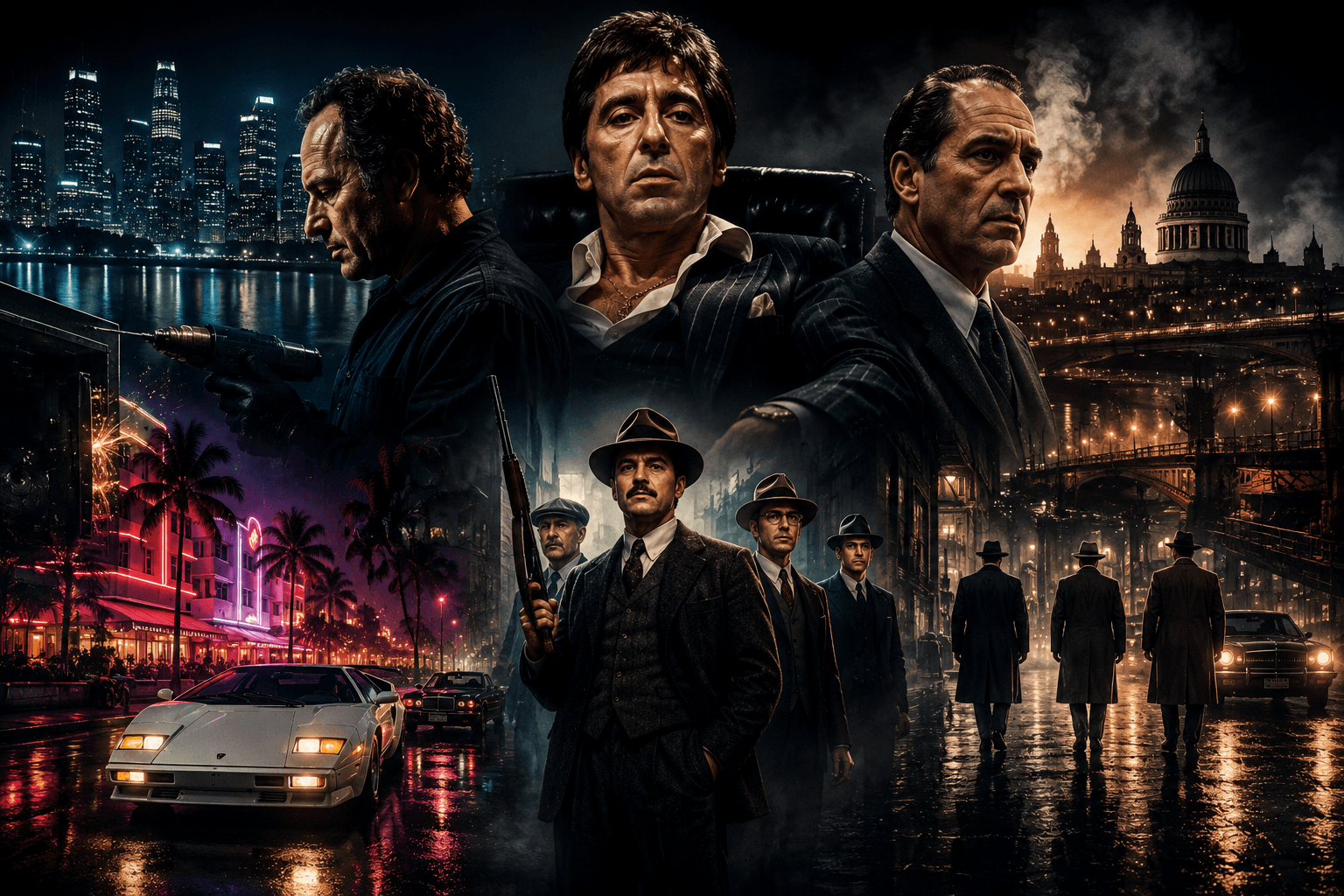
5 Gangster Movies That Defined the 1980s
Five unforgettable gangster films, five very different criminal worlds. From Scarface to The Long Good Friday, these are the movies that defined 80s crime cinema.
80s Crime Classics
Five films. Five very different criminal worlds.
The 1980s gave us some unforgettable gangster movies, but the best of them weren't all doing the same thing.
Some gave us cocaine empires, excess and spectacular self-destruction. Others went back to Prohibition, organised crime and old-school mob mythology. And then there were films that stripped away the glamour completely, showing criminal lives built on paranoia, betrayal and the uncomfortable knowledge that somebody eventually comes to collect.
That's what makes picking five so interesting.
These aren't simply five good crime films released during the decade. They're five movies that approached the gangster world from completely different directions — and helped define what an 80s crime movie could be.
NUMBER 5
Thief (1981)
Michael Mann's Thief doesn't need armies of gangsters or mountains of cocaine to make the criminal world compelling.
James Caan plays Frank, a professional safecracker who has spent years constructing a life around one principle: depend on nobody.
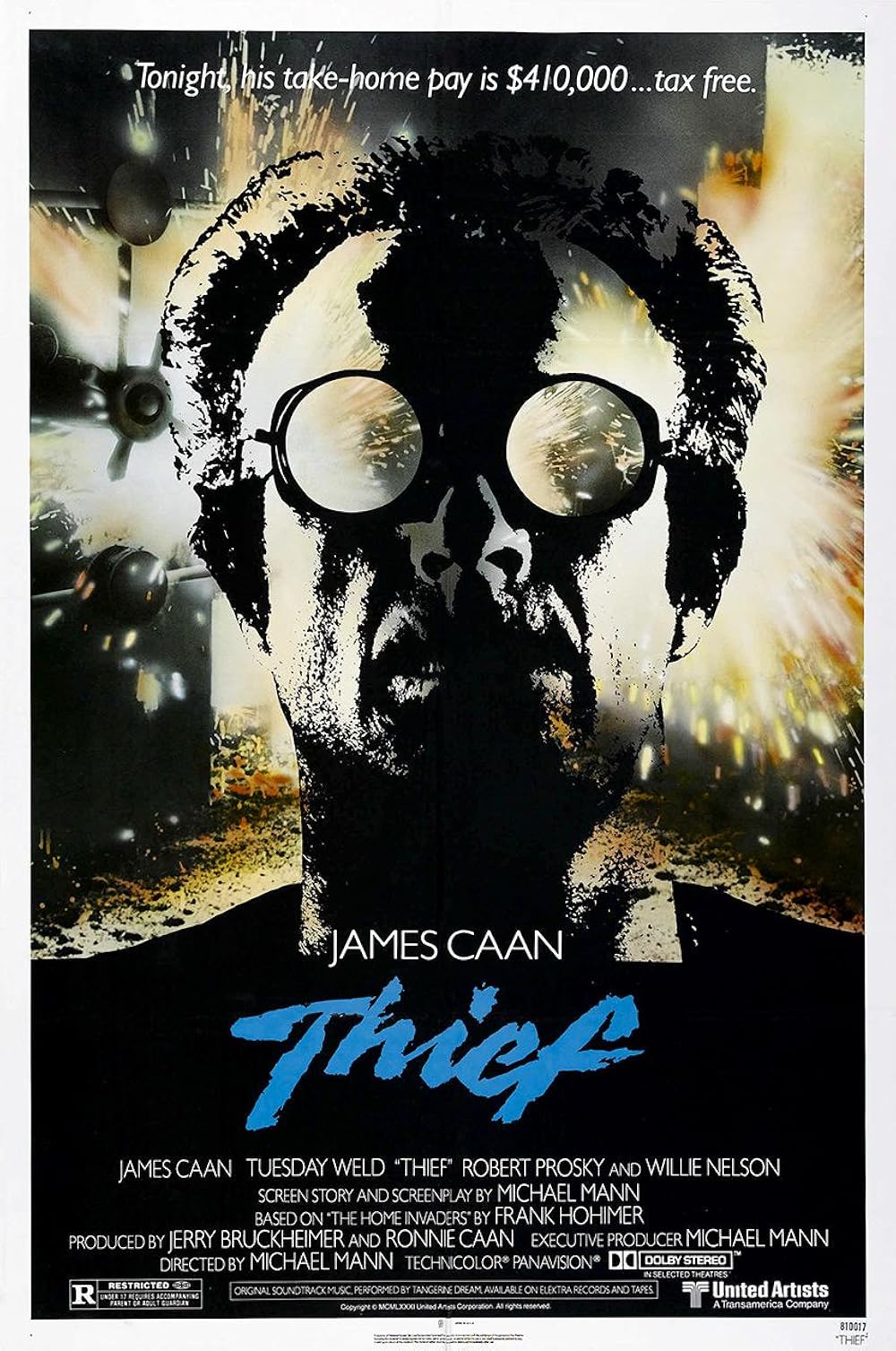
He's disciplined, exceptionally good at what he does and convinced that one final arrangement with organised crime might give him enough money to walk away and build something resembling a normal life.
You can probably see the problem already.
What makes Thief so good is the precision. The robberies feel methodical rather than glamorous, while the neon-soaked streets and Tangerine Dream score give the film an atmosphere that would become unmistakably associated with Michael Mann.
But underneath all that style is a surprisingly simple idea.
Frank thinks independence means nobody can control him. The moment he allows powerful criminals into his life, he discovers how fragile that independence really is.
Why it makes the five: Because few crime films make professionalism, loneliness and criminal independence feel this convincing.
NUMBER 4
The Long Good Friday (1980)
If Thief is controlled, The Long Good Friday feels like watching control disappear minute by minute.
Bob Hoskins is extraordinary as Harold Shand, a London gangster who believes he's about to step into a bigger, more respectable world. He has money, influence, ambition and plans to transform London's Docklands with American investment.
Then people start dying.
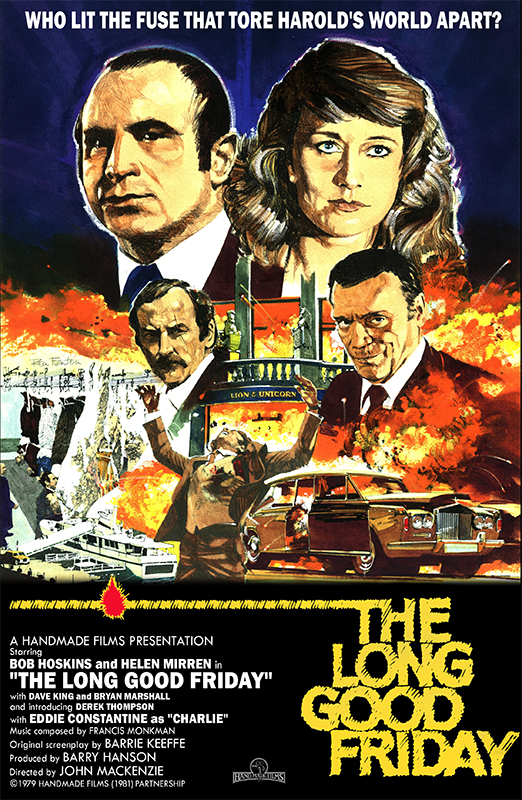
Businesses are attacked. Bombs go off. Associates are murdered. And, perhaps worst of all for Harold, nobody seems particularly interested in telling him why.
Hoskins gives the film enormous energy because Harold spends much of it trying to maintain the authority he assumes he still possesses.
That confidence gradually turns into confusion, anger and desperation as he realises he's dealing with something his usual threats and connections can't easily solve.
And then there's that ending.
No speech is required. Hoskins' face does everything.
Why it makes the five: Because it gave British gangster cinema one of its greatest characters — and one of its greatest endings.
NUMBER 3
The Untouchables (1987)
Brian De Palma's The Untouchables takes us away from contemporary crime and straight back into Prohibition-era Chicago.
Kevin Costner's Eliot Ness arrives determined to enforce the law and discovers fairly quickly that Al Capone's influence reaches considerably further than he expected.
Fortunately, Sean Connery's Jimmy Malone understands the city rather better.
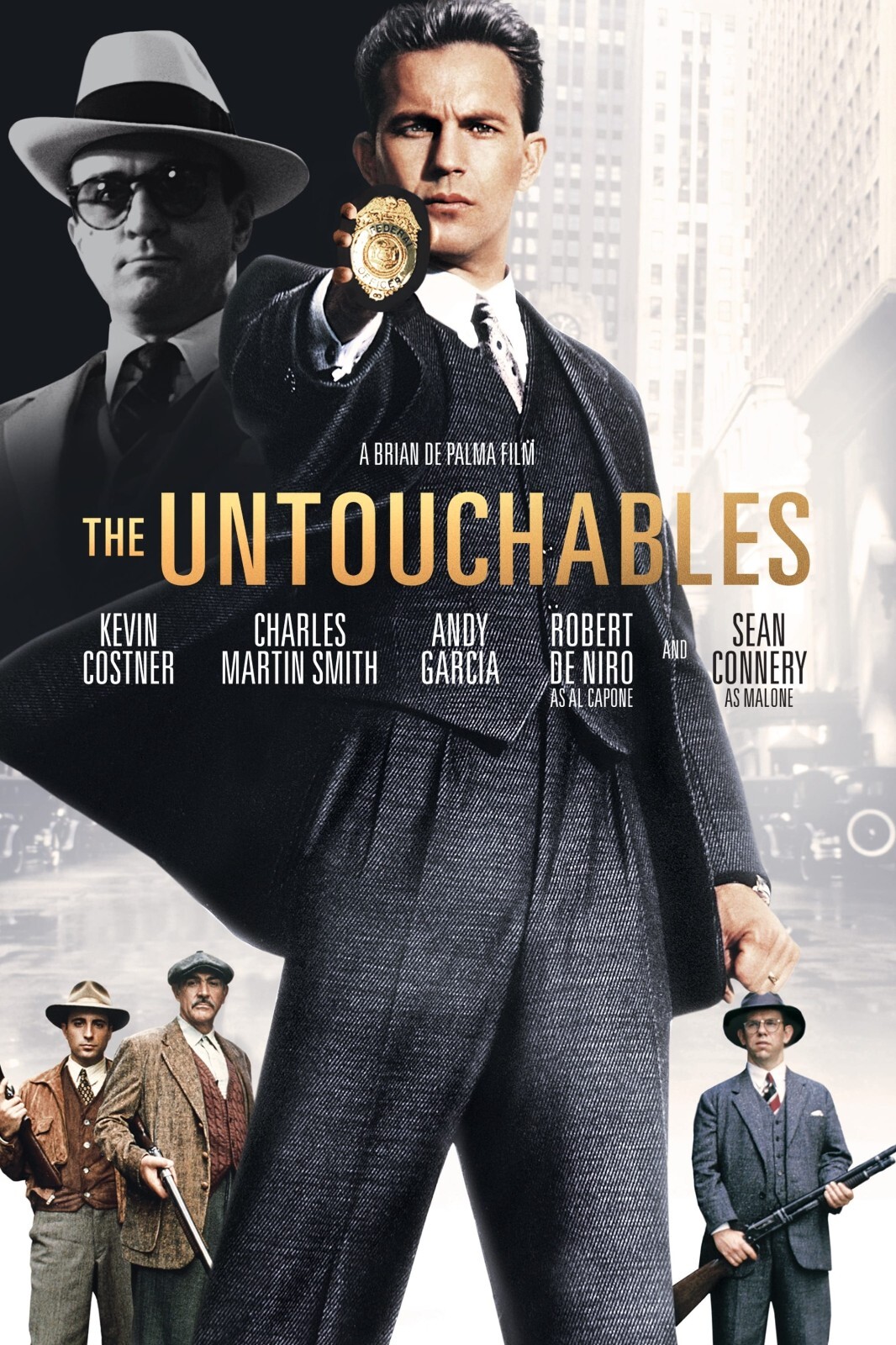
The film isn't interested in being a dry history lesson. It's big, polished Hollywood filmmaking, complete with sweeping Ennio Morricone music, beautifully staged set pieces and Robert De Niro having tremendous fun as Capone.
And sometimes that's exactly what you want.
Connery gives the movie its heart, though. Malone understands that bringing down men like Capone requires more than good intentions, and his relationship with Ness turns a straightforward cops-versus-gangsters story into something much more memorable.
There's style everywhere, but De Palma never forgets to make the film entertaining. Whether it's a raid, a confrontation or that famous railway-station sequence, The Untouchables knows exactly when to turn the tension up.
Why it makes the five: Because it turned the mythology of Prohibition-era gangsters into one of the decade's most entertaining crime films.
NUMBER 2
Once Upon a Time in America (1984)
Sergio Leone didn't exactly make small films.
Once Upon a Time in America is sprawling, melancholy and deliberately patient — a gangster epic concerned as much with memory and regret as it is with organised crime.
Robert De Niro plays Noodles, looking back across decades at the friendships, betrayals and choices that shaped his life. Rather than racing towards the next shootout or criminal victory, Leone lets the past hang over almost everything we see.
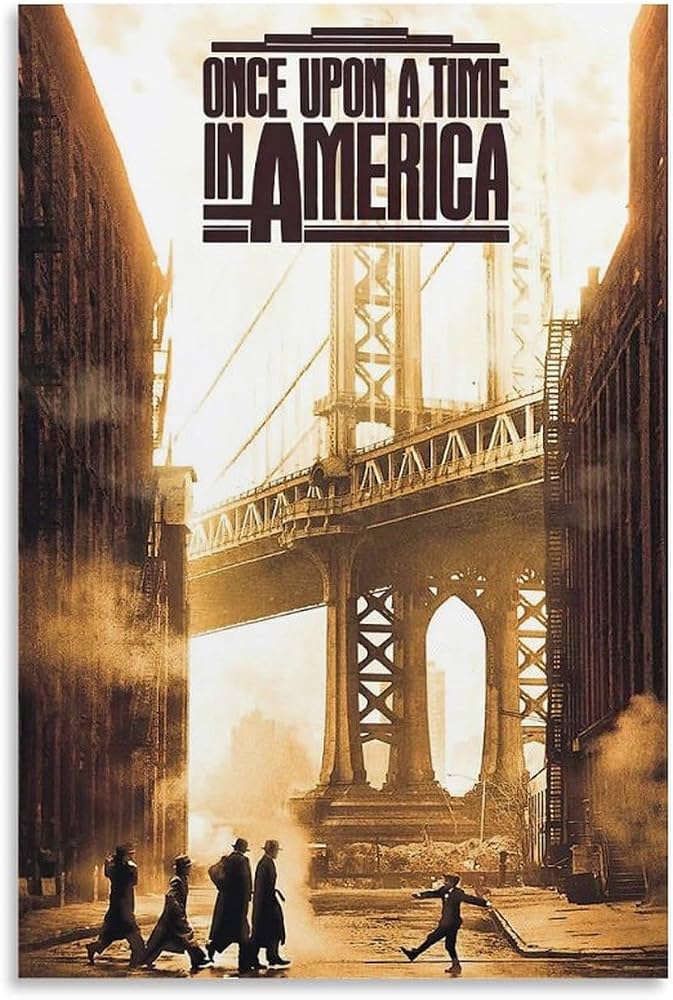
That's what makes this one feel so different.
Crime isn't presented simply as a route towards money and power. It's tangled together with childhood, loyalty, ambition and the consequences of decisions that can't be undone.
The film's history is almost as complicated as its story. Its original American theatrical release was drastically shortened and rearranged, damaging both the narrative and its reception.
Seen in its longer form, the scale of Leone's ambition becomes much clearer.
It isn't always an easy film, and some of its characters' behaviour is deliberately ugly. But that ugliness matters. This isn't a comfortable fantasy about being a gangster. By the time Noodles is looking back, all the supposed glamour has been replaced by loss, uncertainty and regret.
Few gangster movies feel quite this haunted.
Why it makes the five: Because Leone turned the familiar rise-and-fall gangster story into something closer to a tragic memory.
NUMBER 1
Scarface (1983)
There was never much chance of anything else taking the top spot, was there?
Brian De Palma's Scarface is excessive, violent, loud, vulgar and completely uninterested in behaving itself.
Which is rather the point.
Al Pacino's Tony Montana arrives in Miami with virtually nothing and decides that virtually nothing isn't enough. He wants money, power, status and everything else he believes comes with them.
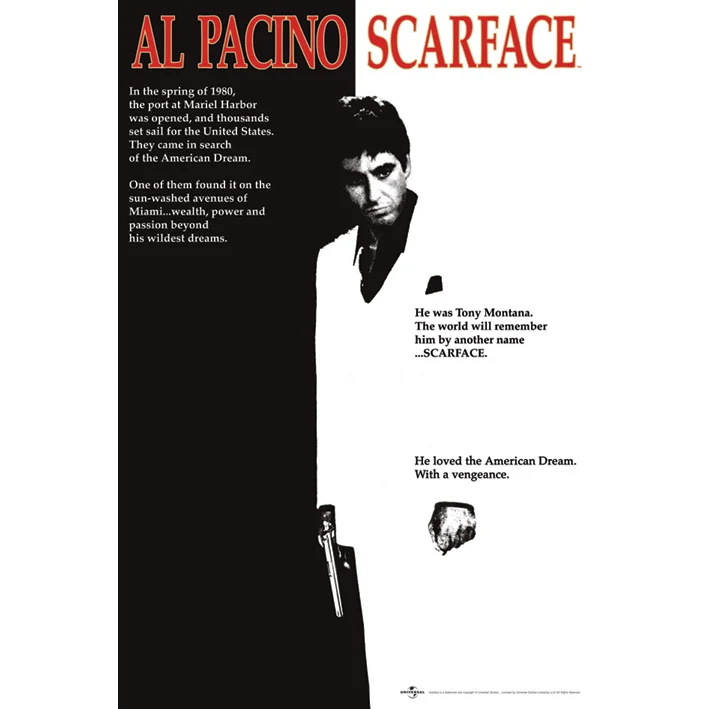
For a while, he gets it.
That's the part of Scarface that popular culture sometimes remembers most enthusiastically: the mansion, the suits, the cars, the money and Tony sitting behind an enormous desk believing he's conquered the world.
Except the film isn't really celebrating any of it.
Tony's success destroys almost everything around him. The richer and more powerful he becomes, the more paranoid and isolated he gets. Relationships collapse, trust disappears and the empire he fought so hard to build gradually becomes a prison of his own making.
Pacino's performance is enormous because Tony himself is enormous. Subtlety wouldn't make much sense for a man who wants the entire world to notice him.
And that's a huge part of why Scarface has never really gone away.
Its imagery escaped the film decades ago. Tony Montana became a fixture of posters, music, fashion and popular culture, while lines and scenes from the movie continue to be referenced by people who weren't even born when it arrived in cinemas.
But underneath all that cultural baggage is still a brutally simple rise-and-fall story.
Tony gets almost everything he thought he wanted.
Then we watch it destroy him.
Why it's number one: Because no other gangster movie from the decade became quite so inseparable from the image of 1980s excess.
FIVE DIFFERENT CRIMINAL WORLDS
That's What Makes This List Work
Put these five films next to each other and the variety is remarkable.
Thief gives us the disciplined professional who believes he can keep the criminal world at arm's length.
The Long Good Friday gives us an established gangster watching his power disappear in front of him.
The Untouchables takes organised crime and turns it into grand, hugely entertaining Hollywood filmmaking.
Once Upon a Time in America looks back at a lifetime of crime through friendship, memory and regret.
And then there's Scarface — ambition, greed and excess with absolutely no brakes.
They're all gangster movies, but they don't really tell the same story.
What connects them is what happens when people build their lives around power. Some desperately try to hold onto it. Some discover they never had as much as they thought. Others get everything they wanted and realise far too late what it cost them.
That's why these five still make such a brilliant snapshot of 1980s crime cinema.
Not because they're interchangeable examples of the same genre, but because each one found its own way into the criminal world — and gave us something completely different once it got there.
FIVE FILMS. ONE HELL OF A DECADE.
The 80s Did Gangster Movies Differently
There isn't really one version of the 1980s gangster movie.
The decade could give us the neon-lit professionalism of Thief, the increasingly desperate London underworld of The Long Good Friday and the old-school Chicago crime mythology of The Untouchables.
Then Once Upon a Time in America could turn the gangster story into something melancholy and reflective, while Scarface went in completely the opposite direction — louder, nastier and more excessive than almost anything around it.
That's what makes going back to these films so much fun.
They share guns, money, criminals and plenty of bad decisions, but they don't feel like variations of the same movie. Each has its own personality, its own world and its own idea of what power eventually costs.
And if there's one thing all five agree on, it's this:
Getting to the top is one thing.
Staying there is another.
Keep reading
More features
Movies
10 Movies That Defined 1985
From time machines to pirate treasure, 1985 might have been one of the most ridiculously entertaining years in movie history.
Read the feature →
Horror
Why 80s Vampire Movies Were So Damn Good
The decade gave vampires leather jackets, nightclubs, motorbikes and a completely new attitude.
Read the feature →